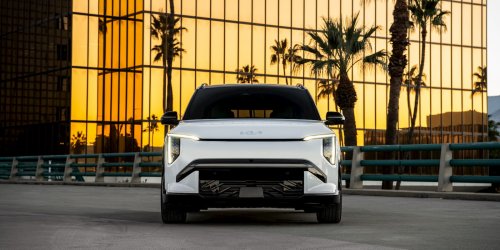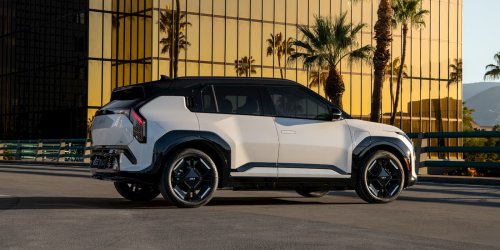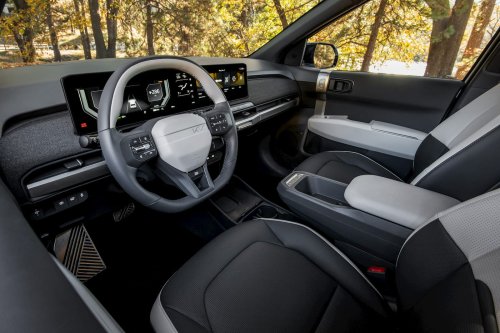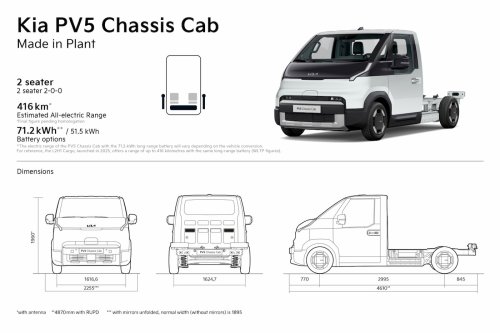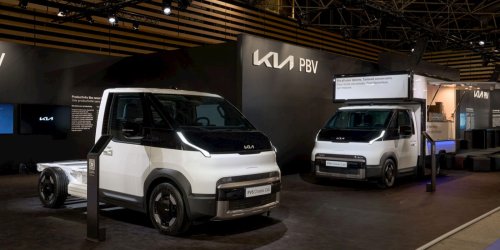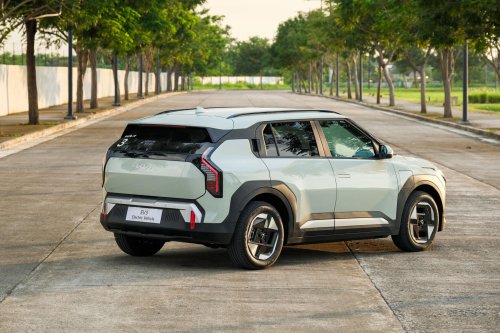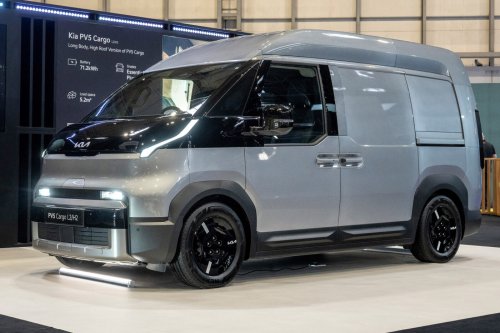
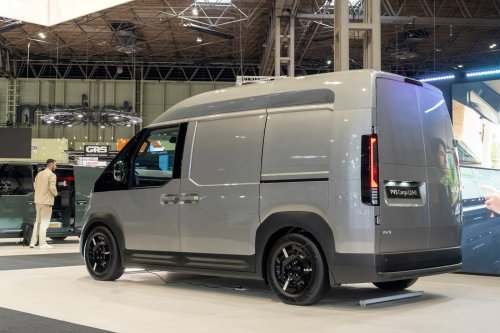
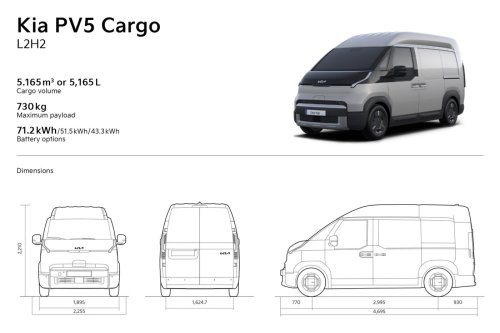
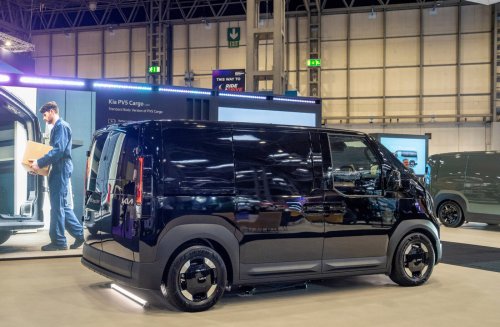
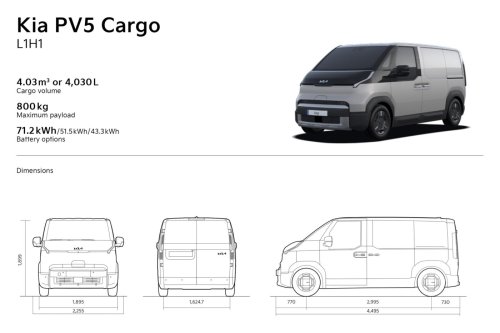



















Image: KiaThe two new variants of the PV5 Cargo made their European debut at the Commercial Vehicle Show 2026 in Birmingham this week (21 to 23 April). However, Kia has yet to reveal further details about the market launch and specifications, such as pricing.At the Birmingham premiere, the Korean manufacturer shared key details of the two new body variants, which had been highly anticipated. The new PV5 L2H2 is 4.67 metres long, the same as the familiar L2H1, but slightly taller at 2.21 metres compared to the previous 1.82 metres. The additional 30 centimetres in height directly increases the cargo area: while the length (2.25 m) and width (1.57 m) remain unchanged, the cargo area in the L2H2 is now 1.82 metres high, compared to just 1.52 metres in the L2H1.According to Kia, the cargo area’s volume increases from 4.4 cubic metres in the L2H1 to over five cubic metres under the VDA standard, specifically measuring 5.165 cubic metres or 5,165 litres. Although the PV5 is positioned in the S-van segment, Kia states that this is ‘a capacity typically found in the M-van segment’. “This makes the high-roof model ideal for customers seeking a van with a balanced ratio of vehicle size and payload capacity,” a German announcement claims.The company also promises ‘functional improvements’ for the high-roof model. For example, depending on the selected optional equipment or accessories, an airline rail system is available in the cargo area to secure loads flexibly and safely. In the driver’s cabin, a three-seat bench can be ordered instead of two individual seats. With the two individual seats, there is also the option to replace the fixed partition with a passageway between the driver’s area and the cargo area. Image: Kia Image: Kia Image: Kia Image: KiaThe short-wheelbase L1H1, also unveiled in Birmingham, is optimised for urban logistics and service fleets due to its excellent manoeuvrability in tight spaces, according to Kia. However, no specific figures have been provided. Instead of the 4.4 cubic metres of cargo volume in the L2 version, the L1H1 offers 4.03 cubic metres (VDA). At 4.50 metres, the L1 is around 20 centimetres shorter than the L2 models, solely due to the rear overhang of just 73 centimetres—the wheelbase remains unchanged at three metres. For the new L2H2, Kia specifies a rear overhang of 93 centimetres.Kia also states that both new variants will be available with three battery options, with capacities of 43.3 kWh, 51.5 kWh, or 71.2 kWh. The previously orderable PV5 Cargo L2H1 was only offered with 51.5 or 71.2 kWh. The additional option of a 43.3 kWh battery with LFP cells had already been announced, for example, for delivery services operating in a defined area that do not require a larger battery for long distances. In addition to DC fast charging in around 30 minutes from 10 to 80 percent, the PV5 also supports AC charging at 22 kW.Kia has not yet disclosed pricing. However, it is likely that the L1H1 with the 51.5 kWh battery will be slightly cheaper than the familiar L2H1 (available in Germany from €32,932.77 net), while the L2H2 will be more expensive. The same applies to the larger battery, which is listed in Germany at €36,810.92 net. The pricing for the 43.3 kWh LFP battery remains unknown.In addition to the now three variants of the PV5 Cargo, Kia also offers the PV5 Chassis Cab (a chassis with cab) and conversion versions such as the PV5 Crew Van (DE). For commercial passenger transport and private customers, there is also the PV5 Passenger, currently available as a five-seater—read our test drive review here. Further Passenger variants with more seats are expected to follow. To cover even more applications, the larger PV7 is planned for 2027 and the PV9 for 2029. With over 40 body variants in total, Kia aims to offer ‘highly customisable mobility solutions tailored to the diverse requirements of customers and businesses’ as part of its PBV strategy.“With the introduction of the PV5 Cargo High Roof and the PV5 Cargo Standard, we are expanding our PBV portfolio to cover a broader range of professional applications in Europe,” said Erhan Eren, PBV Director at Kia Europe, in a German statement. “The different variants represent an approach that allows customers to adapt vehicle specifications to their operational needs. The high-roof variant offers greater cargo volume and additional functionality for more demanding applications, while the shorter variant enables efficient use in city centres, where manoeuvrability is key.”kia.com