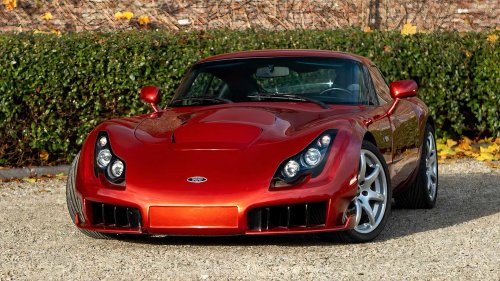
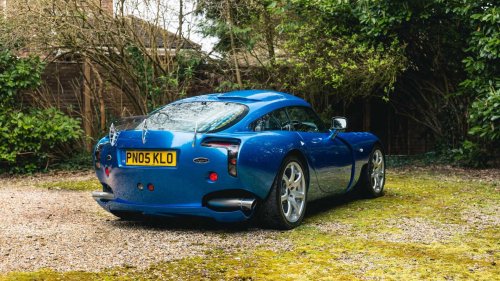
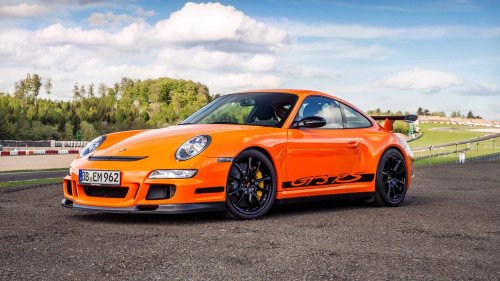
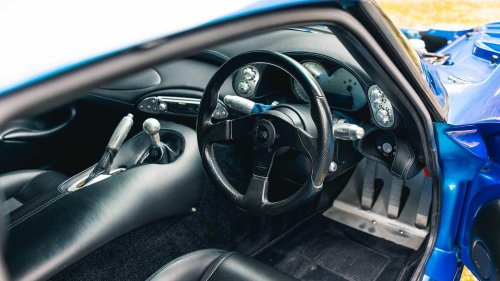
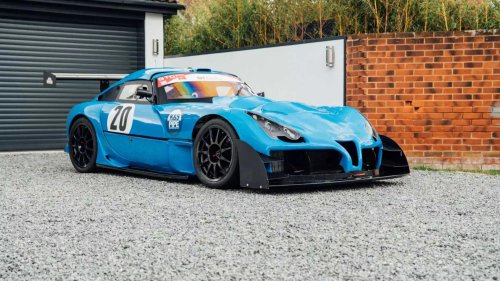


















What does the name TVR mean to you? Does it evoke a sports car maker that shows up in your favorite racing games, only for you to pass and pick something else? Maybe you remember it for putting smiles on the faces of our favorite British motoring presenters, you know the ones. But for some people, TVR means a dedication to pushing the edge, and being a little bit crazy while doing it. All that pent-up machismo culminated in the mid-2000s, and its story is classically wacky. TVR: The British Sports Car Turned Up a Notch Iconicauctioneers.comLet's put it this way: if an MG or Austin-Healey is like the Beatles before the Sgt. Pepper, a TVR is like Ozzy Osbourne during his peak unhinged years. Founded in the immediate aftermath of World War II, its founder, a native Blackpudlian named Trevor Wilkinson, very much believed that anything which made a race car faster does the same for a road-legal sports car. Wilkinson’s first home-brew was a stripped-out Alvis Firebird four-cylinder he turned into a gentleman’s racer.The Alvis factory wound up being destroyed in the German blitz. But after the war, Wilkinson went into business for himself, forming TVR out of the first, fourth, and sixth letters of his first name. Not one to try and compete with Bentley or Jaguar, TVR forged their cars from in-house-built tube steel frames while borrowing components from other OEMs when needed. Axles from a Morris, four-cylinder side-valve engines from Ford, and in the case of the TVR Number Two, the tachometer out of a gosh-darn Spitfire fighter plane! All of it spoke to the level of British man-in-a-shed engineering going on at TVR. A Turbulent History, Then Saved By A Russian Billionaire Bring a TrailerIcons like the TVR Grantura,the original Tuscan, the Griffith, the Chimaera, the Cerbera, and the Sagarisspanned nearly five decades of British history while gradually adding refinements to the driving dynamic. Unlike other British sports car makers, TVR adhered to keeping things as light and simple as possible. Routinely, safety options like ABS, airbags, and pretty much everything north of seat belts was something TVR never really paid much mind to. Most of the time, they just added weight.TVRs had their niche in Great Britain, Europe, and even North America, up until new crash testing standards forced the brand to leave the continent in the 1980s. But perhaps that’s a big reason why TVR struggled in the leadup to the 21st century. By 2004, the brand was on the ragged edge of what would've been its fifth liquidation proceeding since 1962. In those years, problems with cash flow, supply networks, and distribution hubs abroad made TVR something of a revolving door in British courts.Most of the time, a cat with that many lives tends to run out around now. Instead, TVR caught the attention of an eccentric Russian-born son of oligarchs named Nikolay Smolensky. His father, Alexander Smolensky, was the former head of Russia’s SBS-Agro bank, one of the leading financial institutions in the region after the collapse of the Soviet Union. After being handed the remains of the empire in his 20s, the junior Smolensky decided to do something different with his money than play golf all day. The Sagaris: A Retro-Hearted TVR For The 21st Century Collecting CarsAround the same time a Russian nepo-baby decided to do something useful with his fortune, TVR’s last gasp under previous owner, Peter Wheeler, was prepping a car that made Corvettes look wimpy and Porsches look soft. Keeping with the theme of TVRs from the ‘90s, what ultimately became the Sagaris used an in-house powertrain. After decades of borrowing drivetrains from places like esteemed partners Cosworth, Rover, and Ford, these TVR engines harkened back to when sports cars were simpler.They adhered to the bare minimum of British and European safety and emissions regulations, their bodies were made of fiberglass, like old Corvettes. Its interior wasn’t slapped together like an old Lada, but they weren’t exactly assembled on a Rolls-Royce assembly line either. Then again, a Sagaris and a Phantom are both hand-built cars. It really proves the duality of British cars, lots of high-end prestige cars, a bunch of bargain basement drop-tops, and not much in the middle.Collecting CarsUltimately, it just meant the Sagaris was a light car. One that didn't make its four-liter, 406-horsepower "Speed Six" straight-six engine lug more than 2,376 pounds (1,078 kg). Not that you could fit much of anything in the tiny rear hatch. TVR needed all the room they could get to fit twin missile silos of exhaust pipes, wide fender flares, and double-wishbone rear suspension. The front uses a similar double-wishbone unit, with ventilated steel disc brakes, and, get this, no ABS of any kind. Making Porsche Sweat Since 2004 PorscheSuffice it to say, the Sagaris was as difficult to drive quickly as it was barely legal wherever it drove. Zero to 60 was taken care of in 3.7 seconds, and even without ABS, it could brake to a dead standstill again in 2.9 seconds. At the back, a Dana Spicer M80 rear limited-slip differential was geared for a good blend of straight-line speed and balanced handling traits.Of course, you’ll be ripping through the gears of a five-speed manual transmission, because flappy paddles are for the feeble. At least, that was the kind of mentality glowing from every inch of this little speed demon. Even then, the Sagaris’ Chief Engineer, a man named Daniel Boardman, made sure common QC gripes like water ingress and sub-par carpets were improved vastly in this new TVR.Collecting CarsCompared to a 997.1-series Porsche 911 GT3, which made similar power and ostensibly much easier to live with, the Sagaris felt more genuine to drive. With 45 more horsepower and over 120 horsepower-per-ton more than the GT3, the Sagaris’ lightweight body sure did wonders to keep things close. At 3.7 seconds to 60, the Sagaris was .3 seconds faster than a 997.1 GT3. Knowing that 911s of the time were comfortable in their "bloat" years, the 3,000-plus-pound GT3 got all the hell they could handle from TVR. In the quarter mile, the winner was decided by the driver, not the car. Each managed a high 12-second pass with ease, plus trap speeds in the area of 120 mph. Sure, the Porsche was more sophisticated by a country mile. But the Sagaris? That was for real men, and women who were tough as nails. An Ultra-Rare Monster With Racing Pedigree Icon AuctioneersExactly 211 TVR Sagaris sports cars were built between 2005 and 2006. In that time, it cemented TVR as a common name in the mid-2000s automotive zeitgeist. That was, until the company went bankrupt again. In the last 20 years since then, the Russian firm tried pivoting the brand towards the parts side of the business in a relaunch post-bankruptcy. When that went nowhere, the brand was sold yet again, multiple times, to a series of firms who’ve effectively sat on and done nothing with it for over a decade.At the very least, the Sagaris earned some racing credentials before it bit the dust. It competed in the 2011 British GT Cup, an astounding five years after its OEM went out of business, even racking up two wins in a row. These Sagaris GTN factory race cars were separate from the 211 road cars, giving the car a remarkable life after death.Meanwhile, the Sagaris is nearing the 25 year mark to be legal to import into the United States. It’s set to do so upon turning 25 years old in the year 2030 and ‘31, depending on the model year. When it does, expect a small hoard of enthusiasts to go to great lengths trying to get it registered in your home state. Unless you live in the handful that seem to genuinely not care what you drive, we suspect that’s easier said than done. Occasionally, a couple will show up on auction sites in the UK. But for now, it's going to stay that way.Source: Car and Classic, Icon Auctioneers