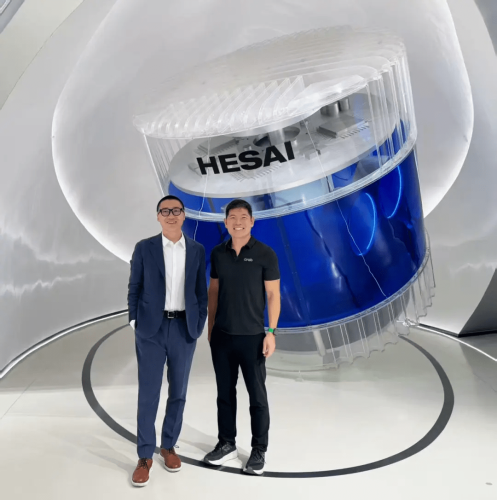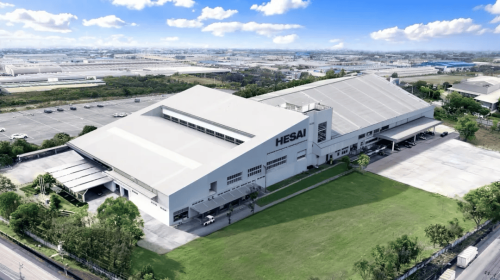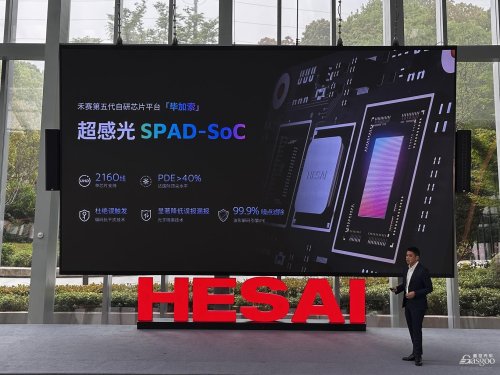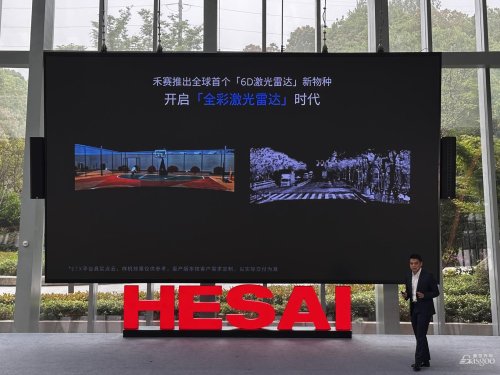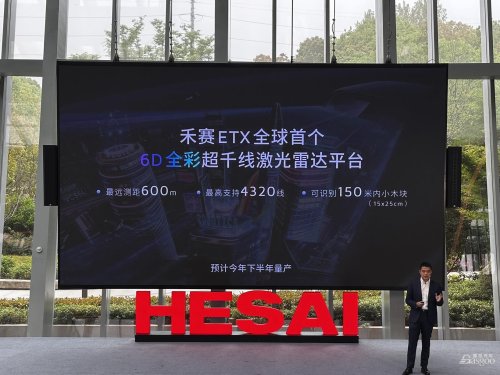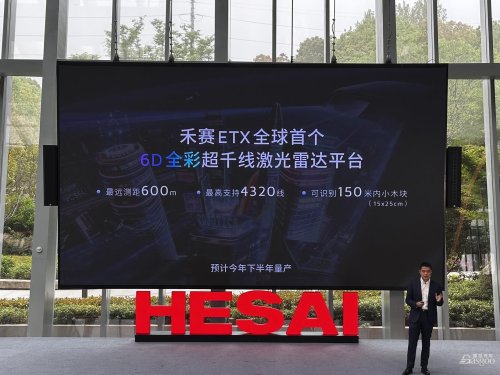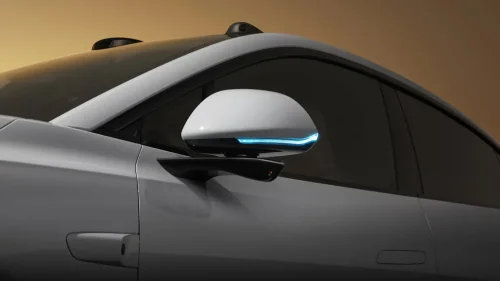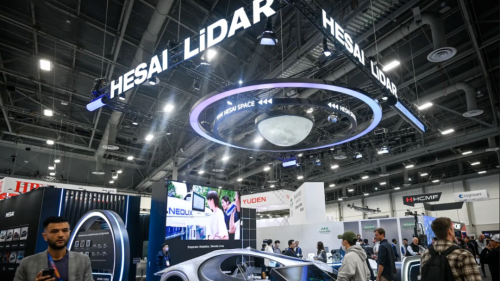
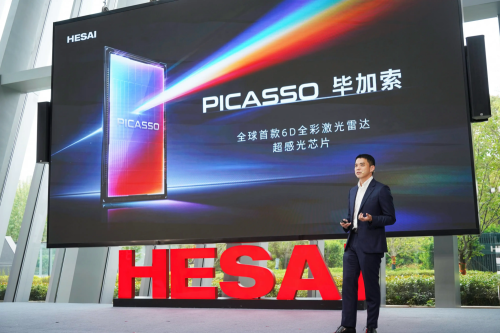
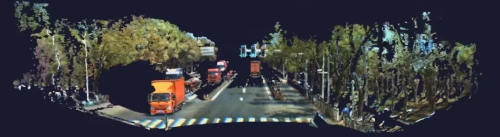
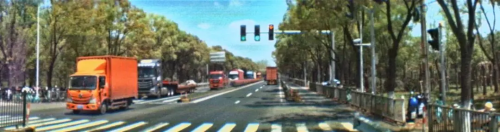
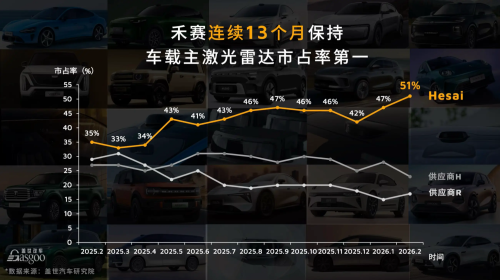





















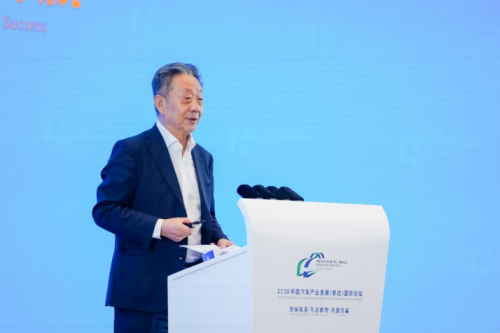

Hesai is one of the leading LiDAR maker. Credit: Sohu Understand China EV’s Market Real-time notifications when critical EV data is released All important data in one place 2,000,000+ data points Become a member Hesai Technology, a LiDAR supplier whose products are widely used by various automotive companies (such as Changan, Chery and Li Auto), has launched the world’s first 6D full-colour LiDAR sensing chip and an ultra-high-resolution platform during its 2026 Technology Open Day event on April 17. The company introduced the Picasso SPAD-SoC, a 6D full-colour LiDAR chip, alongside the ETX platform — the world’s first 6D full-colour ultra-thousand-line LiDAR platform, marking a shift in the industry from “line-count competition” to “experience elevation.” Market growth drives innovation Over the past five years, automotive LiDAR has transitioned from a “high-end option” to a “mainstream standard.” According to GGAI Research Institute, quoted by Sohu, China’s domestic market saw 2.5628 million new vehicles equipped with standard factory-installed LiDAR in 2025, representing an 86.53% year-over-year growth with an installation rate exceeding 11.5%. As L3 autonomous driving policies open up and models launch, industry requirements for perception accuracy, detection range, and environmental recognition have grown exponentially. Traditional low-line-count radars can no longer meet the demands for long-distance small target recognition, complex road condition understanding, and all-weather stable perception. Picasso SPAD-SoC, a 6D full-colour LiDAR chip. Picasso SPAD-SoC: bringing colour to 3D perception Traditional LiDAR chips can only perceive three-dimensional space (XYZ), capturing object position and shape but lacking colour information — akin to a “black-and-white camera.” This limitation makes it difficult to accurately distinguish traffic lights, lane lines, traffic signs, and road obstacles. The Picasso SPAD-SoC achieves a chip-level pixel-level fusion of colour sensing and Time-of-Flight ranging, simultaneously outputting 3D coordinates (XYZ) plus object colour information (RGB) on a single chip, generating native 6D full-colour point clouds. The chip features a Photon Detection Efficiency (PDE) exceeding 40%, reaching international top-tier levels, enabling detection of greater distances, smaller targets, and clearer vision in darker environments. 3D visualisation of photorealistic point clouds. 2D visualisation of photorealistic point clouds. ETX Platform The ETX platform offers flexible line configurations: 1,080-line configuration 2,160-line configuration 4,320-line configuration (3-4 times higher than current flagship products) Key performance metrics: Maximum detection range: 600m Stable detection at 10% reflectivity: 400m Water barrier recognition (120×60cm): within 300m Small animal recognition (60×40cm): within 280m Small wooden block recognition (15×25cm): within 150m The platform incorporates Hesai’s Photon Isolation 2.0 technology, which deeply couples SPAD-SoC hardware design with intelligent algorithms to reduce false alarm and missed detection probabilities. Production timeline The ETX platform is expected to enter mass production delivery in the second half of this year, with plans for widespread deployment across multiple global flagship models from 2027 to 2028. The company has already secured designated contracts from several top-tier automakers, positioning the platform as the “perception core” for L3 and higher autonomous driving systems. Hesai’s market share compared to Huawei (H) and Robosense (R). Over the past 13 months, Hesai has been the world’s leading LiDAR supplier, surpassing Huawei and Robosense, with its market share reaching 51% this February.