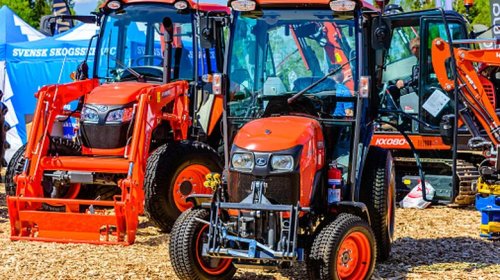
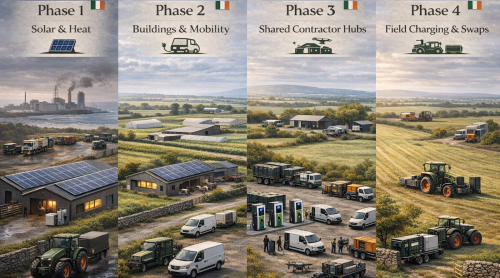
Ask whether agriculture can electrify and the conversation usually arrives at the same machine within minutes: the tractor. More specifically, the large diesel tractor working hard through planting, harvest or another narrow seasonal window. It is a legitimate engineering challenge, but it is a poor organizing principle for farm electrification. Farms do many kinds of work. Milk has to be cooled. Water has to be pumped. Livestock buildings need ventilation and heat. Greenhouses have thermal loads. Grain and other crops may need drying. Chemicals have to be applied across fields. Refrigeration and processing equipment run at fixed locations. Some machinery returns to the same yard every few hours; other equipment may have to work nearly continuously while weather and crop conditions cooperate. Those services have different energy quantities, power requirements, timing constraints and infrastructure needs. The fact that a large battery tractor cannot yet replace every 200-horsepower diesel machine says almost nothing about whether a kerosene heater, irrigation pump or milk chiller should still be burning fossil fuels. That is the strategic mistake I wanted to correct in an updated assessment of farm electrification. My earlier CleanTechnica analysis grew out of Ireland’s fuel protests and the vulnerability created by agricultural dependence on diesel. The wider conclusion is more useful: good farm-electrification strategy should begin with the work the farm needs performed, not with a shopping list of electric equipment. The full TFIE Strategy Briefing develops that work-first framework across dairy, irrigation, greenhouses, broadacre farming and smallholder productive access. It looks at what should electrify now, where the machine itself should change, when electrical infrastructure has to come first, and when retaining existing diesel equipment is still the rational choice. Consider solar on a dairy farm. Teagasc’s 2025 solar guide models a 100-cow farm consuming about 25,000 kWh annually and a 25 kWp solar array producing 23,484 kWh. On annual accounting, that looks close to energy independence: generation equals about 94% of consumption. Yet without a battery, the model uses only 30% of the PV generation on site. Add a 12.5 kWh battery and self-consumption rises to 45%, but under the modeled tariffs the unsubsidized simple payback actually worsens from eight years to ten. That little example contains most of the discipline the sector needs. Annual energy balance is not the same as useful energy delivery. Higher self-consumption is not automatically a better investment. A battery should solve a defined problem—peak demand, backup, charging support, network constraints or a meaningful tariff spread—not simply make the self-consumption percentage look prettier. Stationary thermal loads can offer much cleaner cases. A Teagasc pig-farm example from 2016 involved an 800-sow operation burning around 900 litres of kerosene every week for farrowing and weaner heating. The reported heat-pump installation cost €58,000 including installation and reduced annual energy costs from about €46,800 to €12,800, for a simple payback of roughly 20 months before financing. Those are decade-old prices and should not be used as a 2026 investment case, but the example still illustrates the underlying point: some apparently agricultural fossil-fuel problems are simply conventional stationary heating loads for which mature electric alternatives have existed for years. Irrigation provides another example of why the service matters more than the machine. India has already deployed solar pumping at substantial scale. The official PM-KUSUM dashboard reported 711,133 standalone solar pumps installed under Component B and 841,081 pumps solarized through feeder-level Component C as of July 31, 2026. But the service is not “operate a solar pump.” It is deliver the required volume of water at the required pressure and time without exhausting the resource. Pumping schedules and water storage can sometimes substitute for battery storage, while variable-speed drives can alter both energy consumption and operating flexibility. And because solar reduces the marginal energy cost of pumping, poorly governed systems can increase groundwater withdrawals rather than merely replace diesel. FAO has examined that groundwater risk, which means pumping technology, energy pricing and water governance have to be considered together. Mobile machinery requires the same discipline. Fendt’s e107 Vario provides a useful commercial reality check precisely because its specifications are bounded rather than magical. The tractor has a 100 kWh battery, 55 kW of continuous power and 66 kW peak output. Fendt says it can work for roughly four to seven hours in partial-load applications such as mechanical weed control or planting, while energy-intensive transport reduces runtime. That is not evidence that electric tractors do not work. It is evidence that duty cycle is the question. An electric tractor capable of a full day of lighter specialist work can be commercially useful without being able to replace every high-energy diesel operation. Conversely, rated horsepower tells us surprisingly little about whether a machine is electrifiable. Energy used for the actual task, charging opportunities, return-to-base patterns, completion windows and the cost of downtime matter much more. Electrification can also change the machine itself. Spraying does not intrinsically require several tonnes of tractor to cross every hectare merely because that is how the job evolved around diesel engines, hydraulics and human drivers. Agricultural drones, smaller autonomous equipment and distributed machines can sometimes substitute a different architecture for the historical one. The right comparison is still the complete service, including batteries, support vehicles, operators, refilling, water, application quality and repeat passes—not a propulsion-only comparison. Heavy seasonal work remains genuinely difficult. A paid-off diesel tractor doing relatively few hours annually but occasionally facing extreme workloads may be economically sensible to retain. Replacing it early can become particularly unattractive if the electric alternative also requires expensive batteries and a major rural connection upgrade. That is not a failure of an electrification strategy. It is what a strategy looks like when replacement timing and capital utilization are included. There is a corresponding infrastructure trap. Rural grid connections, transformers and charging capacity can take longer to plan and build than machinery takes to procure. Farms that wait until the ideal electric machine exists before thinking about electricity supply can discover that the machine is available years before the connection it needs. That means some infrastructure should move ahead of equipment. A dairy upgrading electrical capacity for heat pumps, refrigeration and hot water can create headroom for later machinery charging. Contractor depots are especially interesting because they concentrate expensive equipment and annual operating hours. Higher utilization can make costly electric machinery easier to amortize, while one substantial grid connection, charging system or battery buffer can support equipment serving many farms. Contractors do not magically solve the problem. Several customers may all need the same machine during the same three-day weather window, and high utilization increases the cost of downtime. But ownership structure belongs in the analysis. The best owner of an expensive electric agricultural machine may be a service business rather than the farm whose land it works. Different agricultural systems therefore produce different sequences. Dairy and intensive livestock operations may find cooling, hot water, ventilation, heat recovery and pumps at the front of the queue. Irrigated agriculture may start with pumping efficiency, scheduling, water storage and power supply. Greenhouses are more thermal. Broadacre systems can have relatively little stationary fuel use but enormous seasonal mobile peaks. Smallholders without much productive energy access may gain more by adding refrigeration, irrigation or processing than by replacing an existing fossil-fuel machine. Policy should follow those binding constraints rather than simply count subsidized machines. If connection capacity prevents viable projects, reinforce the distribution system. If equipment economics depend on utilization, make contractors and shared-service businesses eligible. If solar irrigation creates groundwater risks, coordinate energy support with water governance. If storage does not provide an economically valuable service, do not pretend that increasing PV self-consumption is sufficient justification. The useful measure of agricultural electrification is not the date when the final diesel tractor disappears. It is whether successive equipment replacements, infrastructure investments and operating changes reduce fossil-fuel exposure while preserving—or improving—the cost and reliability of producing food. The tractor will electrify when the combination of batteries, duty cycles, infrastructure and economics makes sense. Plenty of the rest of the farm should not have to wait for it. Read the complete work-based strategy, operating-context analysis and evidence in TFIE Strategy Briefing.



















 +4 others