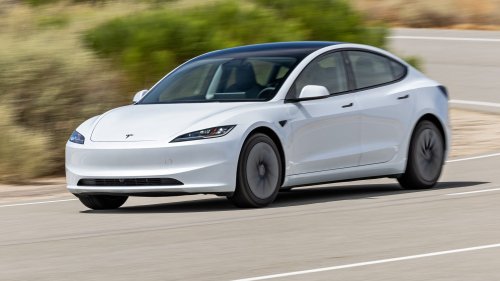
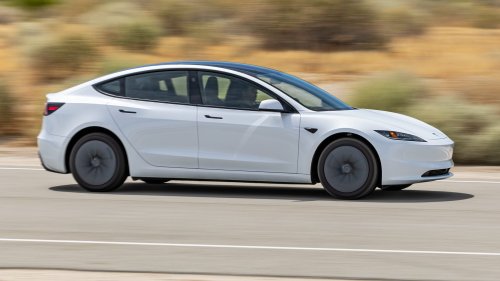
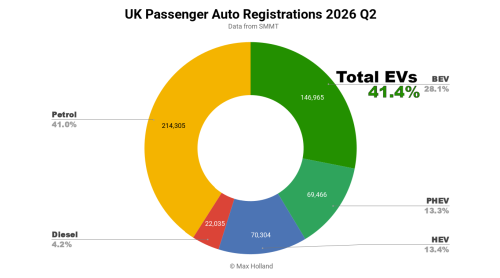
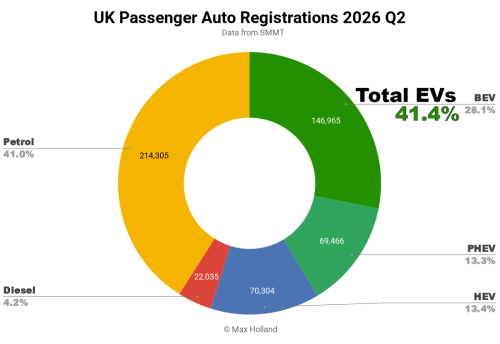
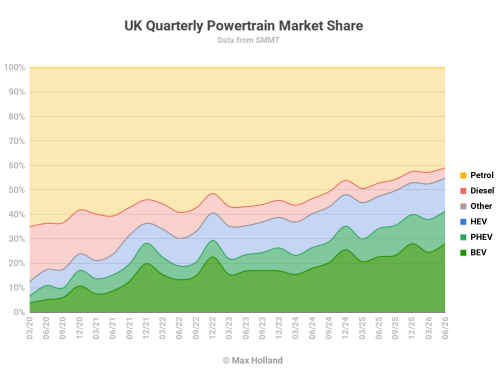
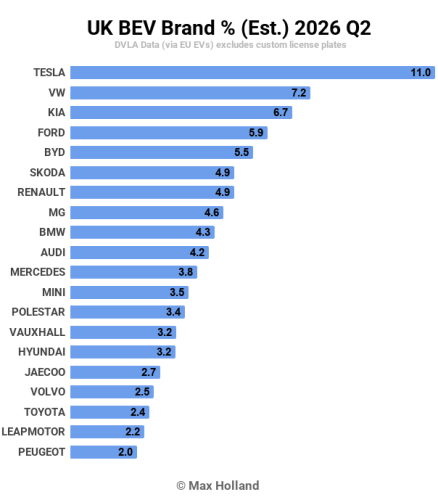
2026 Q2 saw plugin EVs at 41.4% share in the UK, up from 34.2% in Q2 2025. BEV share grew decently year on year, whilst PHEV share grew modestly. Overall Q2 auto volume was 523,075 units, up some 13% YoY. Tesla was the best-selling BEV brand in Q2. 2026 Q2 auto sales saw combined plugin EVs at 41.4% share in the UK, with full electrics (BEVs) at 28.1% and plugin hybrids (PHEVs) at 13.3%. These figures compare YoY against 34.2% combined, 22.7% BEVs and 11.6% PHEVs. In volume terms, Q2’s BEV sales were up 40% YoY, to 146,965 units. PHEVs were up by 30% to 69,466 units. Cumulatively, by the end of Q2, BEV share stood at 25.0% (from 21.6% YoY). PHEVs share stood at 13.0% (from 10.3% YoY). The UK’s legacy industry lobby, the SMMT, is still whining that the “33% ZEV” target for 2026 is going to be “too hard” to meet, and needs watering down. But the reality is that the progress this year in relation to the (now higher) target is only a tiny fraction behind where it was at this point last year (in relation to last year’s lower “28% ZEV” target). In addition, EV momentum has picked up significantly across Q2, from a slow-start Q1, no doubt encouraged by rising fuel prices due to the war of aggression against Iran. In concrete terms, BEVs only grew YoY volume 14.5% in Q1, but accelerated to a substantial 40.4% volume growth in Q2. You can see this in the angle of the Q1 to Q2 uptick in the graph below, much steeper than uptick in the same period last year, or any other recent year. Ignoring and obscuring this positive recent Q2 trajectory, the SMMT are trying to push a “it’s too hard” narrative. Why? Because they want to water down the pace of EV progress regardless, and milk more profit from their sunk investments in ICE technology. Policy makers should inform themselves of the real trend data, and ignore the crocodile tears of the combustion lobby. Combined combustion-only share in Q2 fell to a record low of 45.2%, and should end Q4 close to 40%. Best-Selling BEV Brands The best-selling Q2 BEV brand in the UK was once again Tesla, with market share improving YoY from 9.8% (Q2 2025) to 11.0%. In second place was Volkswagen at 7.2% (from 9.5% YoY), and in third was Kia, at 6.7% share (from 4.7% YoY). As well as Tesla, other brands seeing good YoY growth in market share were MG, Kia, Mini, Leapmotor, Jaecoo and Toyota. Amongst those losing notable YoY share were Volkswagen, BMW and Peugeot. We don’t have access to detailed enough sales data to discern all the new BEV models which debuted in Q2, but keep an eye on our reports on nearby markets to get a rough idea of what new models are likely arriving. A few models which were visible in the UK data were the Kia EV2, the Aion V, and the new Porsche Cayenne. Outlook Unless policy makers allow themselves to be duped by legacy auto, the UK’s ZEV mandate, plus the continuing modest purchase incentives for BEVs, mean BEVs will continue on a decent growth trajectory in 2026. The overall UK economy remains very weak, with Q1 2026 (latest) figures recently revised down to just 0.9% YoY GDP growth. Headline inflation reduced to 2.6% at the end of Q2, from 3.3% as of the end of Q1. This seems strange given that transport fuel prices have increased by over 20% over the period. Interest rates have been flat at 3.75% since mid December. Manufacturing PMI stood at around 52 points at the end of Q2, up from 51 points at end of Q1. What are your expectations for the UK auto market for the remainder of this year? Please share your thoughts and perspectives in the discussion below.



















 +8 others