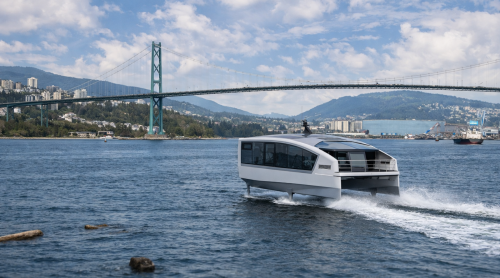
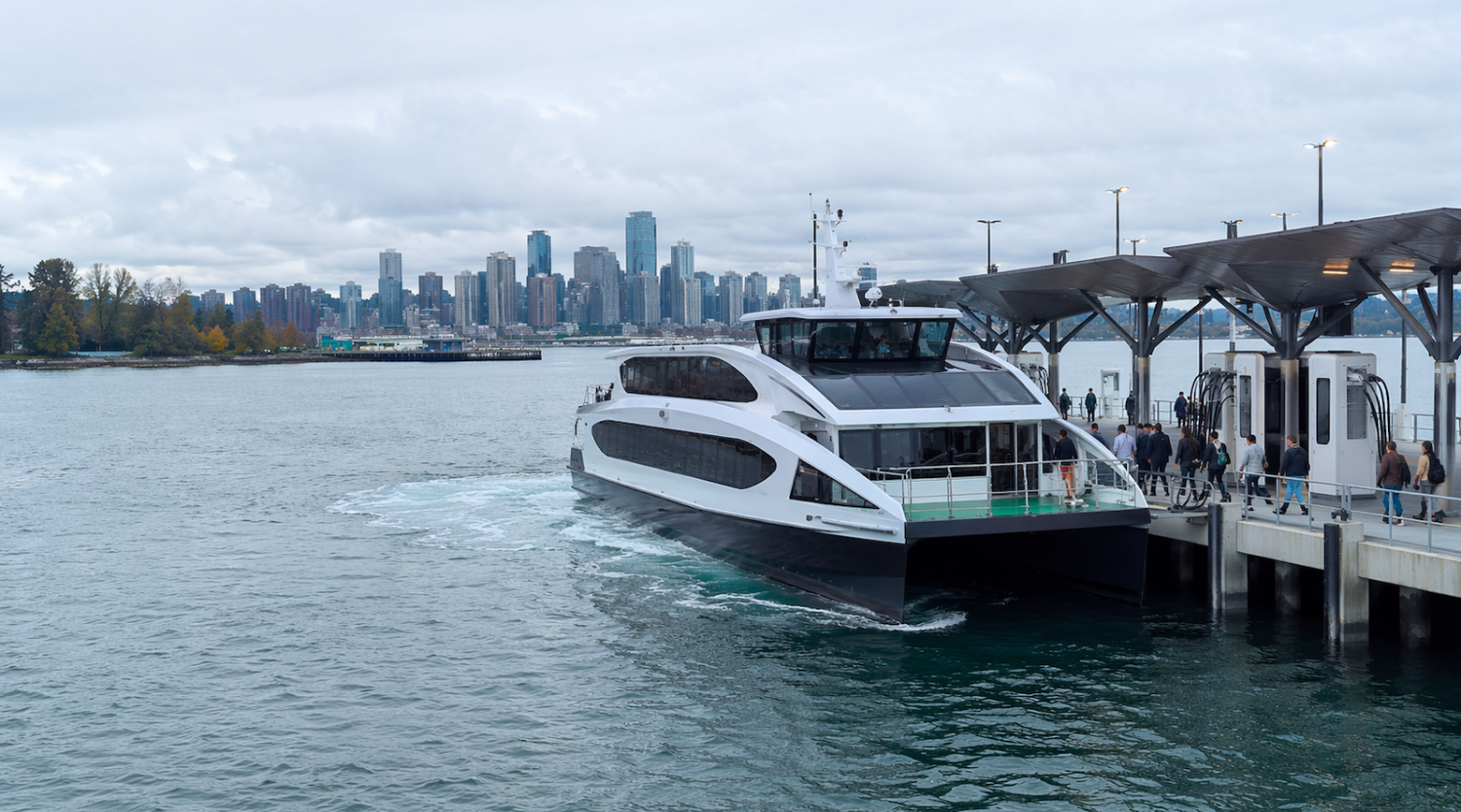
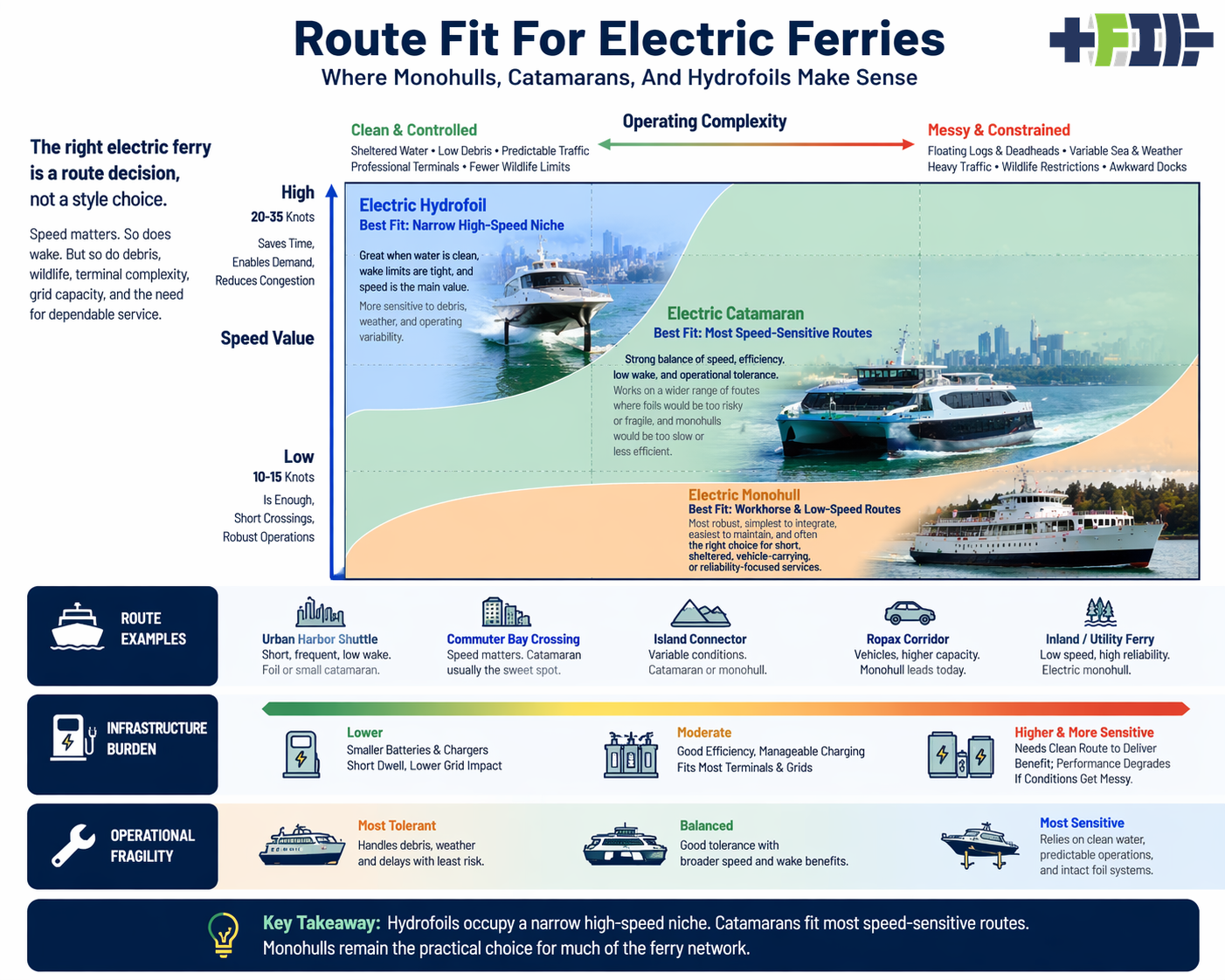
The proposed electric passenger hydrofoil from downtown Vancouver to Bowen Island and Gibsons remains a useful hook for thinking about ferry electrification, but it does not need to carry the full analytical burden twice. In the earlier piece on the proposal, I laid out the core challenges in some detail. BC coastal waters are full of floating logs and deadheads. Marine mammal protection rules in the Salish Sea add operating friction. A startup operator has to align vessels, terminals, charging systems, permits, agreements, and demand all at once. Most important, the whole hydrofoil proposition depends on preserving dependable high-speed foilborne operation in waters that are not naturally friendly to that assumption. Those points still stand. They are not less true because the vessel is appealing. But if the argument stops there, it misses the more interesting and more consequential question for ferry electrification. Even where a hydrofoil could work, is it the right electric vessel architecture, or would a small or mid-sized high-speed electric catamaran be the better answer? That is where the conversation gets more useful. Public discussion often treats hydrofoils as if they are the only modern alternative to conventional ferries. That is the wrong comparison. The real competition is not between an old diesel displacement ferry and a sleek foil. It is between different ways of delivering electric passenger service at useful speed. In many cases the most relevant alternative is not a slower, heavier monohull. It is an electric catamaran that gives up some top-end glamour but retains most of the practical value while cutting a lot of the operational and infrastructure risk. That matters because ferry electrification is already progressing, and most of it is not happening on foils. Billy Bishop’s Marilyn Bell shuttle in Toronto is fully electric. Toronto’s new island ferries are battery-electric. BC Ferries has six Island Class battery-hybrid ferries in service and four more under construction, while also procuring larger hybrid-electric-ready vessels for core routes, with the intent to fully electrify all of those routes. Quebec and Halifax are advancing electric and hybrid-electric projects as well. Across Canada, public estimates point to roughly 155 to 159+ ferry vessels in operation. The electric share of that fleet is still small, but it is growing. And the pattern is clear. Electrification is being built through route-fit designs, battery systems, terminal charging, and pragmatic hull choices, not through a search for the most futuristic silhouette. That practical pattern reflects the physics of ferries as much as the politics of procurement. Electrifying a ferry is not just a matter of replacing diesel engines with batteries. The vessel becomes part of an electrical system that stretches from the battery pack to the berth, from cooling loops and converters to chargers, transformers, and local substations. Energy use underway drives everything else. If propulsion demand is high, the battery gets larger, the vessel gets heavier, the charger gets bigger, and the terminal electrical upgrade becomes harder. If propulsion demand falls, the whole system gets easier. That is why hull form matters so much. It is not a styling choice. It is a grid and power-management choice. At low speeds, a conventional displacement hull can be efficient enough. But once passenger operators want 20, 25, or 30 knots, drag becomes a much larger issue. A monohull fast ferry pushes a lot of water and generates a lot of wave-making resistance. A catamaran spreads the displacement across two narrow hulls, reducing that wave-making resistance and often lowering the power needed for a given payload and speed. A hydrofoil goes further by lifting much of the hull out of the water once it reaches takeoff speed, cutting wetted area and wave drag more aggressively. On paper, that makes hydrofoils look like the natural electric winner. Less drag means fewer kWh per trip, smaller batteries, and lower charging demand. But paper is not the same as service. A hydrofoil’s efficiency advantage depends on staying foilborne for a large share of the route. A catamaran’s efficiency advantage is less dramatic, but it is more durable. If the water is messy, the approaches are constrained, the route has speed restrictions, or the operator must maneuver conservatively, the catamaran retains more of its value. The hydrofoil loses more of the very thing that justified it. That distinction matters far more than it first appears, because it changes not just the vessel’s energy performance, but the entire electrical and operational architecture around it. Consider the onboard electrical system. A modern electric passenger vessel is carrying propulsion loads, hotel loads, navigation systems, controls, communications, lighting, HVAC, battery management, and battery thermal management. Propulsion is the biggest number, but not the only one. If a route requires 3 MWh of propulsion energy for a round trip and another 0.3 to 0.5 MWh for ancillary systems and losses, then even modest reductions in propulsion demand have system-wide effects. A more efficient hull means less battery mass. Less battery mass means a lighter vessel and lower structural burden. Lower power demand means less heat to reject, smaller cooling equipment, and often less stress on high-rate charging. This is why catamarans deserve more attention in the electrification discussion. They often deliver enough reduction in drag to make the whole system more manageable without requiring the narrow operating envelope of a hydrofoil. That middle ground is where a lot of practical ferry electrification is likely to live. A catamaran may not match a hydrofoil’s best-case efficiency at 30-plus knots in clean water, but it can still be materially better than a conventional monohull. If a monohull route would demand 4 MWh per round trip, a catamaran might bring that down to 3.2 to 3.5 MWh. That is a significant reduction. It could mean the difference between a charger averaging 8 MW over a short dwell and one averaging 6 MW, or between requiring a larger berth-side battery buffer and staying within a simpler transformer upgrade. Those are not small engineering details. They are often the difference between a project that gets built on schedule and one that gets dragged into a utility interconnection queue or a terminal rebuild. The terminal side of the equation is where elegant concepts often run into the public-infrastructure wall. A ferry consuming 3 MWh on a round trip and charging in 20 minutes needs an average of about 9 MW before losses. Stretch the dwell to 30 minutes and the average falls to about 6 MW. Reduce the trip energy to 2.4 MWh and the same 30-minute dwell implies roughly 4.8 MW. These differences cascade into cable sizing, charger design, switchgear, thermal constraints, and utility service upgrades. They also shape fleet operations. If one vessel arrives late, how much spare time is there before the charger becomes the bottleneck. If two vessels share one berth, what happens to the power draw. If actual service time varies because of traffic, weather, or protected-species slowdowns, does the terminal electrical system absorb that variability, or does the whole service start to slide. This is where catamarans can have a strong advantage, even when they are not the most hydrodynamically efficient craft in theory. Their service profile is often more forgiving. They can be commercially useful at 20 to 28 knots rather than needing the cleaner, more controlled operating window that hydrofoils require to justify their complexity. That means a catamaran can still produce meaningful time savings even if average service speed is lower than the marketing image of a hydrofoil. The vessel can arrive a few minutes late, charge over a slightly longer window, and still preserve the value of the route. In public transport, that flexibility matters. People do not buy ferry tickets because the craft is elegant. They buy them because the service is dependable. Hydrofoils still have real strengths and should not be dismissed. They can cut wake. They can reduce drag sharply at speed. They can offer ride quality benefits in some conditions. Routes like Hong Kong to Macau, Liberty Lines’ island services, and Sado Kisen’s jetfoil operations show that hydrofoils have a real and durable niche where demand, distance, terminals, and water conditions line up. Stockholm’s Candela service is the current electric poster child because it combines low wake, urban water transit, and a vessel designed around that niche. Artemis’ larger EF-24 is an effort to expand the hydrofoil value proposition into a more substantial passenger ferry class. There is nothing unserious about those efforts. But the historical record also suggests that hydrofoils succeed where the operating environment lets them remain hydrofoils. Transportation Research Board work from decades ago made the key point clearly. Hydrofoils are uneconomical below design speed, and floating or subsurface debris becomes a significant problem. That logic has not gone away. It is one reason a recent U.S. Federal Transit Administration study for a foil ferry in Puget Sound put collisions with logs and deadheads near the center of the design problem. It is also why the earlier Vancouver article focused so much on BC waters. Once the route starts degrading the foilborne operating profile, the hydrofoil’s comparative edge shrinks. There is no need to repeat that whole analysis here. The important thing for this piece is what follows from it. If the foil advantage shrinks, the catamaran starts to look stronger very quickly. That is exactly what current procurement decisions are telling us. Agencies and operators are not waiting for hydrofoils to prove themselves before electrifying passenger service. They are buying catamarans. San Francisco Bay Ferry’s REEF program is built around battery-electric catamarans. Incat Crowther’s electric and hybrid-electric ferry portfolio is overwhelmingly catamaran-based. Auckland’s first plug-in hybrid fast ferry is a catamaran. These are not isolated curiosities. They reflect the way real ferry systems make decisions. Operators want useful speed, lower energy use, manageable charging, mature shipyard capability, and maintenance systems they understand. Catamarans deliver enough of the hydrodynamic benefit to make electrification easier while fitting into an existing industry comfort zone. That comfort zone is not just conservatism. It has technical value. A mature hull type is easier to certify, easier to insure, easier to maintain, and easier to build into a fleet strategy. Spare parts, drydock practice, training, structural assumptions, and operational procedures all become more legible. That matters a lot when the vessel is only one part of a larger electric system. The more novel the vessel, the more coordination burden shifts onto the operator, the charger supplier, the berth designer, the utility, and the regulator. A catamaran reduces that burden while still allowing meaningful innovation in batteries, charging, and operations. Chatgpt generated infographic showing where electric monohulls, catamarans, and hydrofoils fit best This is why the route-fit question needs to be broader than “could a hydrofoil run there.” The better question is “which electric vessel type makes the entire service easiest to build and operate.” That means looking not only at demand, distance, and time savings, but also at debris risk, wildlife constraints, wake limits, dock geometry, berth dwell time, local feeder capacity, charger rating, backup energy strategy, and maintenance regimes. Once that wider lens is applied, many candidate hydrofoil routes look less like foil opportunities and more like catamaran opportunities. The Vancouver, Bowen, and Gibsons proposal illustrates that perfectly. The earlier article laid out why the hydrofoil concept faces a hostile operating environment in BC waters. There is no need to retread every one of those points in detail. What matters here is the implication. Even if the route has real value as a downtown-to-coast passenger service, and even if electric propulsion is the right long-term direction, the vessel architecture may still be wrong. A small or mid-sized high-speed electric catamaran would not eliminate floating logs, deadheads, whale rules, charging infrastructure needs, or startup execution risk. But it would change the balance. It would reduce the specific vulnerability associated with submerged foils. It would preserve more commercial value at lower average speeds. It would sit inside a more mature design and procurement ecosystem. And it would probably make the terminal and grid integration problem more legible. That matters because the real competition on the Vancouver routes is not against BC Ferries on a like-for-like basis. It is against the total travel friction of reaching Horseshoe Bay, boarding, crossing, and then continuing onward. A hydrofoil does not need to preserve every knot of its brochure speed to be useful, but it does need enough high-speed operation to justify its added complexity. A catamaran, by contrast, can still create meaningful door-to-destination savings at lower speed. If an electric catamaran could provide a downtown-to-Bowen or downtown-to-Sunshine Coast trip fast enough to beat the combined car, bus, and conventional ferry journey by a useful margin, that may be enough. The service does not need to be spectacular. It needs to be dependable and fast enough. The same logic carries over to other candidate markets. Seattle to Bremerton is one of the more plausible hydrofoil niches in North America, and Kitsap Transit’s work shows why. There is real passenger demand, fixed terminals, and a meaningful value to speed. But even there, driftwood and route complexity force collision mitigation and operating caution into the design discussion. That is a clue. If one of the strongest candidates still has to work this hard to clear the environmental and operational hurdles, then many routes that look like hydrofoil opportunities are probably better understood as catamaran routes. Auckland to Waiheke, Sydney to Manly, and selected urban corridors in San Francisco, London, and New York all fit that pattern. They have the demand and the terminals. What they do not always have is the clean operating envelope that lets a hydrofoil remain decisively better than a fast catamaran. Scaling is where the catamaran story gets much stronger. Incat Tasmania’s China Zorrilla, now finished with sea trials and doing final finishing and logistics for delivery, is the clearest example of what a scaled high-speed electric catamaran can look like: a 130 m vessel with capacity for about 2,100 passengers and 225 vehicles, built for the River Plate run between Argentina and Uruguay, with a battery system of roughly 40 MWh. That is not a niche demonstrator. It is a full-size ropax fast ferry pushed into the electric era. There is no foil ferry anywhere near that scale in commercial service or close to it in current public programs. The best-known modern electric hydrofoils are still passenger-only craft such as Candela’s 30-passenger P-12 and Artemis’ 24 m, 150-passenger EF-24. Historically, the Boeing Jetfoil topped out in the low hundreds of passengers and was also passenger-only. In practical terms, hydrofoils have remained a walk-on passenger technology, while large fast ropax vessels have evolved as catamarans. That is one reason Incat’s work in Tasmania matters so much to the electrification discussion. It shows that the high-speed e-cat pathway scales from small passenger craft all the way up to large commercial ferry platforms, while the foil pathway still does not. In practice, a lot of supposed e-foil opportunities are probably better described as “e-cat until proven otherwise.” That is not because catamarans are inherently superior. It is because transport systems reward robustness. If a hydrofoil saves 20% of propulsion energy under ideal service conditions, but real operating conditions reduce that advantage to 10%, the absolute gain may shrink to a few hundred kWh per trip. Useful, yes. Decisive, not always. If the catamaran uses 3.3 MWh per round trip and the hydrofoil uses 3.0 MWh in real service, the hydrofoil saves 0.3 MWh each trip. Over ten trips, that is 3 MWh per day. That matters. But it may not outweigh tighter charging requirements, more complicated maintenance, and greater sensitivity to route disruption. In a public-transport context, especially one that depends on predictable terminal power and predictable dispatch, that trade can tilt toward the catamaran very quickly. It is also worth keeping some perspective about where the market actually is. Most electric ferries in service or on order today are still monohulls, and that is not a sign of technological backwardness. It reflects the fact that many ferry routes are short, sheltered, low-speed, vehicle-carrying, or structured around reliability and simple terminal operations rather than around maximizing speed or minimizing wake. On those routes, a conventional monohull can be the easiest hull to electrify because it fits existing docks, operating practices, and maintenance routines while keeping battery and charging demands manageable. Catamarans are often the better choice than hydrofoils where speed and lower wake create real value, because they capture much of the efficiency benefit with less operational fragility. But that does not make catamarans the default answer for every ferry service. On a large share of the network, especially workhorse public-service routes, the practical electric future is still likely to be a monohull. The larger point is that electrification is not won by picking the vessel with the most dramatic hydrodynamic theory. It is won by picking the vessel that makes the complete service easiest to run on electricity. That includes the battery, the thermal system, the charger, the transformer, the berth, the schedule, the backup procedures, and the maintenance team. Once that full-system perspective is adopted, high-speed electric catamarans deserve a lot more attention than they often get in public discussion. They may not leap out of the water, but they do something more valuable for infrastructure systems. They reduce enough drag to make electrification easier, while keeping enough operational tolerance to make daily service more credible. That does not make the Vancouver hydrofoil proposal useless as a thought experiment. Quite the opposite. It is helpful precisely because it forces the comparison out into the open. The future of electric passenger ferries is not a contest between futurism and caution. It is a contest between different ways of solving the same engineering problem. In many of those contests, hydrofoils will still have a niche. But in many more, the winning answer is likely to be the less glamorous one. A fast electric catamaran may end up carrying more of the transition than the foil, not because it is more exciting, but because it is easier to build into the grid, easier to build into the terminal, and easier to build into a real transportation system.



















 +54 others