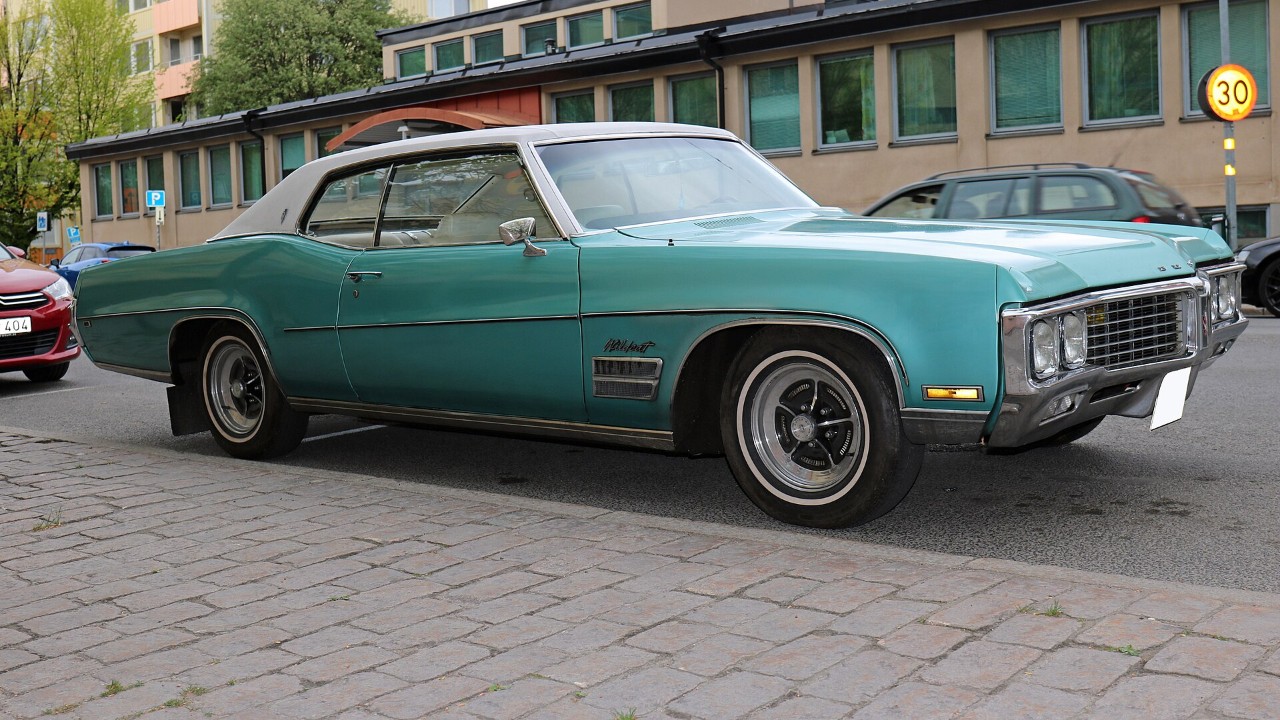
The 1967 Buick GS-340 came in white or Platinum Mist with bold red stripes, yet most Buick shoppers walked straight past it. In fact, that story repeats all through the muscle-car era. For every hit that filled dealer lots, there was a sharp, well-built car that never found enough buyers. Some of them were too expensive, and some arrived just as tastes shifted. Others, meanwhile, sat in the wrong corner of the showroom, overshadowed by a flashier sibling. As a result, many of these cars are rarer today than the famous names that outsold them. These eight are our picks for the cars from the muscle-car era that deserved better sales. The verdict is our opinion, but every number behind it comes from the record. So if you love the period, these are the cars we think you should know. 1. 1967 Buick GS-340 Buick aimed the GS-340 at buyers who wanted the Gran Sport look without the bigger engine’s price and insurance bill. According to Over-Drive Magazine’s 1967 Buick fact sheet, it came in only two colors, white or Platinum Mist. Broad red rally stripes, red hood scoops and red 14-inch Rally wheels set it apart. Even so, the base price was just $2,845. Its 340-cubic-inch V8 made 260 horsepower at 4,000 rpm and 365 lb-ft of torque at 2,800 rpm. That was plenty for a hardtop of this size, especially on a budget. Yet Ate Up With Motor puts 1967 sales at about 3,700 GS-340s, next to roughly 17,500 GS400s. Buick also offered a California GS trimmed like the GS-340, and we’ve covered why the Buick GS California edition is rising. Our take: the Buick GS-340 was the smart buy of the family, and buyers missed it. After all, it was cheaper, easier to insure and dressed up like a show car. If you find a real one, check the paint code before anything else. 2. 1966 Dodge Coronet 500 426 hardtop The Coronet 500 was Dodge’s dressed-up mid-size for 1966. It came with a padded instrument panel, a console and bucket seats as standard, according to Over-Drive Magazine’s 1966 Dodge fact sheet. The big news, though, was under the hood. For 1966, buyers could order the new 426 Street Hemi in any Coronet. The Street Hemi carried a rating of 425 horsepower at 5,000 rpm and 490 lb-ft of torque at 4,000 rpm. However, few people took Dodge up on the offer. The same fact sheet says Dodge built a total of 136 Coronet 500 Street Hemis for 1966. In our view, that is a tiny number for a car that combined bucket-seat comfort with one of the most famous engines of the decade. We’ve written more about the 1966 Coronet 500 that nobody talks about, and it deserves the attention. 3. 1966 Chrysler 300 2-door hardtop The 1966 Chrysler 300 was a full-size car with a muscle-era engine list. The standard engine was a 383 V8 rated at 325 horsepower. Buyers could also order a new 440 TNT V8 rated at 365 horsepower. Chrysler gave the 300 its own wraparound taillights that year, plus thin shell-type bucket seats inside. According to the Chrysler 300 Club’s 1966 production table, the two-door hardtop started at $4,005 and found 24,103 buyers. The four-door hardtop also came close behind at 20,642. Meanwhile, the convertible managed just 2,500. Our take: a 440-powered hardtop with buckets and that sculpted styling should have sold in bigger numbers. It sat in a gap between Chrysler’s sedans and the letter-series legends, and that left it without a clear identity. Today, we think that gap makes it one of the better-value big Mopars to own. 4. 1970 Buick Wildcat Custom coupe Buick built the Wildcat from the 1963 to 1970 model years. For its last season, however, the car came only in Custom trim. It also carried Buick’s 455-cubic-inch V8, rated at 370 horsepower with more than 500 lb-ft of torque. In the end, Buick built 23,645 Wildcats in 1970. Then the name disappeared, because the Centurion replaced it for 1971. That was a quiet ending for a big, fast car with real muscle under its long hood. In our view, the 1970 Wildcat suffered from timing, because it was a full-size performance car in an era that loved intermediates. Even so, a Custom coupe with the 455 offers huge torque in a car built for long highway runs. If you want big-block Buick power without the muscle-car prices, start here. 5. 1969 Mercury Montego MX convertible Mercury launched the Montego for 1968 as part of its mid-size Comet line. The 1969 MX convertible came with a power top and a glass rear window. It also wore simulated wood inserts on the lower body and wood-grain door panels. Engine choices ran from a 155-horsepower 250 six to a 320-horsepower 390 V8. Yet very few buyers signed up. According to Over-Drive Magazine’s 1969 Mercury fact sheet, only 1,725 Montego MX convertibles left dealers that year, making it the rarest of the 1969 mid-size Mercurys. As Curbside Classic notes, that was the last year for the Montego ragtop. Our take: the MX convertible had the looks and the engines, but buyers were already turning away from soft tops. Mercury also did not offer the 428 Cobra Jet in it, according to the same Curbside Classic story. For that reason, a 390-equipped car is the one we would want today. 6. 1968 AMC Ambassador SST For 1968, AMC made air conditioning standard on the Ambassador line. Buyers who did not want it could delete it for a $218 credit. The top-line SST also included reclining front seats, wood-look interior trim and an electric clock. Reviewers even nicknamed it “The Kenosha Cadillac.” AMC’s brochure went further and called it the only American car with standard air conditioning. Hagerty’s write-up notes that the claim did not quite hold up. Hagerty also lists the numbers: the SST two-door hardtop started at $3,172, and AMC sold 7,686. By comparison, the SST sedan started at $3,151, and AMC built 13,387. In our view, that hardtop deserved far more buyers. It offered big-car comfort with a 290 V8 as standard and optional 343 V8s. Then, at midyear, AMC added the 390 AMX V8, rated at 315 horsepower. A 390-powered SST hardtop is a sleeper in a suit. 7. 1966 Ford Fairlane 500 XL hardtop Ford redesigned the Fairlane for 1966 on a longer wheelbase. It also gained vertically stacked headlights and styling borrowed from the full-size Galaxie. The 500 XL sat near the top of the range, with bucket seats, a console and special trim as standard, according to Over-Drive Magazine’s 1966 Fairlane fact sheet. The XL hardtop could also take a 390 V8. In fact, the 315-horsepower 390 four-barrel went to the XL rather than the GT. However, the GT stole the spotlight. Ford sold 33,015 GT hardtops in 1966, while the 500 XL hardtop reached 23,942. Our take: the XL offered most of the GT’s comfort and a strong engine without the stripes and badges. That made it a sleeper, but it also made it easy to overlook. As a result, out of 337,792 Fairlanes delivered that year, the XL hardtop was a small slice. 8. 1969 Ford Torino GT hardtop The 1969 Torino GT changed little from 1968. Every GT came with a non-functional fiberglass hood scoop, which became functional only with the 428 and Ram Air options. Meanwhile, a 302 V8 rated at 220 horsepower was standard. Options climbed through the 351 and 390 to the 428 Cobra Jet, rated at 335 horsepower and 440 lb-ft of torque. The formal hardtop lived in the shadow of the fastback SportsRoof. According to Over-Drive Magazine’s 1969 Fairlane-Torino fact sheet, the hardtop and Cobra hardtop together sold 17,951. By comparison, the SportsRoof and Cobra SportsRoof combined sold 61,319. In our view, the notchback GT is the better-proportioned car, and it deserved more buyers. We explained more of the case in why the Ford Torino GT was underrated. For 1969, Ford built 81,822 Torino GTs out of 129,054 Torinos.

 Liked by Noah Lavoie, Amélie Scott





















 Liked by Noah Lavoie, Amélie Scott