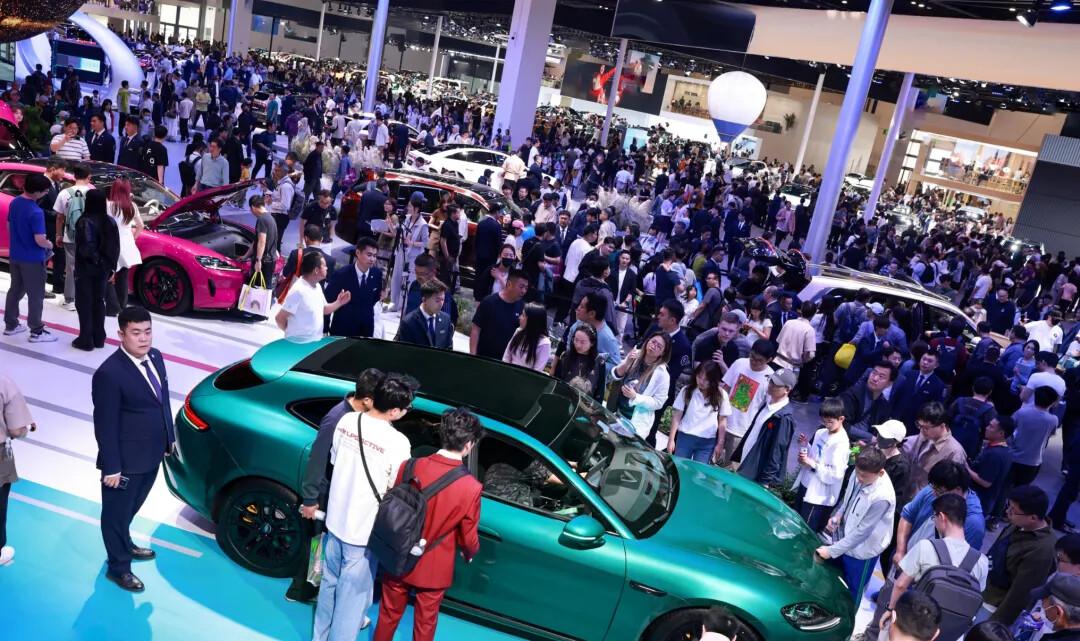
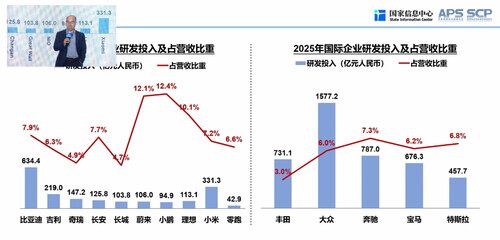
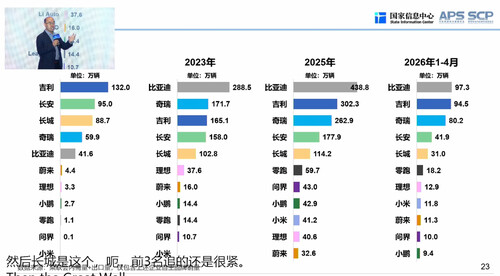
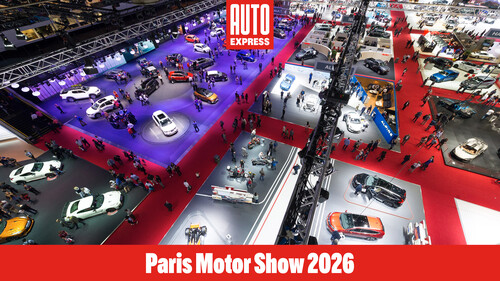
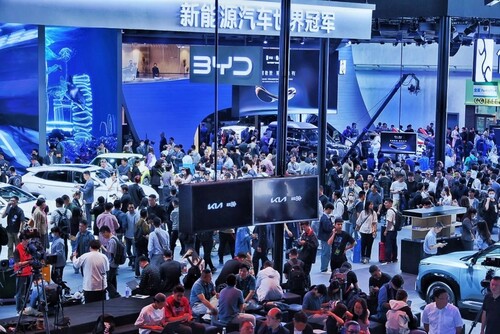
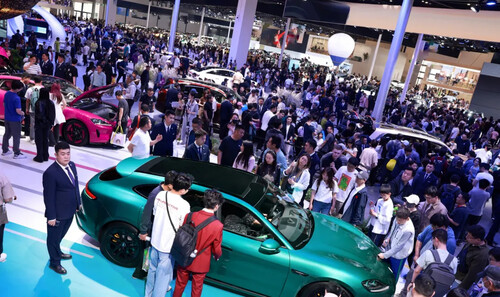
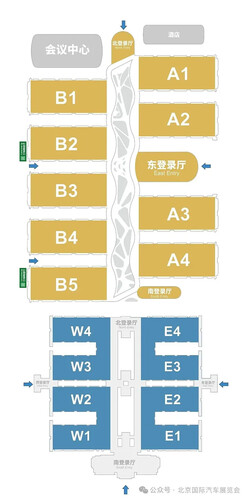
Returning from the 2026 Beijing Auto Show, the fatigue on the faces of colleagues at ChinaEV Home was unmistakable. The reason was straightforward: navigating events, booths and vehicle launches at what NIO Founder Qin Lihong described as “the largest auto show in human history” posed a major physical and mental test. How large was this year’s Beijing Auto Show? Official figures tell the story: 219 press conferences (across April 24–25), 1,451 vehicles on display, more than 2,000 exhibitors, and a total exhibition area of 380,000 square meters. Beijing Auto Show By all measures, the 2026 Beijing Auto Show stands as a peak in the history of China’s auto exhibitions. As a microcosm of the industry’s trajectory, it also signals that China’s auto sector may have reached a cyclical high. Such a scene inevitably recalls a similar moment a decade ago, when China’s smartphone industry peaked in 2016. Rewinding to that year, on the eve of the global smartphone market’s peak, China reached its own zenith first: annual shipments hit 465 million units, an unprecedented level that has yet to be matched. The market landscape at the time resembled this year’s Beijing Auto Show—vibrant, fragmented, and flourishing. Back then, sales were far less concentrated. As many as 71 smartphone brands competed, with even the top 20 each securing a foothold. Internet firms, appliance makers, and PC companies all rushed into the sector, eager to capture a share. At the time, LeEco smartphones gained unexpected traction through its “ecosystem disruption” strategy, while brands such as 360, K-Touch and Coolpad rose as “internet phone” challengers. Previous LeEco Founder Jia Yueting Appliance giants like Hisense and Gree entered the market, while Meitu, originally a photo-editing app company, carved out a niche with its Meitu smartphones. A similar pattern is visible at the Beijing Auto Show, where a wide array of new vehicles and brands made their debut. Examples include the “Freelander” co-developed by Chery and Jaguar Land Rover, Aistaland from Huawei and GAC, Epicland from Huawei and Dongfeng, and MONTX under GAC Group. Even Dreame’s automotive lineup maintained a high-profile presence, while Qianli Technology, previously focused on autonomous driving solutions, launched its own car brand “Pallade.” Pallade originated from Zhuangzi’s Man in the World, Associated with other Men At the same time, joint-venture automakers remained active. SAIC-GM Buick and Beijing Hyundai introduced new products, strategies and brands in a bid to revive their China operations. The scale and intensity of the Beijing Auto Show send a clear signal: a decisive battle in China’s new energy vehicle market—among both domestic and global players—is imminent. However, comparisons to the 2016 smartphone market also raise concerns. Following its 2016 peak, China’s smartphone market entered a downturn, triggering a rapid consolidation. Both market size and brand count shrank sharply, with the top five brands now controlling over 90% of the market. The era of “hundreds of flowers blooming” proved short-lived. The question now is whether China’s auto market is heading toward a similar outcome. Industry consolidation ahead Before offering its own view, ChinaEV Home posed this question to senior executives across leading OEMs and suppliers. William Li of NIO, Oliver Thöne of Mercedes-Benz, Tao Hailong of SAIC Volkswagen, Nakul Duggal of Qualcomm, as well as Yu Kai and Su Jing of Horizon Robotics, all shared their perspectives. Except for Duggal, who said consolidation would not arrive quickly, and Thöne, who said it was difficult to predict, the others broadly agreed that industry consolidation is either imminent or already underway. Their views differed in nuance. William Li and Tao Hailong both said the industry would enter a consolidation phase, with a “final window” for automakers lasting as little as 1.5 years or up to five years. William Li and Tao Hailong in a media briefing Yu Kai and Su Jing argued that consolidation would occur faster and earlier at the supply-chain level than among automakers themselves, though they agreed the overall trend is inevitable. While these leaders did not elaborate on their reasoning, recent sales data offers clues. Unlike the strong momentum seen in 2025, China’s passenger vehicle market showed signs of weakness in early 2026. According to CPCA data, retail sales in the first quarter totaled 4.222 million units, down 17.5% year-on-year. This came despite a 59.4% month-on-month surge in March. Compared with last year, March retail sales still declined 15% year-on-year. In the first three weeks of April (end April 19), retail sales totaled 627,000 units, down 26% year-on-year and 18% from the same period in March. Beijing Auto Show More concerning for industry players is that new energy vehicles, long the growth engine, have underperformed in 2026. NEV retail sales reached 1.908 million units in the first quarter, down 21.1% year-on-year. The data suggests that both the broader auto market and the NEV segment may be entering a downturn. In a market shifting toward stock competition, it becomes increasingly difficult to sustain a growing number of brands. This dynamic drove the post-2016 shakeout in China’s smartphone sector and may now be repeating in autos. BYD booth at Beijing Auto Show Such a downturn may appear counterintuitive. Logically, profit-driven automakers should not invest heavily in an increasingly competitive, saturated market. One explanation is that some companies still believe the NEV growth cycle remains intact and that demand will recover after early-year policy fluctuations. Others are driven by confidence in their own brand strength and technological capabilities to emerge as winners. Ultimately, the reasons matter less than the reality: companies should assume the “final round” is already underway, rather than yet to begin. Final-stage competition In recent years, “final round” has become a frequent term in China’s auto industry. Leaders such as William Li, He Xiaopeng and Yu Chengdong have repeatedly predicted that only five to ten brands will survive in the long run. However, the notion that the final phase has already begun—and may last only a few years—is relatively new. William Li told ChinaEV Home that while the auto industry shares similarities with smartphones, its longer value chain and heavier assets mean changes will be less abrupt. He sees five years as a reasonable timeframe. He also noted that severe product homogeneity is a key driver of consolidation, with too many vehicles occupying similar segments. Indeed, current NEVs show increasing convergence in both design and features. At the Beijing Auto Show, Bloomberg observed that many sedans resemble Porsche, while high-end SUVs often evoke Land Rover. SAIC Z7 In terms of features, most new models emphasize Qualcomm flagship chips, large infotainment screens, and advanced driver assistance systems. For joint ventures, “Momenta” has become a common keyword. On the technical front, 800V architectures and ultra-fast charging are now mainstream, while air suspension is approaching the RMB 200,000 ($29,000) price bracket. Consumers are thus faced with numerous similar choices rather than highly differentiated products. As a result, weaker brands are likely to be marginalized and eventually eliminated. Such homogeneity is a natural outcome of industry maturation. Design convergence reflects market selection, while feature similarity indicates technological plateauing. Xiaomi EV Booth at Beijing Auto Show Bloomberg noted that in a highly competitive market with compressed development cycles, adopting proven design elements is a pragmatic way to reduce risk and accelerate time-to-market. As Tao Hailong of SAIC Volkswagen put it, consolidation is an inevitable phase in the auto industry’s historical cycle. “The auto industry is inherently asset-heavy, with long cycles and low tolerance for error. It cannot sustain prolonged price wars and irrational competition,” he said. He argued that most new brands will disappear if they fail to succeed quickly, as consumers move on. Tao estimated the consolidation window could be as short as 1.5 years under current conditions, or up to three years if the market improves—suggesting a clear outcome before 2030. Yu Kai and Su Jing added that consolidation will extend across the entire value chain, with suppliers reacting faster due to higher R&D costs and lower margins. In mature industries such as smartphones and PCs, core suppliers often consolidate into just a few players—a pattern likely to repeat in autos. Horizon Robotics’ Yu Kai and Su Jing Overall, the debate is not whether consolidation will occur, but how quickly and how broadly it will unfold. Oliver Thöne of Mercedes-Benz China offered historical context: in the 1890s, when Mercedes-Benz was founded, there were more than 3,000 car brands globally. By 1950, that number had fallen to around 50. Survival of the fittest William Li reiterated that competition in China’s NEV market is shifting from isolated features to system-level capabilities. Automakers must strengthen not only products but also organizational efficiency, after-sales service, and brand reputation. Weakness in any area could prove decisive. Tao Hailong echoed this view, saying future competition will not be about marketing narratives or financing capabilities, but about resilience and execution. SAIC VW President Tao Hailong “It’s not about who shouts louder, but who can sustain operations—aligning organization, supply chain, quality, channels and product cadence,” he said. Both perspectives suggest that the ultimate winners have yet to be determined. Recent years have seen frequent leadership changes among NEV startups, with Li Auto, Huawei-backed Harmony Intelligent Mobility Alliance (HIMA), and Leapmotor each taking turns at the top. Meanwhile, NIO Inc. and Xpeng both achieved profitability in Q4 2025, challenging earlier skepticism. This uncertainty has led many companies to believe that opportunities remain to secure a place in the final market structure. In the short term, the influx of new brands and models adds variability, but it may also accelerate consolidation by providing consumers with clearer choices. From this perspective, consolidation is not necessarily negative—it represents a process of industry maturation. Once consolidation stabilizes the market, consumers may benefit from improved product quality, more consistent user experiences, and reduced risks such as brand exits or service disruptions. If the smartphone industry offers any precedent, the result may be a more stable but less exuberant market—one where consumers can purchase with greater confidence. Ultimately, what consumers need is not an overwhelming array of uncertain choices, but reliable products that minimize regret. Terms like “consolidation” and “elimination” may sound harsh, but they are part of the industry’s growing pains—and a necessary step toward rewarding capable and responsible players. Looking ahead, one might borrow a literary line to conclude: Years from now, when the outcome is clear, William Li may recall the spring of 2026—and that crowded, vibrant Beijing Auto Show—as a defining turning point for China’s auto industry.