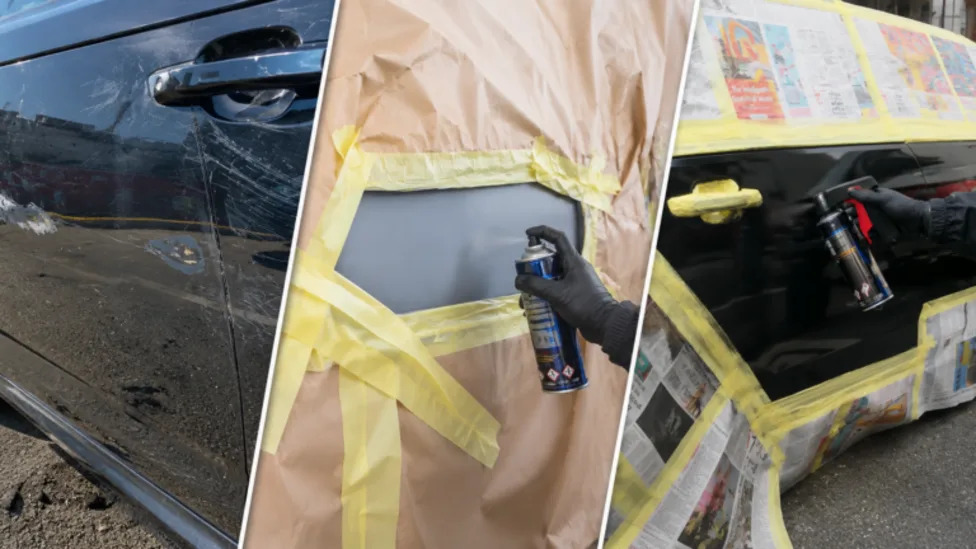
Can You Really Fix a Keyed car With Spray Cans Outside? This Detailer Proved You CanEvery body shop will tell you the same thing: paint needs a booth. Controlled airflow, filtered air, regulated temperature, no wind, no dust, no variables. It's the reason professional downdraft spray booths – which push clean air from ceiling to floor and carry contaminants away before they can settle – produce finishes that look factory-correct. It's also the reason a proper booth setup runs into thousands of dollars to install. So when a detailer decided to spray both keyed doors of a black Audi outside in a yard, using nothing but aerosol cans, the expectation was that something would go wrong. It didn't.The car came in rough. Someone had dragged a key down both driver's-side doors, leaving deep scratches that had cut through the clear coat, the base coat, and the primer all the way to bare metal. The owner had already made things worse with a DIY attempt using touch-up paint and sandpaper, which is a solid way to turn a recoverable scratch into a genuine mess. At that point a professional respray is effectively mandatory – you can't polish your way out of exposed metal.What the Repair Actually InvolvedThe detailer, CVR POV started with 320-grit on a block, working by hand to flatten the damaged area and begin feathering the surrounding paint. From there it stepped up to 400-grit to remove the coarser sanding marks, then 600-grit wet-and-dry for sections where the damage hadn't penetrated quite as deeply – keeping the primed area as small as possible, which in turn keeps the base coat area manageable. Less primer means less color coat, and less color coat means a tighter, easier blend.AdvertisementAdvertisementBecause the deepest sections had gone down to bare metal, the repair called for an etching primer first – applied to a tightly masked area – before a high-build primer went over the top in two or three coats. Etching primer is necessary on exposed metal due to its ability to chemically bond with the steel itself – a property that conventional primer lacks. The primer was then blocked back with 600-grit wet-and-dry, followed by 1,000-grit, until the surface was uniformly smooth and ready to paint.The color coat was a custom-matched aerosol in Volkswagen Audi Y9B brilliant black – a shade that punishes any inconsistency because every flaw reads clearly in dark paint. Three coats went on in sequence, each one progressively heavier, with the spray fanned slightly further out on each pass to blend toward the door edges. The important technique throughout was back-masking: folding the tape back on itself so the edge rolls rather than sits flat, creating a feathered transition instead of a hard line where new paint meets old.For the final protective layer, a two-component aerosol clear coat was chosen over a conventional single-component lacquer. Two-part clear coats incorporate a hardener that triggers a chemical reaction when combined with the base, resulting in a final finish far more durable and resistant to chemicals than what single-stage products can achieve, according to Fatboys Offroad. Once activated, the clock is running, typically a window of 24 to 48 hours before the product is no longer usable.The Case for Painting OutsideOutdoor painting has real drawbacks, and the detailer didn't hide them. According to Tema Equipment, working under unpredictable lighting causes shading to vary as you move across a panel, while dust particles that land in wet lacquer will require additional correction once the finish has dried.AdvertisementAdvertisementWhat made this repair work was timing and conditions. The yard had cleared out, giving the detailer room to work without foot traffic stirring up debris. The temperature was cooperative, which matters because Engineer Fix notes the sweet spot for aerosol application sits between 65 and 75°F – outside that range, solvent evaporation either drags or rushes, both of which cause problems. Warm air was used to help flash off each coat rather than leaving solvents sitting on the panel.The next day, once the clear had cured overnight, the work wasn't done. Small dust nibs and surface texture left by the aerosol went through a wet-sanding sequence: 1,500-grit, then 2,000, then 3,000, using soapy water as lubricant. That left the panel looking flat and dull, which is exactly where it needs to be before a rotary polisher with a cutting compound restores the gloss. A finishing polish knocked out the swirl marks the cutter left behind, and the result – back in full daylight – was a pair of doors that showed no trace of the scratch or the repair.The big takeaway from this isn't that spray booths are overrated. They produce fewer problems, cleaner air, and more consistent conditions, which is why professionals use them. But a controlled environment and aerosol cans aren't mutually exclusive – if the prep is correct, the technique is sound, and the conditions cooperate even briefly, an outside repair on black paint can hold up. The booth removes variables. It doesn't do the work.