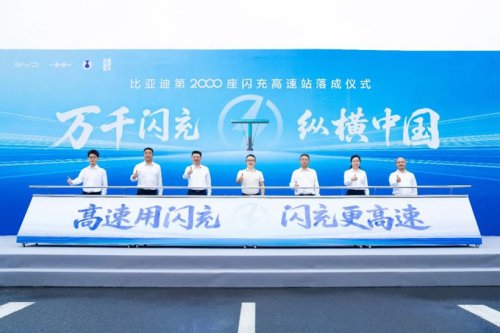
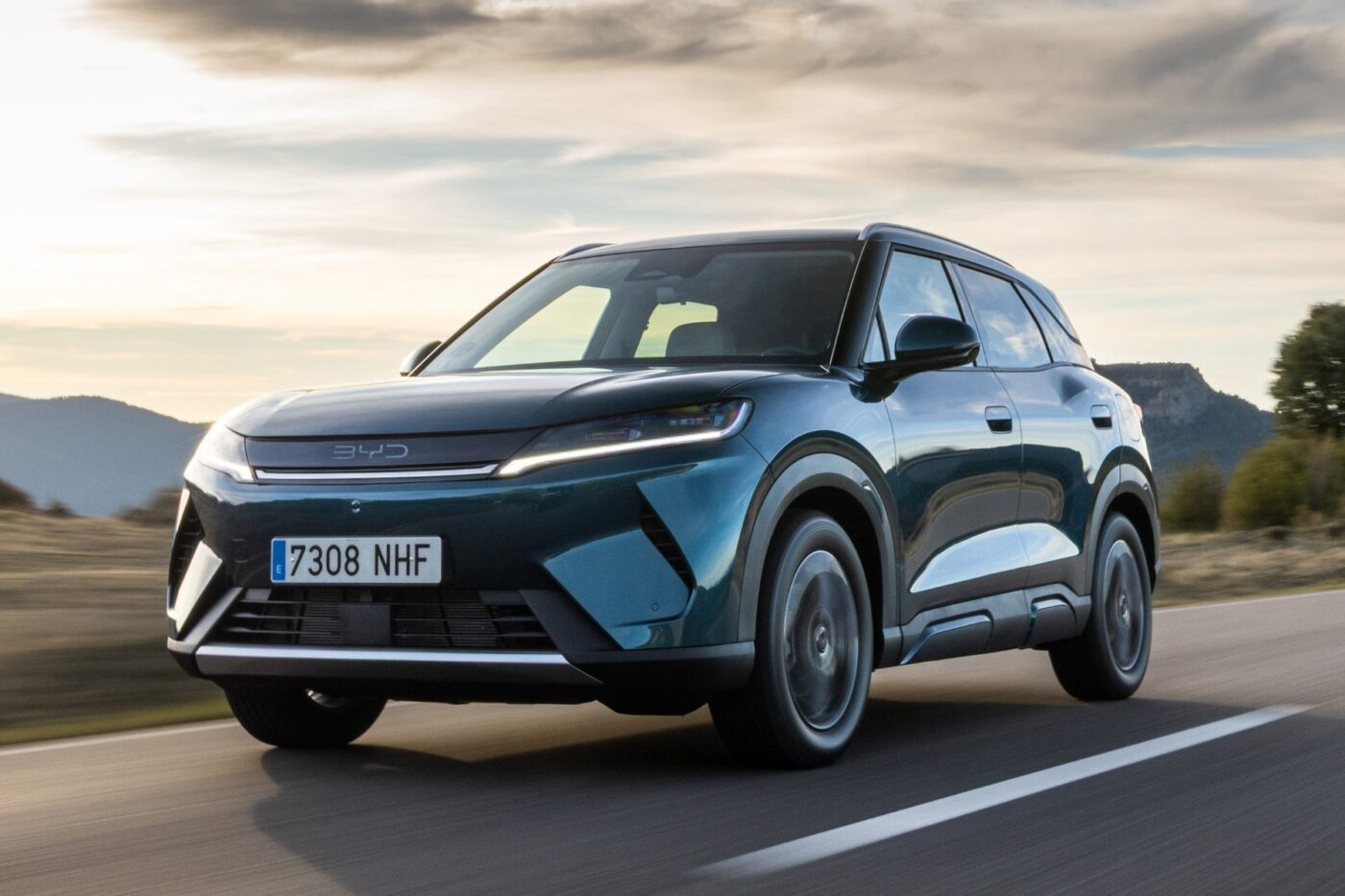
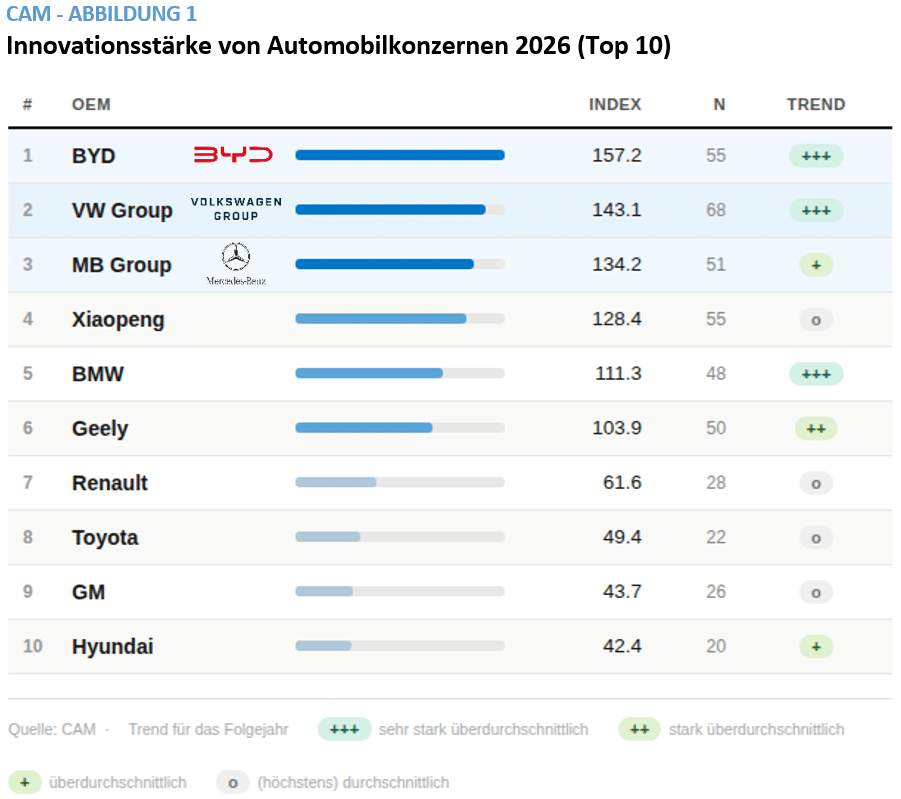
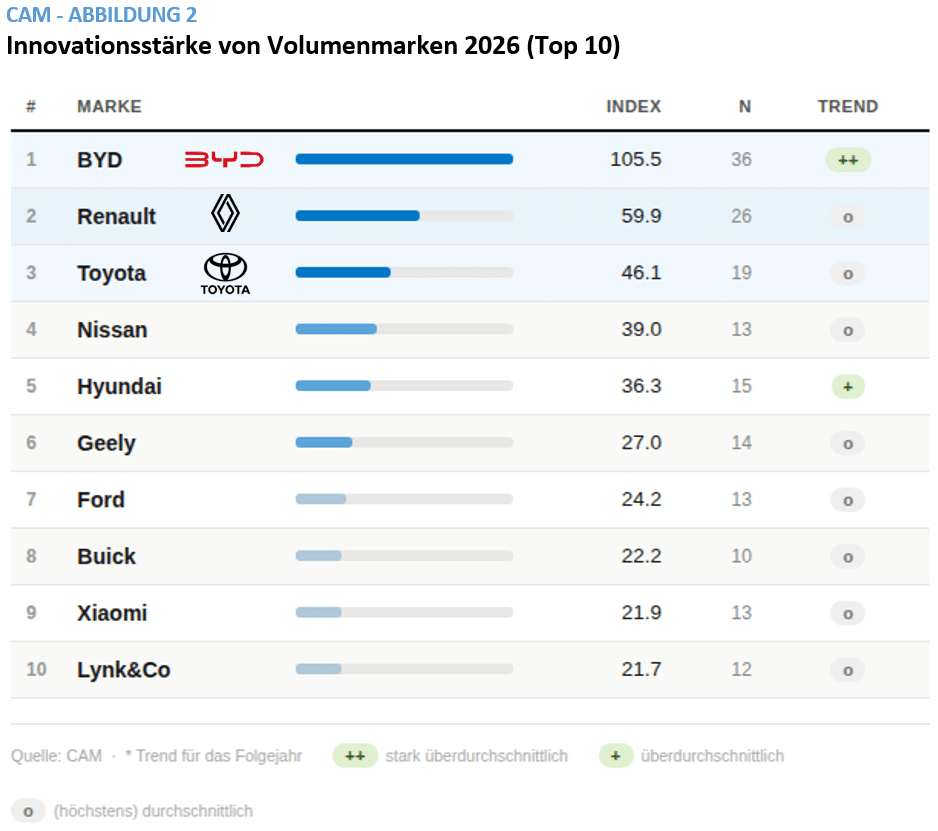
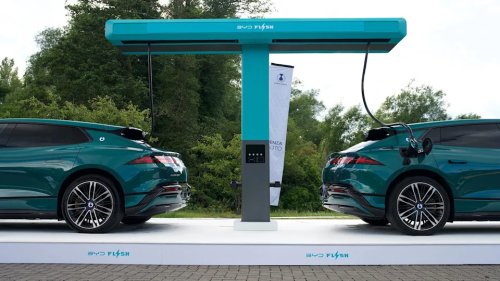
BYD Atto 2 DM-iImage: BYDUnlike the ‘CAM Electromobility Report,’ which most recently in January assessed the innovation strength of 36 car manufacturers in the battery-electric vehicle segment and identified Geely as the leader, the newly published 22nd edition of the ‘Automotive Innovations’ study series examines innovations across all drive types.The analysis evaluated 867 innovations from the 2025/2026 period, including approximately 660 series innovations from 36 automotive groups. The data is compiled by the Center of Automotive Management (CAM) at the University of Applied Sciences for Economics (FHDW) in Bergisch Gladbach under the leadership of Prof. Dr Stefan Bratzel.For the first time, a Chinese manufacturer, BYD, tops the ranking. What sets BYD apart is its exclusive focus on electrified vehicles – namely battery-electric vehicles and plug-in hybrids – unlike many other automotive groups that continue to produce internal combustion engine vehicles. This makes BYD the first winning original equipment manufacturer to offer only electrified models.From a German perspective, the results are encouraging: the Volkswagen Group, last year’s winner, ranks second (143 innovation points), followed by the Mercedes-Benz Group in third place. Positions four to six are occupied by a mix of Chinese and German players: Xpeng, BMW, and the Geely Group. Only thereafter do other countries enter the ranking: Renault, Toyota, GM, and Hyundai complete the top 10 of the most innovative automotive groups, representing France, Japan, the USA, and South Korea, respectively. Innovative strength of automotive groups in 2026Grafik: CAMStudy leader Stefan Bratzel states: “With BYD, not only has a Chinese automotive group become the innovation leader for the first time. Together with Xpeng and the Geely Group, three Chinese groups now rank among the top six most innovative automotive manufacturers of the year, elevating the tectonic shift in the automotive industry to a new level. The success formula is largely based on a combination of broad expertise in future technologies, high innovation speed, and low development and production costs. The magical innovation triangle of relevant core competencies, high agility, and cost efficiency is vital for survival in the Darwinian selection process of the automotive industry.”As mentioned earlier, the above ranking refers to automotive groups, most of which comprise multiple brands. BYD’s innovations, for example, are distributed across its three most important brands: BYD, Yangwang, and Denza.The BYD brand itself accounts for the majority of innovations (36) and the highest number of world firsts (18). These include, for instance, a Level 2+ highway assist system, which is available for the first time in the Dolphin and Seagull models in the subcompact and minicar segments. The Denza D9 van features an improved, semi-autonomous motorway assistant that can now automatically pass toll stations without driver intervention. The CAM study also highlights charging performance, mentioning BYD’s network of megawatt hyperchargers, which allow compatible BYD vehicles to recharge enough energy for approximately 400 kilometres of range in just five minutes.BYD leads among brands ahead of RenaultIn addition to the group ranking, BYD also leads as the most innovative volume brand in 2026. The CAM study once again highlights innovations in powertrain technology (battery systems) and driver assistance systems. BYD is celebrating both accolades.BYD manager Patrick Schulz states: “That BYD has been recognised as both the most innovative group and the most innovative brand by the renowned Center of Automotive Management confirms our ambition to be far more than just a traditional car manufacturer. BYD is a technology company that consistently drives innovation—with around 45 patent applications filed per working day.” Innovative strength from the mass market in 2026Grafik: CAMThe brand ranking reveals a surprise: Renault ranks second, significantly higher than in the group ranking. This could be partly due to the fact that higher-ranked players in the group ranking control far more brands than Renault, which only includes the main brand alongside the budget brand Dacia and the niche brand Alpine. Among Renault’s innovations, the CAM study highlights the retro-style electric models R4 and R5. It also notes that the new all-electric Twingo is the first minicar to feature a vehicle-to-grid (V2G) function.A similar effect is observed with Toyota, which ranks third in the brand ranking but eighth in the group ranking—the group only includes Lexus as a second brand. The opposite is true for Volkswagen, which benefits from its ten brands in the group ranking, securing second place, but none of its ten brands appear in the top 10 of the brand ranking. Instead, Volkswagen as a brand ranks only 11th.However, Stefan Bratzel and his team expect that pre-series innovations not yet evaluated, such as those in the upcoming VW ID.Polo, will lead to a significantly improved placement in the next ranking.auto-institut.de, myconvento.com (BYD statement; both in German)



















 +2 others



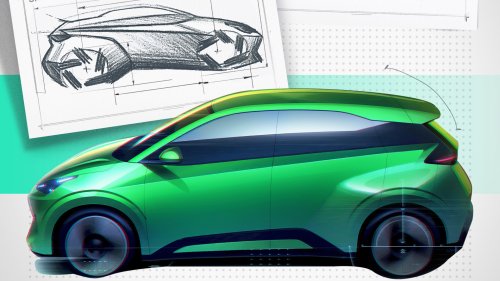
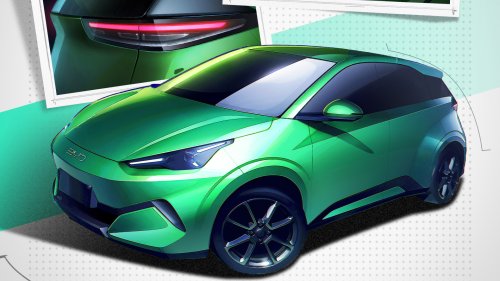
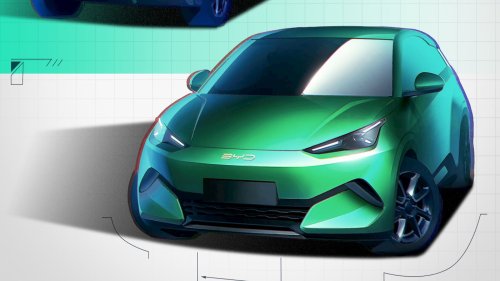
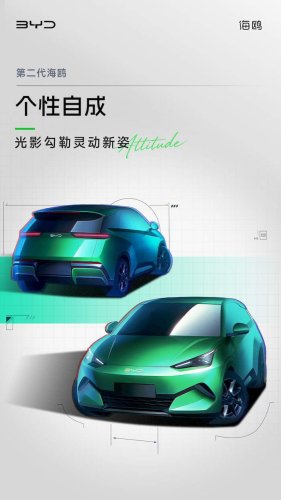
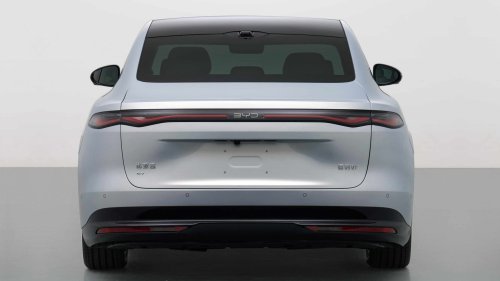
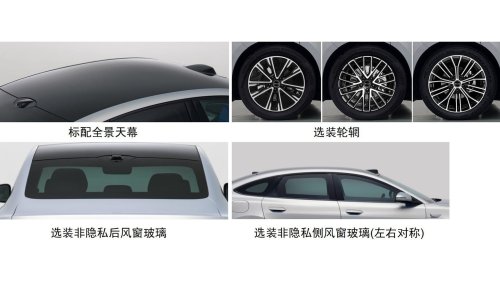

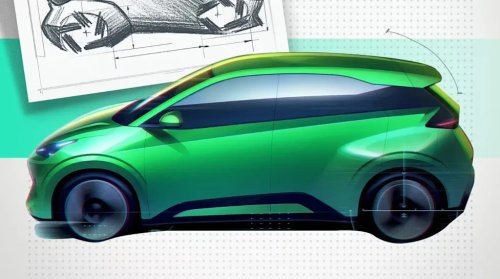
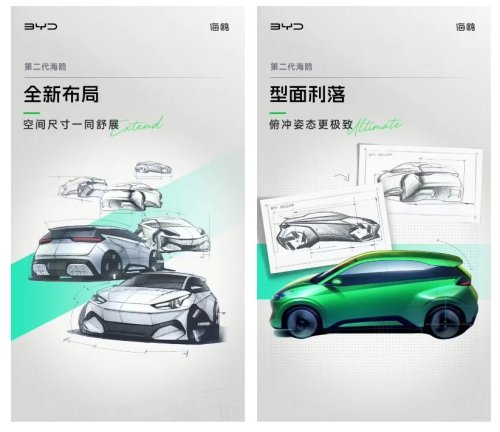
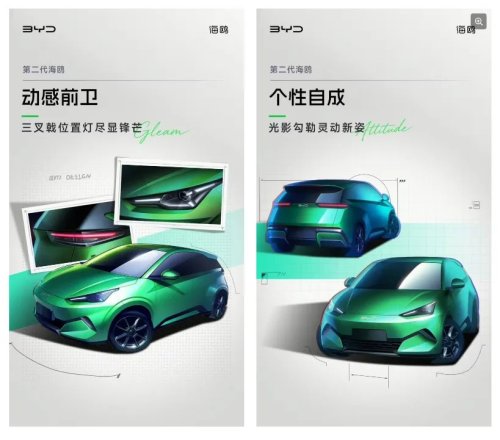
![BYD, BYD Seagull, BYD offers a closer look at the new Seagull EV [Images]](https://cdn.topcarnews.net/thumb/id/aHR0cHM6Ly9pMC53cC5jb20vZWxlY3Ry-ZWsuY28vd3AtY29udGVudC91cGxvYWRz-L3NpdGVzLzMvMjAyNi8wOS9CWUQtbmV3-LVNlYWd1bGwtRVYtdXBkYXRlLmpwZWc_-dz0xNTAwJmFtcDtxdWFsaXR5PTgyJmFt-cDtzdHJpcD1hbGwmYW1wO3NzbD0x/9c0b758dc4a218f611566b2a03c52e8a.jpeg?t=20261005&post_id=64651)
![BYD, BYD Seagull, BYD offers a closer look at the new Seagull EV [Images]](https://cdn.topcarnews.net/thumb/id/aHR0cHM6Ly9lbGVjdHJlay5jby93cC1j-b250ZW50L3VwbG9hZHMvc2l0ZXMvMy8y-MDI2LzA5L0JZRC1uZXctU2VhZ3VsbC1F-Vi0xLmpwZWc_c3RyaXA9aW5mbyZhbXA7-dz03MDA/9f44752c6c4b6208b3a29d7e2ceaf455.jpeg?t=20261005&post_id=64651)
![BYD, BYD Seagull, BYD offers a closer look at the new Seagull EV [Images]](https://cdn.topcarnews.net/thumb/id/aHR0cHM6Ly9lbGVjdHJlay5jby93cC1j-b250ZW50L3VwbG9hZHMvc2l0ZXMvMy8y-MDI2LzA5L0JZRC1uZXctU2VhZ3VsbC1F-Vi0zLmpwZWc_c3RyaXA9aW5mbyZhbXA7-dz03MDA/53e754be2aacba076b7b389ef9413f41.jpeg?t=20261005&post_id=64651)
![BYD, BYD Seagull, BYD offers a closer look at the new Seagull EV [Images]](https://cdn.topcarnews.net/thumb/id/aHR0cHM6Ly9lbGVjdHJlay5jby93cC1j-b250ZW50L3VwbG9hZHMvc2l0ZXMvMy8y-MDI2LzA5L0JZRC1uZXctU2VhZ3VsbC1F-Vi5qcGVnP3N0cmlwPWluZm8mYW1wO3c9-NzAw/3b0cb7f441d090c464769d93120d8543.jpeg?t=20261005&post_id=64651)
![BYD, BYD Seagull, BYD offers a closer look at the new Seagull EV [Images]](https://cdn.topcarnews.net/thumb/id/aHR0cHM6Ly9lbGVjdHJlay5jby93cC1j-b250ZW50L3VwbG9hZHMvc2l0ZXMvMy8y-MDI2LzA5L0JZRC1uZXctU2VhZ3VsbC1F-Vi0yLmpwZWc_c3RyaXA9aW5mbyZhbXA7-dz03MDA/ea2b4ebf38c4e9bf732d179d639b1562.jpeg?t=20261005&post_id=64651)
![BYD, BYD Seagull, BYD offers a closer look at the new Seagull EV [Images]](https://cdn.topcarnews.net/thumb/id/aHR0cHM6Ly9lbGVjdHJlay5jby93cC1j-b250ZW50L3VwbG9hZHMvc2l0ZXMvMy8y-MDI2LzA3L0JZRC1TZWFndWxsLUVWLXVw-ZGF0ZS0zLmpwZWc_c3RyaXA9aW5mbyZh-bXA7dz0xNDAw/02a0f7b5011767092a1ea11a79495fc7.jpeg?t=20261005&post_id=64651)