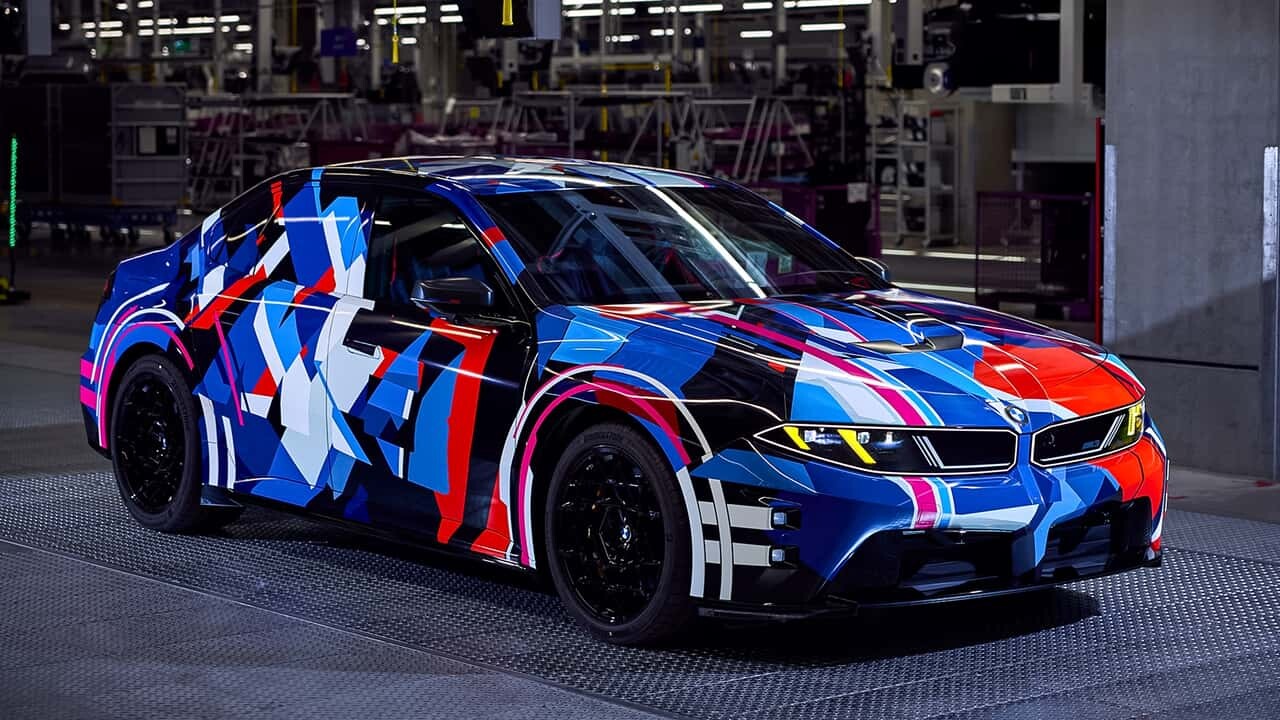
Most BMW fans cannot help falling all over themselves when a new M3 is launched, but this time they might get well and truly tripped up. That's because what BMW is calling "the fastest and most powerful BMW M3 of all time" is 100 percent electric. There's no mention of a gasoline version and no special EV designation tagged onto the name, just "here's the new 2027 BMW M3, and we hope you like it," or words to that effect. After driving a camouflaged prototype and hearing all the dirty details at BMW's Miramas test center in southern France, we most certainly do. BMW This machine has four electrically excited synchronous motors, one for each wheel. The pair at each axle is not quite what you expect, with one motor situated ahead of the other and a reduction gear for one of them on each side of the shared housing. The front-axle motors make approximately 644 horsepower and 398 pound-feet of torque, while the pair on the rear axle is good for about 751 horsepower and 738 pound-feet. Combined output is likewise still subject to an asterisk at this pre-production stage, but total power is at least 838 horsepower, and torque is an axle-twisting 885 pound-feet. If you're thinking the sum total is less than the two axles, you are absolutely correct. The surplus is there to allow for serious torque vectoring, both front to rear and side to side. In normal driving, the car operates strictly in rear-wheel drive, with the front axle brought in whenever there's acceleration, if the situation demands front-axle recuperation, or if you have the drivetrain set to Sport mode. Four motors require precise and rapid control during acceleration and braking, but they also play an outsize role in cornering. It all operates much more smoothly and immediately than any electronically controlled differential or transfer case ever could, so you absolutely get what you request. The so-called Heart of Joy (essentially another name for the M Dynamic Performance Control module) is the single ECU that oversees everything in the powertrain and driving dynamics arena. It's the brain that seamlessly decides what motor is required for whatever demands you place on the car by looking at steering position, accelerator input, and braking demands, with a nod toward the basic settings that you have dialed in. The battery that powers all of this is specific to the M3, even though it fits in a similarly sized case as the one in the i3. It's designed to give higher peak and sustained power output and is capable of higher energy recuperation (up to 540 kilowatts) and faster charging (420 kilowatts), which means it has a higher level of cooling. The battery capacity is slightly lower for all this, currently sitting at about 100 kWh. Estimated EPA range is currently 300 miles or so, but all of these numbers are subject to change. As for the difference between how this battery pack is installed versus the i3's, the M3 gains a direct connection to the front and rear axle subframes for enhanced torsional rigidity for more precise handling. BMW Whatever the underlying mumbo jumbo, we can say that it really works, and the result is simply epic. We first went out in the default mode, with the drivetrain, chassis, steering, and brakes set to Comfort and energy recovery set to Mid, just to get a feel of the track. Once we knew where we were going, we let fly with the M1 button, and that brought everything to Sport mode but left the energy recovery in Mid and, crucially, left the DSC stability control setting in On. We pressed the car hard, and the M3 absolutely responded, and our pace built immensely. But that eventually resulted in a bit too much understeer as speeds climbed, which led to a brief off-track excursion, as they say in the business. We kept on going, but the car was imposing a limit on our fun. We did what you would do at that point and duly selected the M2 button. That setting was programmed by our hosts to bring the drivetrain and chassis up to Sport+ and raised the recuperation to Max. It also put the DSC in a more permissive state, otherwise known as MDM, and all of that was the magic bullet. The car now dived toward apexes and slithered nicely out of corners. The front end was quite pointy, and the rear now had permission to loosen up. Our lap times fell, and our grin widened. This car felt alive. It really did feel like an M3, just like no other before it. Through it all, the braking response felt entirely natural, probably because on the track there was a strong base level of recuperation, overlaid with a thin veneer of friction braking for a precise feel of what is happening underfoot. BMW Interestingly, there is a sound accompanying all of this, although BMW says it's not modeled on any particular car. We drove it with the eDrive set to Auto, which delivers the augmented sound of six gears known as "stages." You don't have to shift in this mode, and there's no real interruption of power, but the interior sound level rises and falls as the car progresses up and down through each stage. There's extra emphasis on powertrain load and aggression, too, so when you're driving the M3 hard, it really does give you the auditory cues that you miss when you drive an otherwise-quiet EV. If you want a manual-like experience, you can set the eDrive accordingly, and then you'll get shift lights, and it'll even cut power if you don't upshift at the right time. In the time we had, this setting was not particularly fun. We'll table this issue for now, probably until we can get our own M3 to soak in. You can also turn the eDrive to Off, in which setting the car will just quietly amble along like any other EV, but what's the fun in that? BMW The prototype's camouflage didn't do much to cover up the exterior of the new M3, as it was formfitting. That said, you couldn't really get a sense of the exterior look of the car, although it was still clear that every panel below the greenhouse was different from the i3. The body is distinctly pulled out to cover the wide Michelin Pilot Sport S 6 tires. Also clear to see were the M Yellow DRLs and the track lights below them, as well as many of the carbon-fiber bits, such as the hood vents, the rockers, and the mirror housings. It was even more difficult to see what was going on inside, as much of the interior was obscured. But you could still see some things, such as the steering wheel and its extra buttons. The top of the "wings" (because the spokes are lower down in typical Neue Klasse parlance) has two extra red buttons per side. There are the M1 and M2 buttons, but there's also the M Setup button you use in conjunction with the touchscreen to program each one. The fourth button is interesting; press it twice to deactivate the ADAS active-safety minders. For track work, it's nice to have one button that will do all that. The 17.9-inch central screen was obvious, but BMW had it covered much of the time, except to show the new screens that had to do with setting up the M buttons. The Panoramic Vision screen at the base of the windshield was mostly visible and mostly the same apart from fonts and the like, but for some reason the central section was blocked off. BMW As for what it's called, the car's official name is just 2027 BMW M3. Like we said, there's no EV or Electric nomenclature tagged onto the end. As for the unofficial model code that you may be wondering about, that is ZA0. More will be divulged as we get closer to its summer 2027 launch date, including the price. We have a $90,000 placeholder, but that is subject to change. As for an ICE version, there is no official word from BMW. Stay tuned. ➡️ Skip the lot. Let Car and Driver help you find your next car.

 Liked by Hannah Hill, Amélie Brown














 Liked by Hannah Hill, Amélie Brown