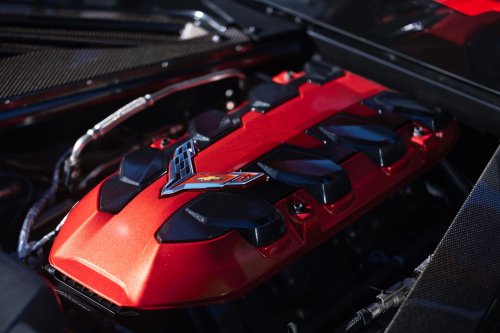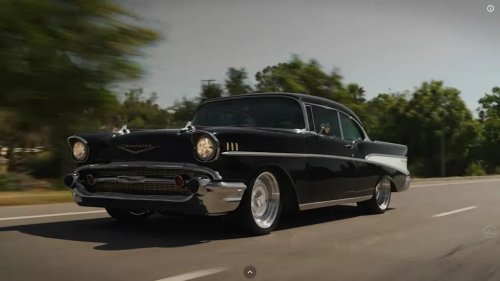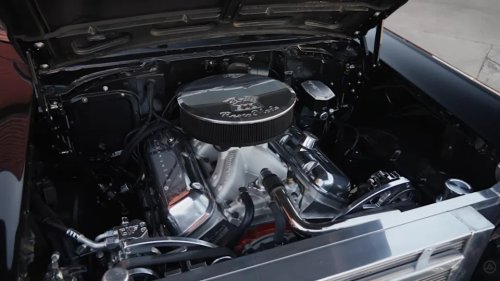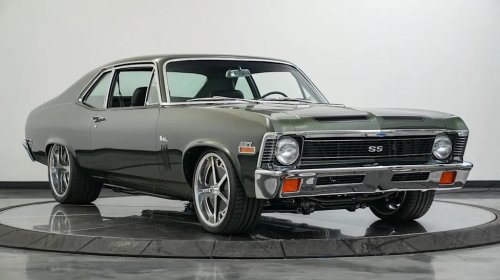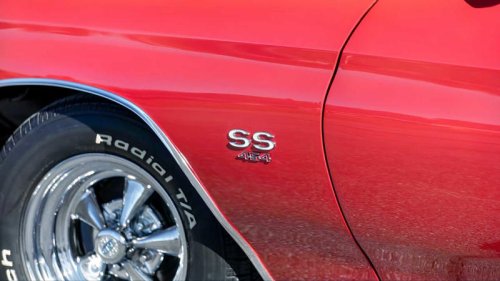
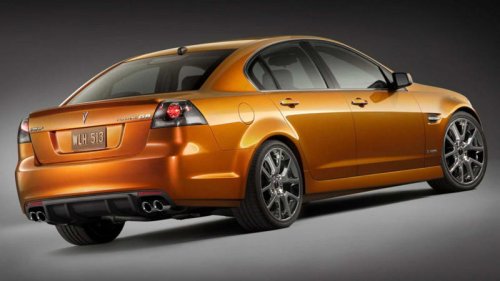
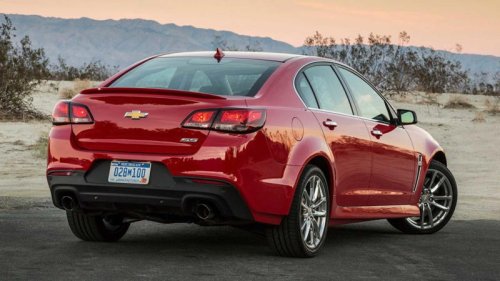
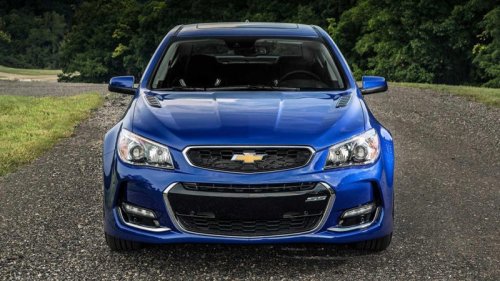



















There's something undeniably cool about sleeper sedans. To many, a car that offers genuine practicality and the sort of looks that wouldn't make bystanders think twice but packs a sports car-slaying punch is as appealing an all-round package as can be.There have been plenty of brilliantly subtle sleepers over the years, but perhaps the coolest in recent memory was a full-size Chevrolet with styling so unassuming that it gave nothing away about the 415 hp V8 beneath its hood. It is undeniably one of the most enthusiast-friendly family haulers of the 21st century, and a car like it will almost certainly never happen again. That's thanks to the unusual manufacturing situation because, like very few other cars sold outside a certain part of the world, that thunder came from a land down under. A Famous Badge MecumChevrolet's SS badge is one of the most recognizable performance names in the world. Standing for Super Sport, it's a name that first appeared on a racing version of the original Corvette in 1957, before finding its way onto the Impala and Nova in the 1960s, initially as just a cosmetic trim package.It was really its appearance on the Camaro later that decade, when the SS trim represented a distinct high-performance model. The name has come and gone over the years, and can currently be found on the 615 hp performance version of the Blazer EV, but it's almost always been a trim level offered as part of a wider model range.The Chevrolet SS, sold between 2014 and 2017, is the only time SS has been used as a model name within its own right, with the exception of a 2003 concept car. And that's rather apt, because this big four-door bruiser was different to most cars marketed under the Chevrolet badge before and since. Aussie Muscle In The US Pontiac Though it's all but non-existent today, for decades Australia had its own distinct, highly localized car industry, albeit one dominated by two American companies. Ford established its Australian division way back in 1925, while in 1931, General Motors bought local company Holden to get its own foothold in the market.Many of the cars sold by both companies over the years were captive imports, but they did develop their own vehicles to meet the unique needs of Australia and New Zealand. Most famously the Ford Falcon and Holden Commodore full-size sedans and pickup versions of both, known in the local parlance as utes. Over the years, both models got their own performance versions through the companies' Ford Performance Vehicles (FPV) and Holden Special Vehicles (HSV) divisions.While Ford's Aussie-built cars rarely made it outside the Australian and New Zealand markets, GM occasionally used its global presence to sell Australian-built performance cars in other markets, including the US. The first of these was 2004's reborn Pontiac GTO, a rebadged Holden Monaro, which was essentially a coupe version of the Commodore sedan.Pontiac It was followed in 2008 by the Pontiac G8, a rebadge of the Commodore itself. This even nearly spawned a coupe utility version named the G8 ST, based on the Commodore Ute. Unveiled as a concept in 2008 and slated for production, it was ultimately canceled thanks to the decision to kill the Pontiac brand in the wake of GM's financial difficulties at the time.Following Pontiac's shutdown, only law enforcement could initially buy Australian-built cars in the US in the form of the Commodore-based Chevrolet Caprice PPV. That changed in January 2013, when Chevrolet unveiled the SS, the latest, and what would prove to be the last, of GM's Australian-built, American-market models. The SS Arrives ChevroletAs mentioned, the road-going SS was unveiled in January 2013. Although our first hint at the car had actually come a few months earlier, in November 2012. That's because, from 2013, the SS would serve as Chevy's model of choice for the NASCAR Cup Series, replacing the long-running Impala, and it was the racing model we saw first. The road version, however, was unveiled as a 2014 model year car, and came straight out of the gates with a tantalizing spec sheet. Its basis was the then-new 'VF' generation Commodore, based on GM's rear-drive Zeta platform that also underpinned the Camaro.While the Camaro liked to shout about its performance aspirations, though, the SS kept quiet about what hid underneath. It was powered by GM's legendary 6.2-liter LS3 V8, producing 415 hp and 415 lb-ft of torque. Hooked to a standard six-speed automatic, Chevy put the SS's 0-60 mph time at around 5.0 seconds, although some road tests, like Car and Driver's, clocked it at as little as 4.5 seconds. Top speed, meanwhile, was electronically limited to 160 mph.Chevrolet It wasn't just a straight-line hero, though. The platform had a near 50/50 weight distribution, and chassis kit like independent multi-link rear suspension and beefy 14-inch ventilated Brembo front brake discs won the SS praise for its handling, too. Best of all, the SS wasn't ludicrously expensive with an MSRP of $43,475. Although, a Dodge Charger SRT-8 brought 470 hp to the table for very similar money.The SS was never meant to be a high-volume car. Sales were limited to select Chevrolet dealers based on their successes in selling the Camaro and Corvette, but it quickly built up a small but loyal fanbase. Perhaps the only thing that limited its unabashed driver appeal was its auto-only status. But this quickly changed for the 2015 model year, when a six-speed manual became a no-cost option. 2015 also saw the fitment of rear Brembo brakes too, but more transformatively, the arrival of standard-fit Magnetic Ride Control adaptive damping. Reviews at the time praised this for bringing some welcome adaptability in place of the 2014 model's firm passive setup.Chevrolet A facelift for 2016 brought some very minor styling changes to the front and rear fascias. But, more excitingly, a new dual-mode exhaust system to uncork a little more of that unmistakeable LS3 rumble. It remained unchanged into 2017, which would be its final model year. Production wound up that year, and by the spring of 2018, all remaining stock was sold.Figures from GM Authority put overall sales at a modest. But for each of the four full calendar years it was available, sales of the SS steadily grew. So why did Chevrolet kill it? Why It'll Never Happen Again Chevrolet The truth is that the SS was living on borrowed time almost from day one. Australian car manufacturing had been on a trend of steady decline throughout much of the 2000s, and the 2009 financial crisis had put things in an even more precarious position. In December 2013, just months after the SS had gone on sale, GM announced that it would wind down its Australian manufacturing operations by the end of 2017. Ford had made a similar announcement a few months earlier. Holden would live on, but exclusively selling badge-engineered imports.That meant that for almost the entire time the SS was on sale, its impending death was hanging over it, unless GM made the extremely unlikely move to establish a whole new production line somewhere else for what was always a niche model. That obviously didn't happen, and the SS died in 2017, a few months before GM brought an end to its 86-year history of Australian manufacturing.Chevrolet A replacement was unlikely to come along, either. The declining sedan market meant Chevrolet was concentrating harder than ever on SUVs and trucks, with the only sedans left in its range at the time the front-drive Malibu and Impala, both since discontinued. GM has continued building rear-wheel drive performance sedans, but they've come from Cadillac and competed at more premium ends of the market.There is a little glimmer of hope for the American performance sedan from more mainstream brands. The Dodge Charger lives on as a four-door, albeit with only electric or turbocharged straight-six power, for now. Meanwhile, rumors have been gathering pace around a potential sedan spinoff of the Ford Mustang, with Ford CEO Jim Farley recently affirming his view that a sizable sedan market still exists.Most promisingly, GM is working on a new sedan platform to underpin a replacement for the Cadillac CT5. Maybe these developments will one day spur GM on to develop a spiritual successor to the SS, but if it ever does happen, it certainly won't have the uniquely Australian roots that made the original so special.Sources: Chevrolet, Car & Driver, GM Authority