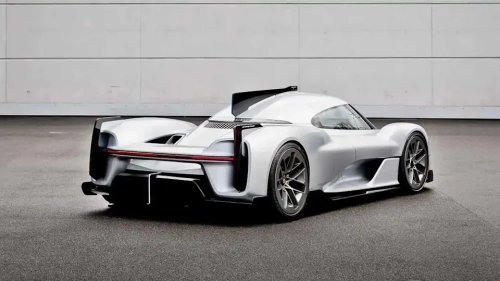
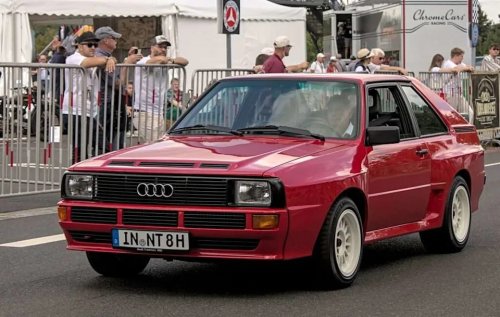
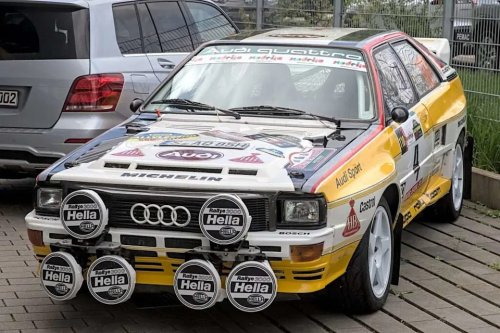
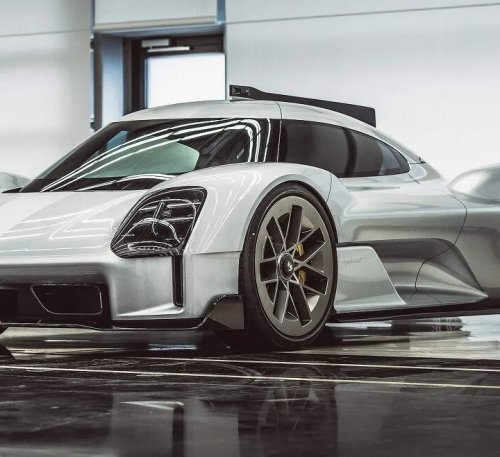
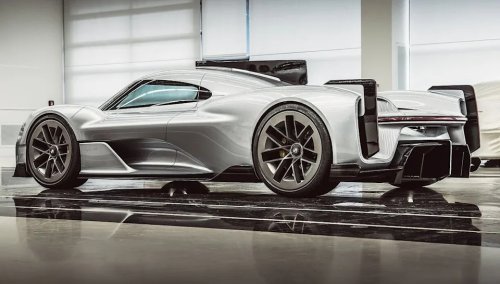
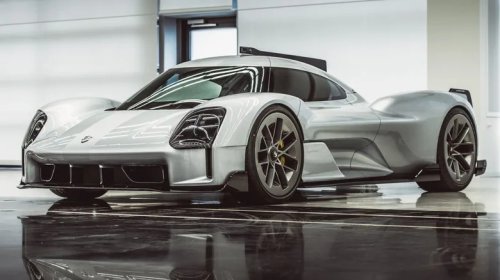
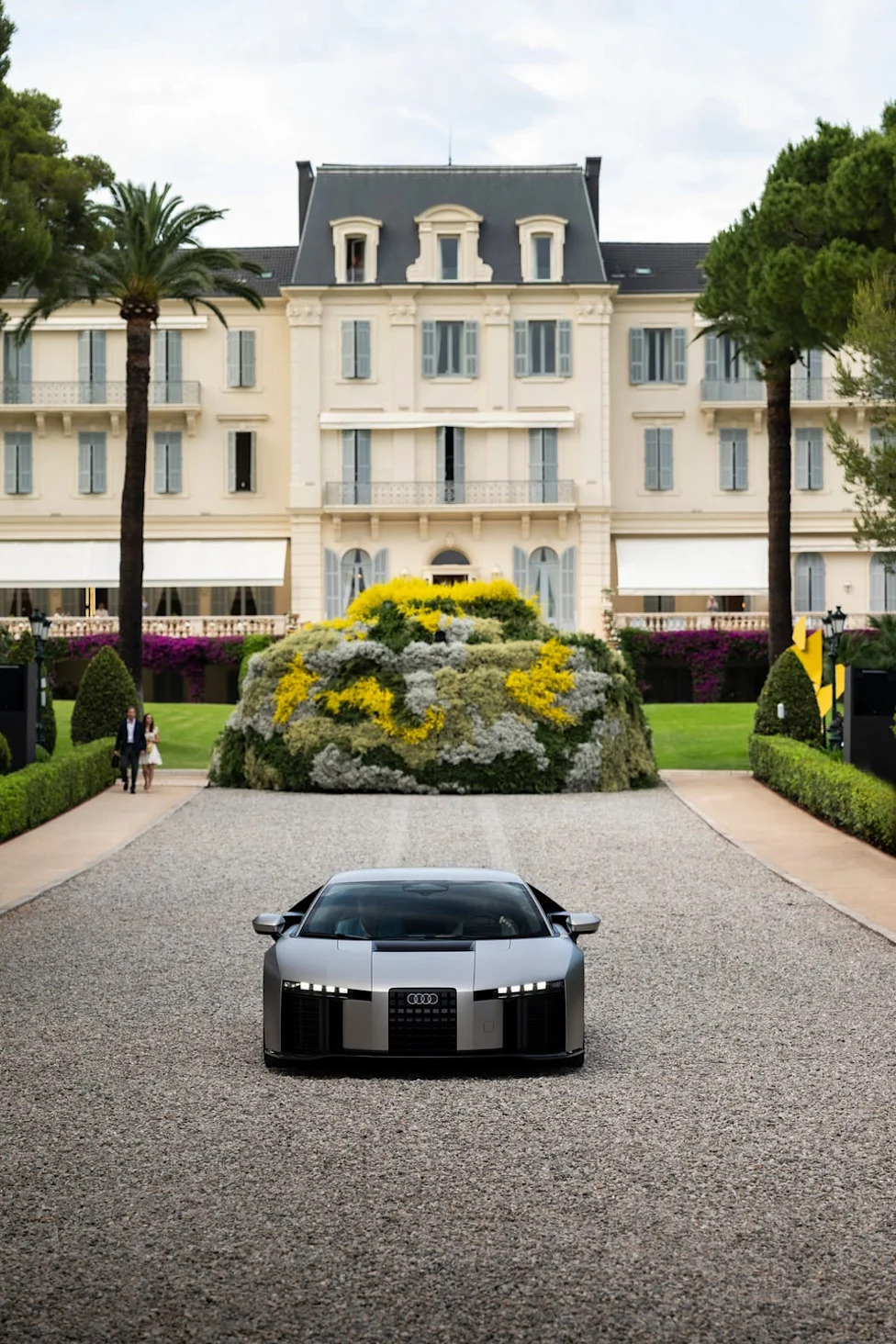
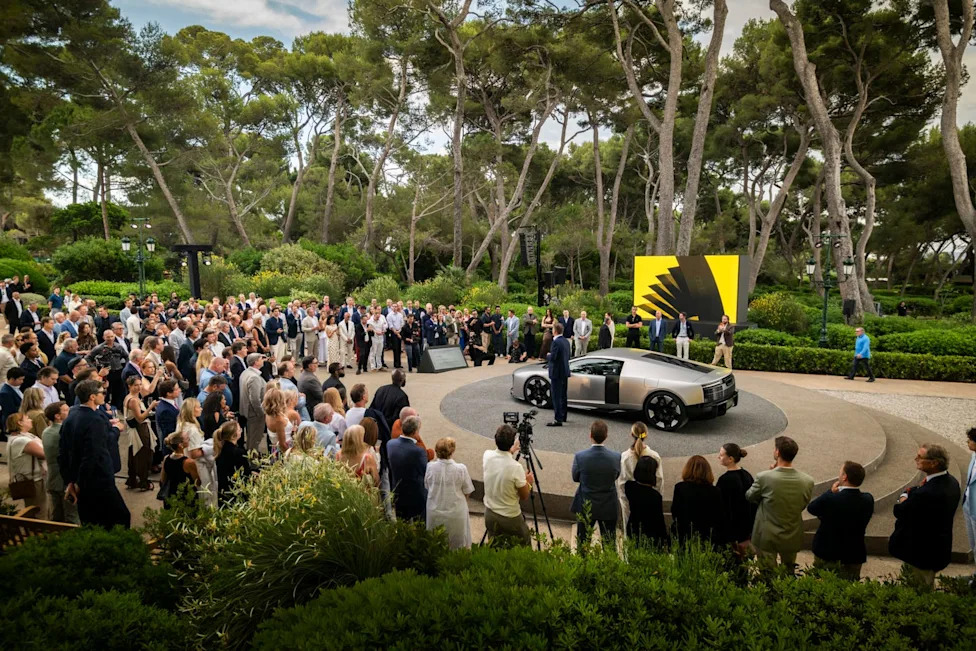
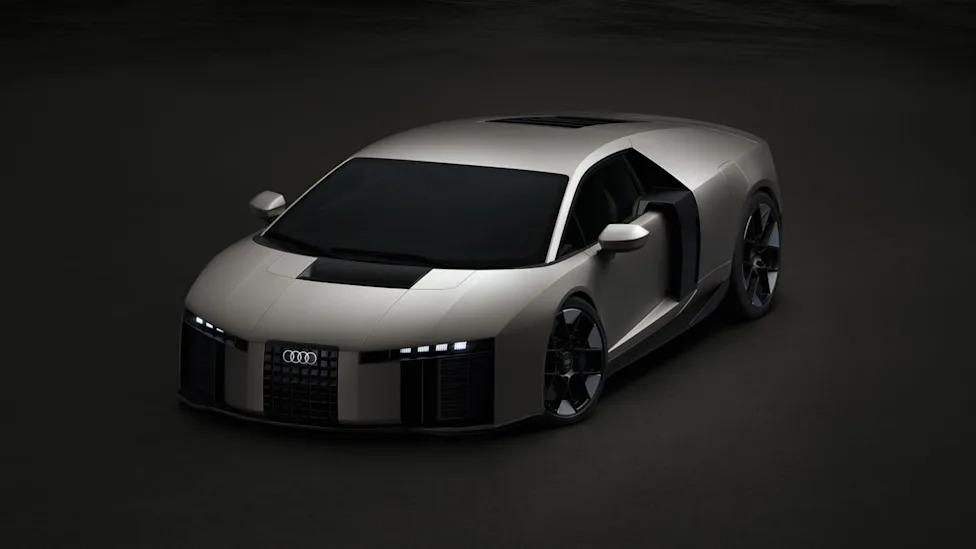
Audi Latest Supercar Reminds Me Why I Love CarsTobias Sagmeister (Tobias Sagmeister)There's no other place on earth that holds cultural, plutocratic, and motorsport influence quite like the French Riviera. For a century, this strip of Mediterranean coast has been the epicenter of exquisite design and unadulterated hedonism. It's where Christian Dior, Elsa Schiaparelli, Jeanne Lanvin, and Hubert de Givenchy came to escape; where Slim Aarons snapped poolside photos of high-society; and where drivers like Ayrton Senna, Graham Hill, and Michael Schumacher dominated the streets of Monaco.It was precisely here, days ahead of this year's Monaco Grand Prix and Audi's first official European race on the Formula 1 grid, that the German manufacturer chose to stage a top-secret unveiling of their newest supercar.Set against the backdrop of the Hotel du Cap-Eden-Roc in Antibes, I found myself being ushered down the Grande Allée, the tree-lined pathway that hosted the late Karl Lagerfeld's Chanel Cruise 2011/2012 runway show. About 100 guests were met by a massive, organic structure completely blanketed in fresh flowers. We lined the gravel runway, champagne glasses in hand, as we congregated in hushed anticipation for what would come next. If I were a nail-biter, my cuticles would have been shredded.AdvertisementAdvertisementAs the music swelled, the flowered structure gracefully parted to reveal the all-new Audi Nuvolari supercar. Finished in futuristic matte titanium—a signature hue shared with Audi's Concept C and the F1 F26 race car—the car floated down the runway. Inside, Audi's F1 drivers made their way towards the crowd—Nico Hülkenberg at the wheel, Gabriel Bortoleto in the passenger seat.The Nuvolari arrives at a fascinating inflection point. We're living through a wave of technological burnout. For me, the hype surrounding AI, automation, and hyperconnectivity has curdled into psychological fatigue. Like many others, I'm actively trying to claw my way back to what's real.The new Audi Nuvolari was revealed at the Hotel du Cap-Eden-Roc in Antibes just days before the Monaco F1 Grand Prix.Maximilian Thum (Maximilian Thum)Yet, for the past decade, the automotive industry has spent billions chasing the exact opposite. Due to the adoption of high-tech electrification, cars have become silent, rolling iPads. Legacy automakers have faced harsh consumer blowback, dialing back their ambitions for EVs.When I sat down with Massimo Frascella, Audi's Head of Design, I asked him if the Nuvolari was a direct acknowledgment that the modern luxury car has become a source of cultural anxiety. For Audi, he says, luxury is no longer about what digital clutter can be added, but how much of the noise can be filtered out. It'a a calculated counter-cultural response to an overstimulated society.AdvertisementAdvertisement"There is a certain trajectory developing around technology overload," Frascella says. "It's a race, perhaps, and that is ultimately creating anxiety. The application of our new design philosophy is all about reducing down to what really is essential—to what really matters."This pivot cuts right to the core of Audi's DNA. For decades, the Ingolstadt manufacturer has led with the ethos, Vorsprung durch Technik—a phrase that when translated, falls somewhere between "an edge over the competition through engineering" and "a head start through technology." It has always been a declaration that Audi intends to leapfrog everyone else by their clever innovations in engineering.Historically, Audi's brute-force engineering has resulted in some of the most visceral experiences in motorsport history. Take the 1980s Group B rally era. The brutalist, Bauhaus silhouettes of the Sport Quattro—piloted by icons like Michèle Mouton and Fabrizia Pons—developed a winning pedigree and instant cultural icon status.The Nuvolari has a semi-brutalist, neo-futuristic architectural identity.Audi (Audi)"We see Audi as a beautiful balance of the highly technical and the deeply emotional," Frascella says, anchoring the car's design philosophy to its ancestors. "It is probably the one brand that can be incredibly rational and irrational at the same time."AdvertisementAdvertisementThe Nuvolari name itself draws heavily from this exact intersection of rational engineering and irrational courage. It channels the spirit of Tazio Nuvolari, the legendary Italian driver who piloted the terrifying, mid-engined "Silver Arrows" that dominated European Grand Prix racing in the 1930s. Nuvolari was a man remembered for a single-minded, borderline-insane will to win—once finishing a race sitting on a bundle of fruit because his seat had disintegrated.That mechanical soul is anchored directly to how the car is built. For over thirty years, Audi constructed its high-performance frames out of aluminum. For the Nuvolari, they used the exact same methods used to build a F1 chassis. Audi fused the traditional metal core with stiff, lightweight carbon-fiber in order to shed massive amounts of weight while maintaining the vehicle's structural integrity.This lightweight skin works in lockstep with a predictive all-wheel-drive system that monitors the road in real-time, instantly stiffening suspension or redistributing power to whichever tire has the most grip. And then, if you have the opportunity to push past triple digits on the speedometer, the Nuvolari's active aerodynamics deploy a rear wing that downshifts drag on long straightaways or acts as a high-force air brake in corners—just like the driver-controlled mechanism used in F1.But the real pièce de résistance is the hybrid powerplant: a 4.0-liter V8 biturbo engine producing 800 horsepower on its own. When paired with three high-output electric motors, it delivers a staggering combined 987 horsepower. While the engine is a direct derivative of the Lamborghini Temerario, Audi has recalibrated the hybrid architecture specifically for the Nuvolari—allowing drivers to reach a staggering 10,000-rpm redline, a mechanical sensory experience previously reserved strictly for motorsports.AdvertisementAdvertisementBut what is genuinely mind-boggling is how fast this car went from idea to asphalt. Historically, the technology trickle-down loop from F1 to a road-legal production car could take anywhere from five to ten years. Audi managed to do it in just over twelve months.Frascella admits that the turnaround was breakneck. From a blank sheet of paper in March of last year to a full-scale clay model by June, the development curve was vertical. It was an exercise in striking the right balance in the triangle of speed, quality, and execution which ultimately served as evidence that it's possible to bypass traditional, years-long bottlenecks in R&D.Seeing the Nuvolari for the first time reminded me exactly why I fell in love with cars in the first place. It is a shot of raw, physical theatre and pure emotion. It's exactly what the modern automotive industry has spent a decade trying to hide beneath layers of sterile touchscreens and manufactured exhaust sounds.Frascella clarifies that the Nuvolari is not a reactionary love letter to a dying era. Audi isn't abandoning its electrification roadmap. But they are acknowledging the reality that the EV transition is moving at a more deliberate pace than predicted. The critical takeaway? Powertrain selection, he argues, must serve the character of the vehicle.AdvertisementAdvertisement"We don't see electrification as the right powertrain choice for this supercar—a vehicle that encompasses all of these specific values for us. So, internal combustion is perfect."Outside, the Nuvolari has a semi-brutalist, neo-futuristic architectural identity. The styling integrates hidden air intakes to cool the high-performance powertrain. It uses Audi's first-ever factory-produced forged-aluminum center-lock wheels—another design borrowed from F1 that replaces traditional lug nuts with a single, ultra-strong central racing nut. Inside, the cabin is a lesson in radical minimalism. The steering wheel features tactile, physical buttons, no haptic touch sliders. The rearview mirror is a digital video screen, because there is no rear window. The center console is completely uncompromising—zero cupholders. It is a driver's car.The supercar isn't just a concept either; it will have a hyper-limited production run. Only 499 units will be built worldwide with a base price of roughly $686,000.Frascella only joined Audi two years ago, meaning the Nuvolari stands as his opening salvo, the halo car meant to anchor an entire brand overhaul under his direction. If this is just the baseline of his vision, Audi next era will be something special.AdvertisementAdvertisement"I can't tell you exactly where we are going to go next, of course," Frascella says with a subtle smile. "But I can say that this is literally just the beginning. I hope that one day we look back at this era as a historic time for the brand. In a way, today is already history."You Might Also Like11 Hard Jigsaw Puzzles for Adults16 Things Esquire Editors Always Buy on Amazon100 Photos of Celebrities Partying in the '70s



















 +14 others