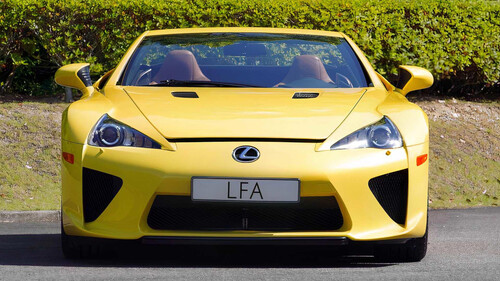
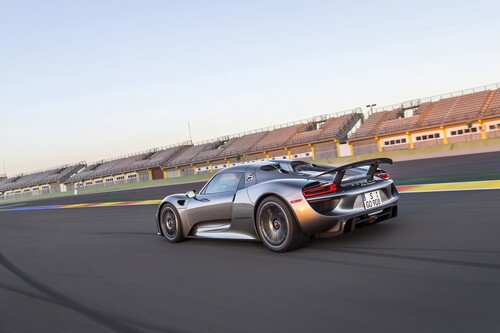
A 72-Mile Lexus LFA Nürburgring Package Shows How Far Japan's Supercar Has ComeA 2012 Lexus LFA Nürburgring Package has surfaced for private sale through Broad Arrow Private Sales carrying just 72 miles on its odometer — 23 of which were logged during its pre-delivery inspection at Toyota's Motomachi quality control facility in Japan. In the fourteen years since, across three owners and two states, the car has covered barely enough distance to reach the end of a long driveway a few dozen times over.That detail is worth sitting with longer than any number Broad Arrow eventually attaches to the sale, which for now is listed simply as price available upon request. The Nürburgring Package was engineered to be driven near its 9,000-rpm redline on the circuit it's named for. This particular example has instead spent a decade and a half in careful stillness, first in California, then Ohio, now Arizona. The paradox is the real headline: a car built for the world's most demanding racetrack has become too historically important, in the eyes of its caretakers, to risk turning a wheel.A Supercar Built to Prove a PointThe LFA exists because Akio Toyoda, then chief executive of Toyota, wanted proof that his company could hand-build a car capable of standing beside anything coming out of Stuttgart or Maranello. After a nine-year development program, Lexus unveiled the finished car at the 2009 Tokyo Motor Show: a carbon-fiber monocoque wrapped around aluminum subframes, double-wishbone front suspension, a multi-link rear end, and a 4.8-liter, 40-valve V10 — codenamed 1LR-GUE — co-developed with Yamaha using knowledge from Toyota's abandoned Formula 1 program. The engine was small enough to rival a V8 in size yet light enough to rival a V6 in weight, with a dry-sump design that let engineers mount it lower in the chassis and forged titanium connecting rods that gave it a throttle response closer to a race engine than a road car's.AdvertisementAdvertisementLexus built exactly 500 examples before ending production, and has not fielded a direct successor since, though the LFR now completing final testing suggests that may soon change.The Nürburgring Package That Made the Car WholeOf those 500 cars, only 64 were built to Nürburgring Package specification, and just 25 came to the United States. The $70,000 option wasn't a cosmetic upgrade. It cut roughly 200 pounds from the car, added a fixed carbon-fiber rear wing, a front splitter, and turning vanes, sharpened the six-speed automated sequential gearbox's shift times, and raised output to 563 horsepower. The name itself commemorates the LFA's class wins at the Nürburgring 24 Hours between 2008 and 2010, the same circuit where a Nürburgring Package car lapped the Nordschleife in 7 minutes, 14.64 seconds in August 2011, a production-car record that stood for nearly three years until the Porsche 918 Spyder took it down.That is what separates the Nürburgring Package from an appearance package on a sales sheet: it is tied to an actual competition record set by the actual specification being sold, not a marketing story invented after the fact.The Paper Trail That Makes It Investment-GradeThis is LFA number 488 of 500, chassis JTHHX8BH8C1000485, finished in Whitest White over red-and-white leather and riding on BBS Forged Graphite wheels — one of only a handful of U.S. Nürburgring cars delivered in that color. Its original window sticker shows the $70,000 package plus an additional $70,500 for its Nürburgring serial plate, pushing total options past $141,000 and the all-in sticker price to roughly $522,000, among the highest-optioned Nürburgring builds on record.AdvertisementAdvertisementIts ownership history is short and clean: delivered new through Lexus of Riverside in California, sold to its first owner in January 2013, transferred to a second owner in Ohio in August 2017, and placed in the care of its current Arizona-based owner in February 2019. A clean CARFAX backs up a documentation file that includes the original owner's manuals, delivery certificate, first-aid kit, branded car cover, all three keys, and the framed window sticker, the kind of complete factory kit that rarely survives intact on a car this specialized.None of that paperwork makes the car valuable by itself. What it does is remove doubt. In a market still learning how to underwrite modern Japanese exotics the way it has underwritten Ferraris and Porsches for decades, a fully documented, single-purpose chassis with an unbroken ownership record is what allows a serious buyer to pay a premium with confidence instead of hope.What the Last Comparable Sale Actually Tells UsIn 2023, an LFA Nürburgring Package carrying roughly double this car's mileage sold at auction for $1.875 million, more than triple its original as-optioned sticker price. A similarly preserved example, a Fresh Green LFA with just 840 miles, changed hands through DK Engineering around the same time, underscoring how many ultra-low-mileage LFAs are only now reaching the market as first and second owners let go. That result matters less as a price target for this example than as evidence of how completely the market's opinion of the LFA has turned. Lexus dealers reportedly struggled to sell these cars near sticker when they were new; the marque simply had no performance-car reputation to lean on. Fourteen years later, the LFA is treated as one of the defining engineering statements of its generation, and the Nürburgring Package, once just the expensive option box, is now understood as the version that matters most.That a car this significant is being shopped as a private sale rather than run across an auction stage is itself instructive. Private treaty sales let a seller find the single right buyer for an irreplaceable car without setting a public price that becomes the market's new floor or ceiling. For an example this documented, that discretion is a feature, not a limitation.The Real Signal for CollectorsThe LFA's rehabilitation tracks closely with a broader change in who is buying at the top of the collector market, buyers who came of age idolizing Japanese performance cars and now have the capital to pursue them at the same level once reserved for European icons. It also tracks with strengthening interest in Japan's other period performance cars, from a rare 1997 Toyota Supra Turbo 15th Anniversary Edition that surfaced with under 19,000 miles to Lamborghini's own recent lesson in how fast a limited-run halo car can outgrow its original price, in the case of the Sián FKP 37.AdvertisementAdvertisementThe LFA was never meant to be a vault piece. Toyota built it to be driven hard, on the one circuit that could prove it belonged next to Ferrari and Porsche. That a numbers-matching example with its full factory kit intact has instead spent fourteen years barely leaving the garage says little about neglect and everything about how seriously today's collectors now take the car Toyota built to change their minds.Join our Newsletter, follow our Instagram page, and follow us on Facebook.