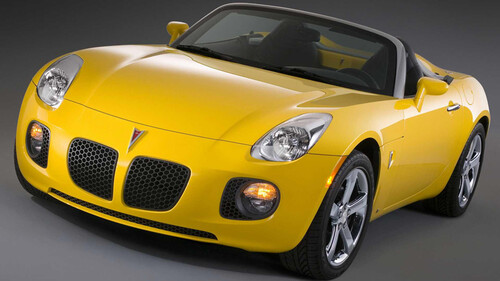
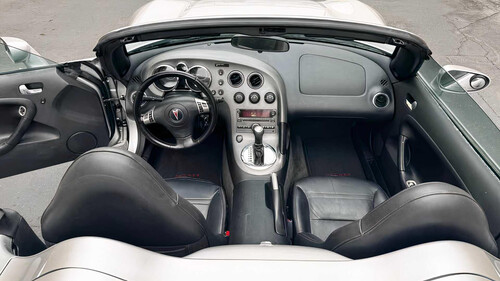
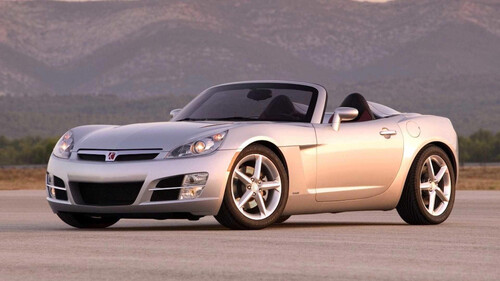
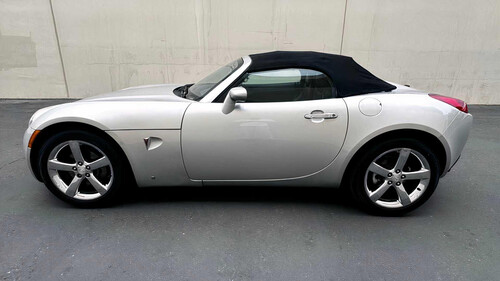
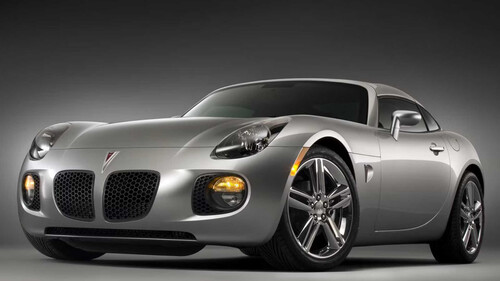
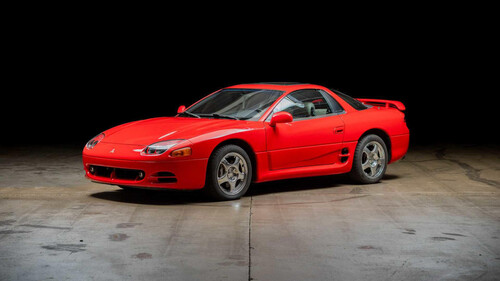
9 American Sports Cars That Aren't CorvettesRyan Lugo - MotorTrend (Ryan Lugo - MotorTrend)So you want to buy a classic sports car, but you really don't want to buy a Corvette? Fortunately, there are a bunch of fun-to-drive American sports cars that will keep you from having to buy stock in New Balance and polish up your set of gold chains, as long as you're willing to step outside the standard muscle car fare associated with Detroit and take a risk on models that dare to be different from the traditional born-in-the-USA performance mold.Here are our nine favorite classic made-in-America sports cars that are absolutely, positively, not Corvettes, but which will still get you from one apex to the next with a grin on your face.Additional photography by Getty Images1) 1955–1957 Ford ThunderbirdPhoto credit: MotorTrendThe Corvette gets so much focus as the progenitor of the first American sports car push that it's easy to forget those early C1 models were sold with a six-cylinder engine and an automatic transmission. By the time a V-8 made it under the hood of the 'Vette, Ford was ready with the Thunderbird, which went on sale as a 1955 model with an eight-cylinder engine of its own.AdvertisementAdvertisementStylistically similar to the Chevy, the T-Bird offered a compact roadster package, just under 200 horsepower from its Y-block engine, and a three-speed manual gearbox (beating the Corvette to the clutch by several months). Although more sedate than its crosstown rival, all of the sports car elements are there, and the first-generation Thunderbird marked by far the purest driving experience then on offer from the badge.2) 1968–1970 AMC AMXPhoto credit: MotorTrendSome might dispute the AMX's inclusion on this list of classic American sports cars, pointing to its muscle car heritage (the coupe rides on a truncated version of the AMC Javelin's frame). That decision to differentiate the AMX from its Javelin sibling, however, is enough to push it into the sports car camp, for several reasons.The first is that it's the only '60s/'70s American performance machine other than the same-era Corvette to adopt a two-seat setup, as its shortened wheelbase no longer had the room for anything other than a few overnight bags behind the front buckets. Then there's the fact that the AMX offered significant speed from a gaggle of V-8 engines, with power peaking at well over 300 ponies (and 420 lb-ft of torque), more than enough to motivate the modestly sized two-door.Finally, the AMX was used as the testbed for several very cool American Motors sports car prototypes that never made it to market. The first was the AMX-R, which came with a "ramble" seat that folded out of the trunk, offering passengers a novel way to make road pizza. The second was the AMX/3, a mid-engine marvel that was canceled due to spiraling development costs after just five prototypes were built. That AMC saw enough of a future in the AMX's sports car potential to make it the backbone of these efforts is a strong vote of confidence in its bona fides.3) 1995–1998 Eagle Talon TSiPhoto credit: Bring a TrailerYes, we're well aware that the Eagle Talon TSi borrows most of its mechanical bits from the Mitsubishi-designed Eclipse. However, it's wearing an American badge—and it happens to have been built in the United States at the same Normal, Illinois, plant where the Eclipse and the Plymouth Laser were produced. (Rivians are built in that facility today.) Not only that, but all three of these cars technically ride on Chrysler's D platform, an evolution of, not a direct match for, the underpinnings of the Mitsubishi Galant sedan.AdvertisementAdvertisementConfused by all of that mixed DNA? We don't blame you. Let's just focus on what makes the second-generation (or 2G) Eagle Talon TSi such an appealing classic American sports car. There's no denying the appeal of its curvy, '90s-informed sheetmetal, capped off by the power bulge on its hood that hints at the 210 horsepower and 214 lb-ft of torque lurking in its turbocharged four-cylinder engine. Even better? With the right aftermarket support, it's possible to coax much more than that from its 2.0 liters of displacement, with a standard all-wheel-drive system delivering the grip required to keep the Eagle's talons hooked into the asphalt.4) 1996–2002 Dodge ViperPhoto credit: MotorTrendWhile the early Dodge Viper remains an icon, by the time the second iteration of the sports car arrived in 1996 its engineers and designers had had the chance to fully develop the platform. This included a legitimate removable roof with glass windows for the RT/10 roadster, a fixed-roof coupe GTS model (with "double bubbles" molded into the roof to help accommodate helmets), and a healthy weight reduction thanks to the increased use of aluminum. The Viper's bite also increased substantially in this period, with its 8.0-liter V-10 now rated at 450 horsepower and 490 lb-ft of torque.The Dodge Viper walks a fascinating line between modern reliability and muscle, with classic, seat-of-the-pants driving dynamics that require absolute attention given the lack of digital safety nets such as traction or stability control. Despite ostensibly being marketed to a similar customer, the Viper is in many ways the anti-Corvette and stood as the Chevy's most direct antagonist throughout its decades of production.5) 1992–1999 Panoz Roadster/AIVPhoto credit: MotorTrendThe Plymouth Prowler gets most of the press covering 1990s open-wheel roadsters, but anyone seeking actual performance from their throwback American sports car would do better to seek out the Panoz Roadster.AdvertisementAdvertisementArriving in 1992, this low-production machine was far from practical. You won't find a top, a radio, or even climate controls with the Panoz (other than a federally mandated blower for the windshield defroster). What you will discover is a small-block V-8 under the hood, matched with a five-speed manual gearbox.The second-run Panoz cars (dubbed the AIV for Aluminum Intensive Vehicle) borrowed its motivation from the Ford Mustang Cobra, giving it 305 horsepower and 300 lb-ft of torque from a 32-valve, 4.6-liter engine. With just under 2,600 pounds to motivate, these cars are both a handful in a straight line and surprisingly sublime in the corners.6) 2000–2007 Panoz EsperantePhoto credit: Bring a TrailerPerhaps realizing that not all sports car fans are cool with taking a bath every time it rains, Panoz produced a more genteel performance vehicle as a successor to the Roadster/AIV. The Esperante featured swooping bodywork, was sized to be not much bigger than a Mazda Miata, and was offered in multiple editions depending on how potent a buyer's budget could afford the car to be.The Esperante was considerably heavier than the Roadster, checking in at 3,200 pounds (roughly the same weight as the C5-generation Corvette on sale at the time), but it made use of the same powerplant in base models. A supercharged, 420-hp version was also available.AdvertisementAdvertisementThose Mustang drivetrain similarities aren't the only ties the Esperante has to the pony car. The convertible also made use of the firewall, cowl, windshield, and independent rear suspension offered by the SVT Cobra of its period, which was matched to a modular chassis that was specifically designed for inexpensive production.7) 2000–Present Factory Five Type 65 CoupePhoto credit: Factory FiveFactory Five got its start building Cobra replicas, either in kit or turnkey form. Its Type 65 Coupe, however, served to distance it from other, similar Cobra-kit companies by providing sports car fans with the chance to drive home in one of the most gorgeous shapes ever to grace a track.Modeled after the Shelby Daytona race car of the 1960s (of which only six were ever built), the Factory Five Type 65 has gone through three generations of development to this point. The original edition made its debut in 2000 and immediately made waves with its ability to sprint to 60 mph in just 3.6 seconds. Capable of accommodating a range of different drivetrains and offering owners the chance to get their hands dirty and assemble the vehicle themselves in their garage if they truly want to, the Type 65 is a unique take on the classic American sports car formula.Factory Five cars are like the ultimate Lego kit if you're an experienced wrench, and the best part is, everything is new and clean, so you can literally assemble one in the middle of an office, like we did for MotorTrend's 75th anniversary (pictured, above).8) 2006–2009 Cadillac XLR-VPhoto credit: MotorTrendLike the first Thunderbird at the beginning of this list, the Cadillac XLR walks the line between American sports car and grand tourer. Still, it's built on the same platform as the C6 Corvette, which means it has the right bones to serve as an alternative to the Chevy for buyers who need a fancier badge than what the Bow Tie can provide.AdvertisementAdvertisementThe XLR is at its most interesting as a V model. Featuring a magnetorheological ride control suspension and a supercharged, 4.4-liter Northstar V-8, the XLR-V packed 443 horsepower and 414 lb-ft of torque, enough to at least keep up with a contemporary Corvette. Its power-retractable hard top also gives it a further sheen of comfort and daily practicality not available with its platform mate, but of all the sports cars on this list, it's the only one that forces you to accept an automatic gearbox.9) 2006–2010 Pontiac Solstice GXP/Saturn Sky RedlinePhoto credit: MotorTrendIn the mid-2000s, General Motors made the surprising decision to build a pair of sporty roadsters. The Pontiac Solstice GXP and Saturn Sky Redline featured notably differentiated bodywork, but underneath their styling they delivered the same 260 horsepower and 260 lb-ft of torque from a turbocharged, 2.0-liter four-cylinder engine, sent to the rear wheels via six-speed manual gearbox (or an optional automatic). Both Pontiac and Saturn also had access to a factory tuning program that could upgrade output to 290 horsepower and 340 lb-ft of torque (325 with an automatic transmission) through something called the GMPP package.The cars were quick and fun but asked owners to deal with more than a few compromises, including a near total lack of storage space. A coupe version of the Solstice followed a few years into its production run but was almost immediately discontinued when GM's bankruptcy at the end of the decade sent both Pontiac and Saturn to the graveyard, taking their compact sports cars with them.