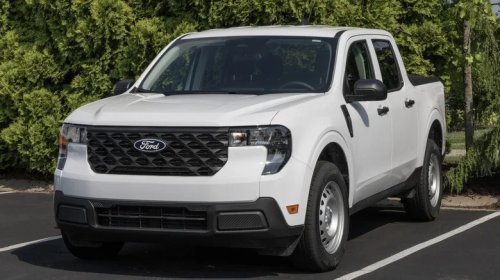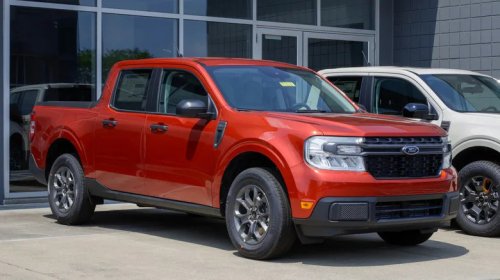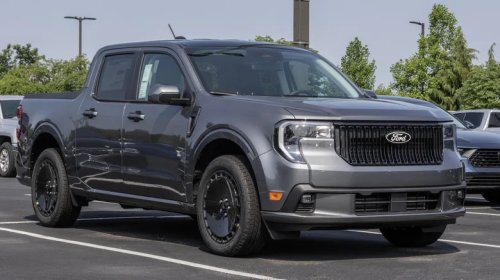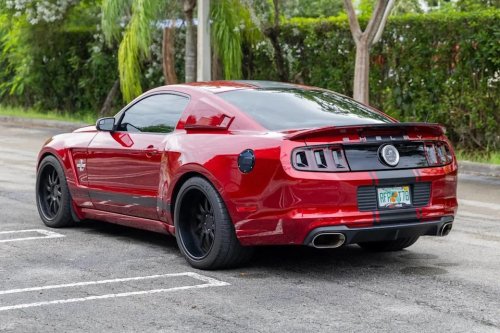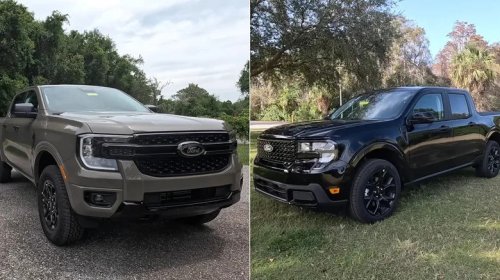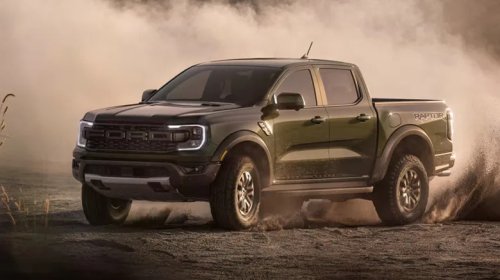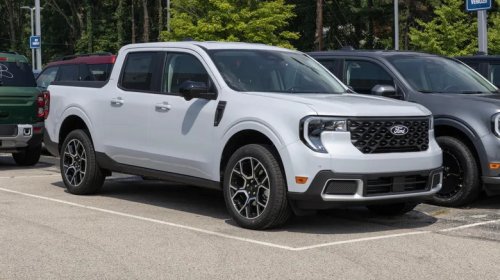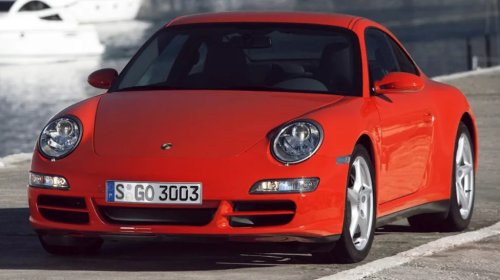
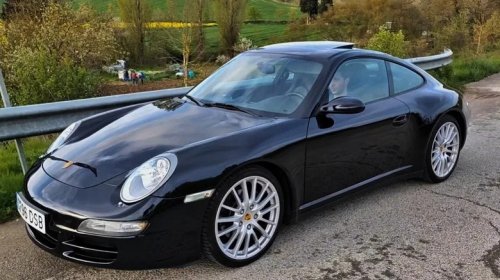
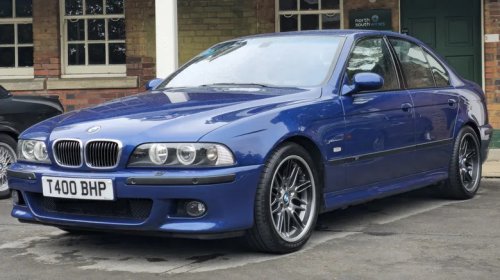
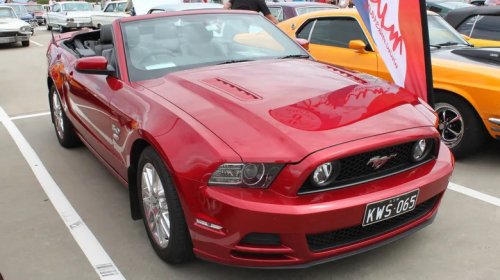
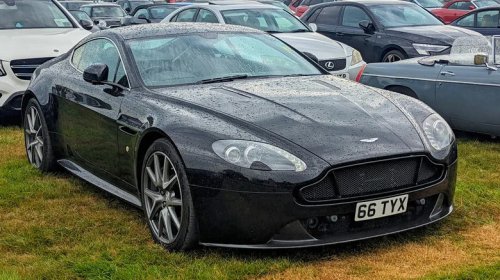
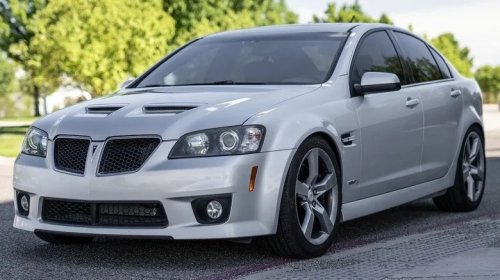



















Porsche Add Jalopnik on Google: Google Discover This year has already been one of the most exciting yet for affordable pickup truck shoppers. Slate Auto has opened U.S. order books for America's cheapest EV pickup truck, and Ford's similarly low-priced Fathom electric pickup is pencilled in to arrive in 2027, ahead of the 2028 model year. With the midsize electric truck still months away, much is still under wraps in terms of its specifications and the features buyers will get. However, we do know that it will sit on Ford's own Universal Electric Vehicle platform and has a set 0-60 mph target of 4.5 seconds, which should make it a massive 3.5 seconds quicker than the 2027 Slate Pickup if realized. But the small EV isn't the only one that's potentially at risk of getting left in the dust by the Blue Oval's new Fathom pickup. Doing 0-60 mph in 4.5 seconds means that the Ford Fathom will also be brisker than many performance cars we once considered crazy fast, like the legendary E39 BMW M5, 2012 Aston Martin V8 Vantage, 2009 Pontiac G8 GXP, 997-generation Porsche 911 Carrera 4 Coupe, and 2013 Ford Mustang GT 5.0 Convertible. We've put them in order below, starting with the slowest. 2006 Porsche 911 Carrera 4 Coupe | 0-60 mph in 4.9 seconds NOR Classics/YouTube The 997 Porsche 911 remains forever etched in the memory of drivers, largely thanks to a facelift that reintroduced the rounded headlight design. The previous-generation 996 used the "fried egg" headlights, which continue to divide opinions, with some claiming that it is Porsche's best headlights and others still feeling affronted by it. But beyond its attractive styling, the 997 was every bit as competent as you would imagine. It was so impressive, in fact, that Jalopnik made a case for it being the best Porsche 911 generation so far. Of course, a big part of the appeal of the 911 is its sharp handling and exhilarating performance. At the heart of the 997 Carrera 4 was the 3.6-liter water-cooled horizontally opposed flat-six engine, which produced 325 horsepower and 273 lb-ft of torque, allowing the four-seater coupe to sprint to 60 mph in a manufacturer-estimated 4.9 seconds, with top speed arriving at 174 mph. Opting for the available Tiptronic S automatic transmission (instead of the six-speed manual) raises the 0-60 time to 5.3 ticks while lowering the top speed to 171 mph. A manual-equipped 997 Carrera 4 Convertible similarly gets from 0-60 mph in 5.3 seconds. Both body styles are predominantly rear-wheel driven under normal driving conditions, with only 5% of the engine's punch making its way to the front wheels. However, all-wheel drive system can put up to 40% of power to the front wheels if it detects rear-wheel slip. E39 BMW M5 | 0-60 mph in 4.8 seconds Calreyn88/Wikimedia Commons Perhaps not quite the most standout BMW, but the E39 M5 is the godfather of sport sedans and almost certainly one of BMW's truly great models. This was the first M car to be fitted with an eight-cylinder engine — a naturally aspirated 4.9-liter S62 V8 engine shared with the gorgeous Z8 two-door roadster that was built to celebrate the BMW 507 of the late 1950s. At its peak, the enthusiastic engine developed 394 horsepower and 369 lb-ft of torque, which was good enough for a 0-60 time of 4.8 seconds, with top speed electronically limited to 155 mph. To fully appreciate these numbers, you have to consider what came before. The E34 M5 had a 3.5-liter S38B36 inline-six that generated 310 hp and 265 lb-ft, with 0-60 happening in a slower 6.4 seconds (the 340-hp, 3.8-liter SB38B38 version never made it stateside). Yet it wasn't just the power output or its lightning-quick acceleration that made the E39 M5 so revered. The blend of rear-wheel drive, well-sorted chassis, and the car's incredible ability to willingly go where it's pointed attracted plenty of praise. 2013 Ford Mustang GT 5.0 Convertible Automatic | 0-60 mph in 4.8 seconds Jeremy/Wikimedia Commons Few modern engines have greater staying power than Ford's 5.0-liter DOHC Coyote V8. The naturally aspirated eight cylinder powerplant was introduced for the 2011 model year, powering everything from the Ford F-150 to the S197-generation Mustang Boss 302, S650 Mustang Dark Horse, as well as the S550 Mustang Bullitt and Mach 1. Beyond these vehicles, the V8 also featured in the S197 Mustang GT, producing 420 horsepower and 390 lb-ft. Thanks to this, the automatic-equipped Convertible could rocket to 60 mph in 4.8 seconds and cover the quarter-mile in 13.3 seconds at 109 mph, per Car and Driver. That makes the GT Convertible about three tenths slower than the Ford Fathom's targeted 4.5-second sprint time. However, opting for the coupe with six-speed manual drops the 2013 GT Mustang's 0-60 figure to 4.5 seconds, as Car and Driver found after it ran a coupe equipped with the Track package — which bundles 3.73 gear ratio and Pirelli P Zero summer tires — as a long-term test car. 2012 Aston Martin V8 Vantage | 0-60 mph in 4.7 seconds Calreyn88/Wikimedia Commons It may have been an entry-level sports car in the British manufacturer's range, but the Aston Martin V8 Vantage was no slouch. After all, this is a car that was conceived as a rival to the Porsche 911. It's got a dry-sump, naturally aspirated, 4.7-liter V8 that produces a very healthy 420 hp and 346 lb-ft, with 0-60 mph coming up in a manufacturer-estimated 4.7 seconds. Even now, that acceleration is impressive, just not quite as rapid as the Ford Fathom's proposed 0-60 mph time. But before you think less of it, the baby Ashton does offer more fiery performance in Vantage S guise, thanks in part to its quick-shifting seven-speed single-clutch automated manual as well as the 10 hp power boost and 15 extra pounds of torque over the standard car. The combination meant that the Aston Martin Vantage S was able to pull a 0-60 time of 4.0 seconds in a test carried out by Car and Driver. Besides being blisteringly rapid, its reputedly well-weighted steering as well as firm but controlled ride are added pluses for the Aston Martin V8 Vantage, as are the luxury amenities. 2009 Pontiac G8 GXP | 0-60 mph in 4.6 seconds Exotic Car Trader Automotive Marketplace/YouTube One of the best sports sedans of all time, the Pontiac G8 GXP began life in Australia as the Commodore VE but eventually became a fitting swansong for the now-deceased GM brand. It was equipped with a Corvette-derived, all-aluminum 6.2-liter LS3 V8 that sent 415 horsepower and 415 lb-ft of torque to the rear wheels via either a Tremec TR-6060 six-speed manual transmission or Hydra-Matic 6L80-E automatic. The rear axles on the models equipped with the manual transmission are fitted with 3.70 gears, while automatic-equipped Pontiac G8 GXPs came with 3.27 gears. With that much power on tap, the Pontiac G8 GXP bagged the title of the most powerful production vehicle to wear a Pontiac badge, making it capable of 0-60 mph in 4.6 seconds and an electronically limited top speed of 155 mph. To deal with the G8 GXP's potency, Pontiac equipped it with high-performance Brembo front brakes with four-piston calipers and 14-inch vented rotors. In its road test, Car and Driver found that the brakes could haul the G8 GXP down from 70 mph in 156 feet.