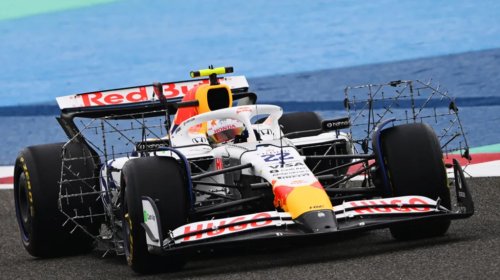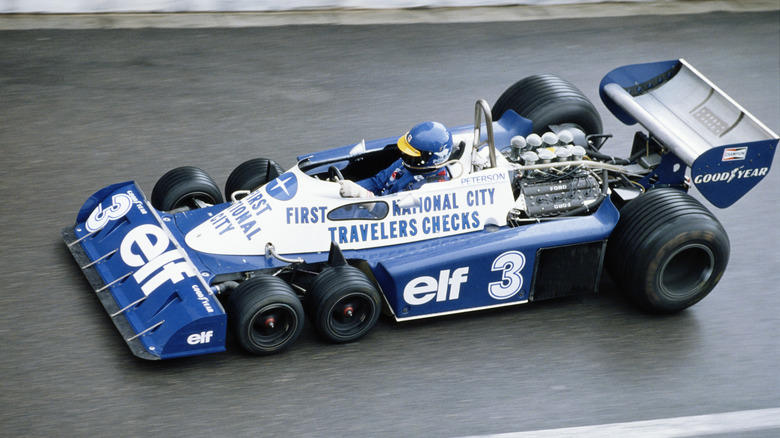
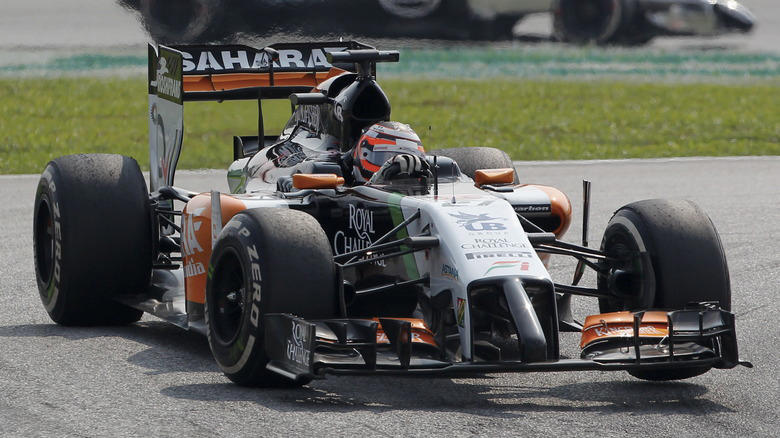



















Tyrrell P34One of the most famous unusual F1 car designs debuted at the 1976 Spanish Grand Prix and immediately turned heads. Rather than the conventional four-wheel design, the Tyrrell P34 featured two pairs of small wheels at the front of the car and a larger pair at the rear. The idea was conceived by designer Derek Gardner, who realized that having four wheels at the front of the car would result in superior front-end grip, which meant that less downforce-inducing aerodynamics would be needed. That effectively gave the car the equivalent of about a 40-horsepower boost compared to its rivals, although the design wasn't without its skeptics or faults. British racing legend Jackie Stewart reportedly choked on his drink when Gardner showed him plans for the car, and braking performance was an issue throughout the P34's competition history. The unique design also meant that Tyrrell had to petition Goodyear to make smaller front tires specially for the car. Tyrrell unveiled the P34 for the fourth race of the season at Jarama, where Patrick Depailler qualified third but completed just 25 of 75 laps due to brake issues. Two weeks later, his teammate Jody Sheckter drove the car to a fourth-place finish in Belgium, and the next two races saw the two Tyrrell cars finish second and third at Monaco and one-two in Sweden. It might have been an innovative design, and a successful one at that, but the P34 was not a good looking car. Its six wheels and stubby nose — combined with the portholes in the side of the cockpit so that the driver could see the front wheels — all looked ungainly even by '70s F1 standards.Force India VJM07New rules for the 2014 season saw the maximum allowed nose height lowered significantly from previous seasons, and that left teams scrambling to find a way to meet the new requirements. The result was that many teams fitted a proboscis nose that extended from the front of the car and dipped down so that its end met the new limit. All teams competing in the 2014 season struggled to incorporate the new design requirements to some degree, but a few cars ended up looking worse than others.The Force India VJM07 is arguably one of the worst interpretations of the nose height rule, with the team almost completely redesigning the car from the previous year. The team's livery that season didn't do much to hide the new, ugly nose, instead leaving it as a prominent narrow black appendage that stuck out from the white and orange finish applied to the rest of the front end. Force India's car was far from the only ugly design that season, with the Caterham CT05 also sporting a similarly conspicuous nose appendage in response to the revised regulations.