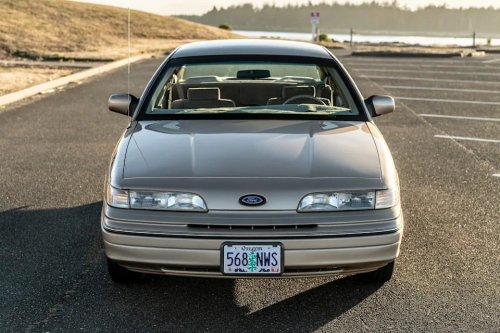




















Ford FairmontWhile the Granada was Ford's first half-hearted attempt at European-izing their lineup, it was only the precursor to something more substantial. Just three years after the introduction of the Ford Granada, Ford rolled out the Ford Fairmont, which was built on an entirely new platform. The Fox platform, as it would later be known, was developed to create a new foundation for small cars that utilized more modern technology compared to the outdated chassis of the 1960s. The Fairmont was the first model to use the architecture, which would eventually underpin countless other Ford models all the way through the mid-1990s. The ultimate goal of the Ford Fairmont was to create a light, simple, and practical car that could get you from A to B consistently. That's it. Everything about it was stripped back to basics, from its no-frills dashboard to its brick-like styling. It was a genuine effort by Ford to disconnect from tacky posturing and provide something with a "less is more" attitude. To this day, my grandmother has a 1980 Fairmont sitting in her attached garage. A year after I got my driver's license, I backed onto (not into) a parking pole, not yet registering the full importance of side-view mirrors, sending my car to the shop. A stern conversation with my father about the incident ended in him getting my grandmother to agree to lend me her hardly driven Fairmont for the few days that my car was being worked on. Having stepped out of a 1993 Jeep XJ, the Fairmont immediately became the best-handling car that I had ever driven. While the Fairmont wasn't Ford's worst effort in the late 1970s, it was still light years worse than even the rust bucket 1992 Civic that I followed up my XJ with.Ford Mustang IIThe Ford Mustang II is a very polarizing car, mainly due to the fact that the first generation Mustang was an impossible act to follow and that it was a product of its time. Regardless of the fuel crisis, the Mustang was moving in a very different direction by the beginning of the 1970s. Ford was listening to the constructive criticism of the market, complaining that the Mustang was getting bloated by the end of its first generation. Ford, and Mustang progenitor Lee Iacocca in particular, wanted to strip the Mustang back for its second generation. While that is all well and good if power stayed the same while weight decreased, that wasn't in the cards. When the Mustang II was released in 1973, it was only offered with either a four or six-cylinder engine, much to the dismay of pony enthusiasts looking for a healthy V8. To hurt the Mustang's case even more, it was built on the same chassis as the subcompact Pinto chassis, removing that much more muscle from the Mustang's legacy. Somewhat surprisingly, the second-generation Mustang wasn't met with scathing reviews or public outcry, but with buyers showing up at dealerships. The 1974 Mustang sold as many units as the first generation sold at the peak of its popularity in 1967. It was the car that the American people needed at the time, and Lee Iacocca predicted the market perfectly yet again. The second-generation Mustang gets its bad reputation from comparison. As a model sandwiched between two of the Mustang's most popular generations, the Mustang II was an embarrassment, but so was every American car at the time. While it is true that the Mustang II is an awful sport scar and the nameplate's weakest model, it isn't truly terrible.