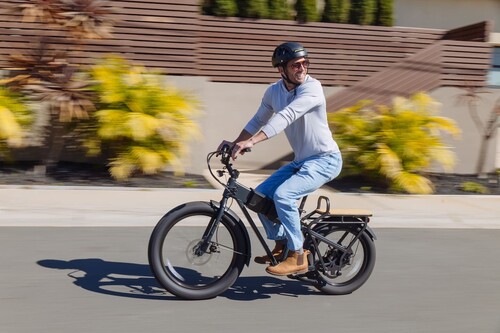
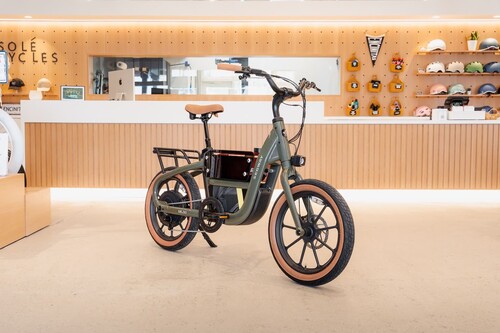
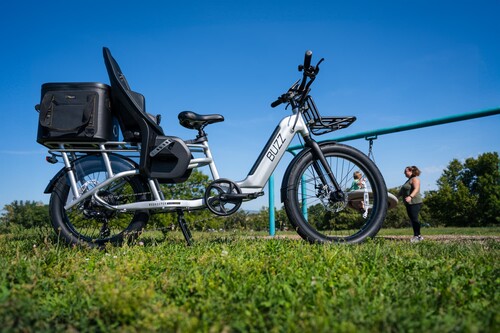
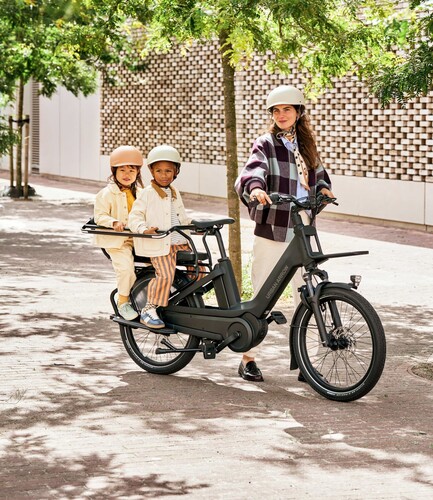
3 New E-Bikes, from Cargo Haulers to 40-MPH RocketsHearst OwnedAs a sign of e-bike market health, the test units in my garage now cover a wide gamut, from budget cruisers to hot rods that can attain 40 mph. According to the Light Electric Vehicle Association (LEVA), the US is currently importing 2.2 million e-bikes annually, up from 920,000 in 2024. E-bikes are roughly 30 percent of the entire U.S. bicycle market, with an average price of $3,055.That latter figure (based on sales at specialty shops) seems high, as there are plenty of very nice e-bikes available in the $1,500 to $2,500 range. But most of those two-wheelers are bought through online direct-to-consumer sales channels.My guess is that one factor in holding e-bikes back is a continued misperception of how they work. People say, "What kind of exercise is that? It does the pedaling for you!" Actually, no. I rarely stop pedaling, though throttles make that possible. Remember, e-bikes feature pedal assist—they're not motorcycles, though they are moving in that direction.AdvertisementAdvertisementOther very good reasons for continued e-bike hesitancy include:High import tariffs, especially on Chinese-made examples;Reports of battery fires (a good reason to avoid bikes without Underwriters Laboratories approval);Uncertainty that selected brands will remain open for servicing. There have been a lot of bankruptcies and mergers among e-bike brands that have left warranty customers stranded.There are some bright spots. Established vendor Pedego closed many of very useful brick-and-mortar stores, shrinking from 220 outlets to 120. But the company is soldiering on and honoring warranties, after being acquired by the investor group behind US startup Urtopia in late 2025. The plan is to rebuild the dealer network and ultimately have 500 stores.Here are some new e-bike choices:Pedal Electric H/T 750, $2,295This little bulldog of a hardtail is unlike any other e-bike I've tested. The H/T's small size, industrial design, bench seat, and lack of fenders makes it look like something of a starter unit. But that's very deceiving. It's a road rocket with just one speed, a 750-watt rear hub motor and torque galore (between 80 and 90 Nm. If you just use pedal assist, you can get as much as 60 miles out of the 768-Wh battery. Recharge time is six hours.Pedal Electric's H/T is a minimalist road rocket.pedal electricThis is a Class Two e-bike, with adjustable front suspension (again, no rear) and a thumb throttle and 28-mph top speed. The company describes the stripped-down H/T as "short-rider friendly," and it is, but unlike the really great bench-seat Pedego I previously tested, it's not really "designed for riders of all heights." Taller people are going to suffer.AdvertisementAdvertisementThe H/T is the company's lightest model, thanks to compact dimensions and an aircraft-grade aluminum chassis. But 60 pounds means it's still a bit of a heft to move around, though it will tuck in almost anywhere. The weight limit is a generous 350 pounds.Quite frankly, the little H/T is just a blast to drive. There's only one speed, but five (customizable) levels of pedal assist. At anything above 2, it leaps off the line like a panther. At 4, it's a dragster doing the quarter mile. The power comes on abruptly, which can be disconcerting until you're used to it. The little bike just jets up hills like they weren't even there—a benefit that's not always there on units costing twice as much.It's possible to unlock Class Three performance on this bike, with pedal assistance up to 28 mph, but rules for use vary widely. Class Threes are prohibited from bike paths, trails, and sidewalks in many places, and you have to be 16 to ride one in California.Instead of adjusting the seat, the rider slides forward or back on the fixed platform. That works up to a point. As a taller person (just under six feet) I could ride the H/T, but on longer trips I'd really want to sit higher, and further from the pedals. The bench seat does allow someone (a smaller person preferred) to sit behind the driver.AdvertisementAdvertisementSince the 750 is so powerful, it's helpful that its hydraulic brakes (a 203 mm front rotor, and 180 mm rear) are strong. It's equipped with knobby all-terrain 20-inch tires that may or may not suit your riding routes but suit the bike. Cool features include an integrated AirTag holder under the seat for security, a USB charge port, data tracking, and an information-rich display. There's an 80-lux LED headlight and a brake-activated taillight.The H/T earns points for being easy to assemble, just needing the front wheel and pedals attached.Engwe M20 3.0, $1,499Like the Pedal Electric, this moped-style bike is one speedy, range-friendly two-wheeler, especially if you order the twin-battery version (with two 60-volt, 20-Ah units) that yields up to 180 miles on a charge. With one battery the range is up to 94 miles (40 if you use only the throttle). And you can unleash the 750-watt (3,300-watt peak power) motor with 120 Nm of torque. The shifter is a seven-speed Shimano unit.The Engwe M20 3.0 is blistering fast for an e-bike—40 mph when jailbroken.Jim MotavalliThis Chinese-made bargain bike is sharply styled in a retro motorcycle manner, with cool graphics. It's a big leap from the competent but unexciting folding L20 3.0 also tested. It's as much motorcycle or moped as bicycle, and it really demands judicious use—and a mandatory helmet. You can ride on the hand throttle and leave the pedals alone. If you unlock "off-road mode," it's actually capable of 40 mph. Jailbreaking the bike requires entering a few keystrokes on the LCD display unit, after which e-bike modes 1 to 4 are options. Again, it's not legal to use the bike this way in many places.AdvertisementAdvertisementTo accommodate the power, this is the one bike here with both front and rear suspension. Despite the aluminum frame, it's a heavy bike at 102 pounds (the second battery adds eight to 15 pounds). But this little scooter has so much power you won't notice the weight much until you try to move it in your garage, or load it onto a car rack. Charging takes 2.5 to three hours, and you access the battery (or batteries) through some quite clever magnetic side panels.This Engwe is built like a tank—one reason it's so heavy—but that translates to a real peace of mind on the road, even at higher speeds. It just feels very stable and safe.It didn't take a lot to get the bike to a heady (for an e-bike) 38 mph—just some furious pedaling, the half-twist throttle, and a steep downhill grade. The Engwe M20 feels powerful on just the first level of power assist, but it really turns into a beast on the higher assist levels (there are five total). The e-bike takes the steepest hills in stride.This is another bench seat model, so your friend can ride along—they even get detachable foot pegs like on a motorcycle. The M20's eight-amp charger can get the battery to 80 percent in only two hours. Given the speeds it's capable of, the four-piston hydraulic brakes are an absolute must.AdvertisementAdvertisementNeat features are turn signals (all e-bikes should have them), a key-locking storage box that looks like a motorcycle's gas tank, and the intelligently laid-out 3.5-inch TFT color display screen (which turns red on Level 4).The bike really has amazing features for the relatively affordable price. Once your phone is paired, the e-bike can be locked or unlocked via Bluetooth, and it also has cruise control and on-screen navigation. There is password protection, too. The only serious drawback with this bike is the weight, and the standard Chinese-brand tires, which could have better grip. Some users also install semi-metallic brake pads. Assembly was simple (about an hour, with a helper), though more text to accompany the visuals would have been useful.Radio Flyer Loop, $2,999Radio Flyer, the venerable Chicago brand best known for its little red wagons, continues to improve its product line. The Loop is a more compact step-through bike with a 440-pound payload, very good upgraded Magura hydraulic brakes, plus front and rear-mounted turn signals. The Loop, Radio Flyer's third-generation cargo bike, has a 500-watt rear hub motor with a torque sensor, eight-speed Shimano gearing, and a 48-volt, 720-watt-hour battery for 30- to 50-mile range. It's fully UL compliant for fire safety.The Radio Flyer Loop is a much-improved cargo bike from the company that builds the little red wagons.Radio FlyerFour years ago I tested the $1,800 Radio Flyer M880, which was a Ford Expedition-sized cargo e-bike that could only haul 300 pounds. I said that it was "on the large side," with "styling [that] is low-slung and retro, perhaps suggesting a 1930s motorcycle." That quirkiness is largely gone, and the Loop—four inches shorter than previous models—is a more mainstream ride that can carry up to two kids in the cloth-paneled way-back that fits on to the rear rack (which itself has capacity of 220 pounds).AdvertisementAdvertisementThings I liked about the Loop include the four-level pedal assist (the "Turbo" setting is the most useful) and a color LCD display with an odometer. It's a Class One e-bike, with pedal-assist only (no throttle) and a 20-mph top speed. Accessories include a cloth front basket and rear saddlebags that increase the cargo utility without adding much weight.Attention to detail and build quality are definitely better than the M880. The Loop is heavy at 77 pounds, but it lightens up when underway. There's no chain guard, and either the chain tension or the derailleur itself could use some adjustment because things get noisy when the pedals are engaged. The bike feels very stable, if no speed demon, kind of like a vintage Harley or BMW. It has reasonable hill-climbing ability, and is best just cruising along, kids or groceries in tow.The Loop comes in just one size, able to accommodate riders from 4'11" to 6'3". It has adjustable front suspension, but nothing in the rear, and that means it feels rough terrain more than other brands. Assembly was easy.