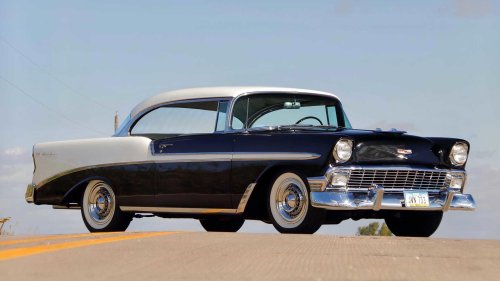
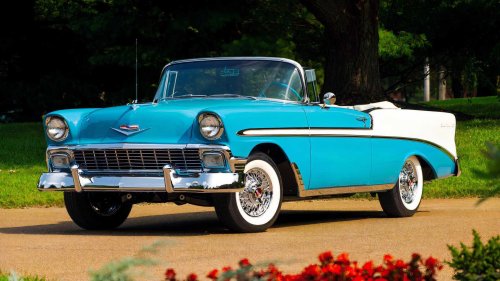
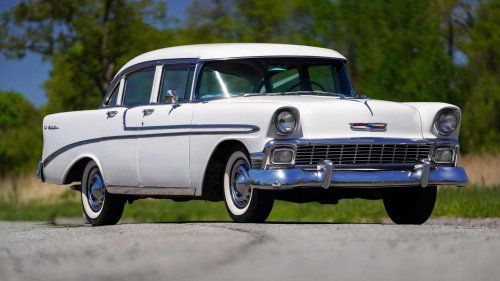
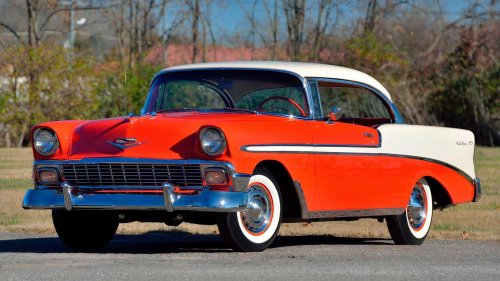
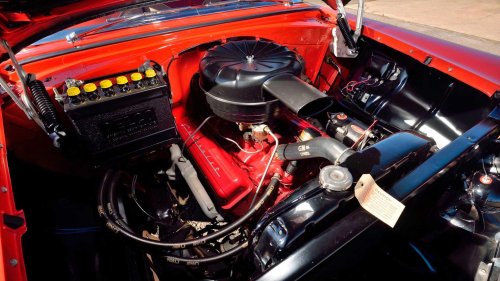
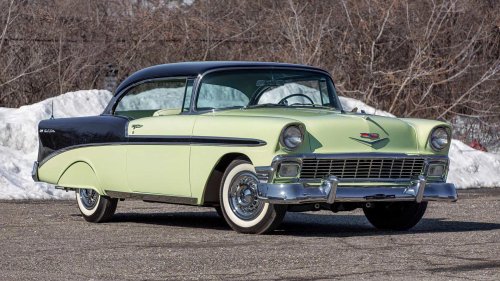
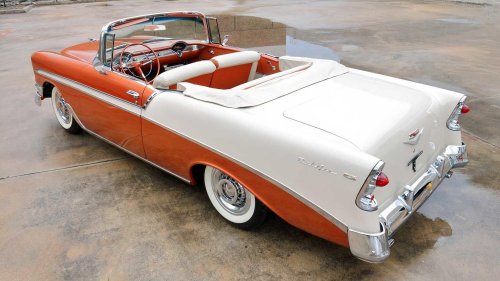
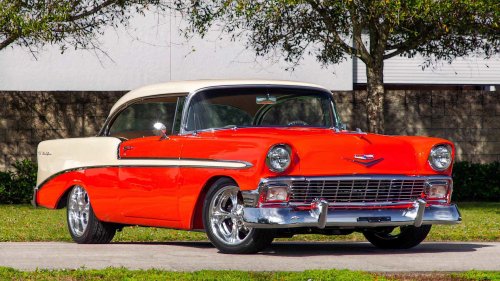
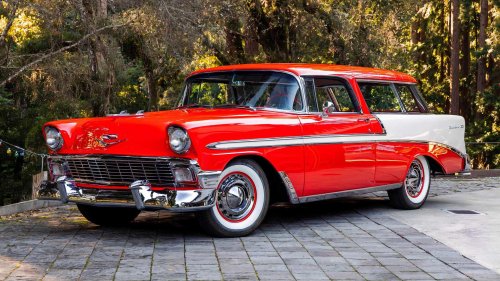
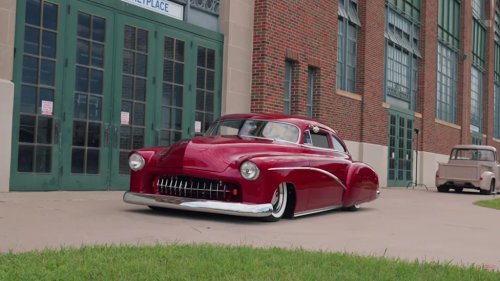
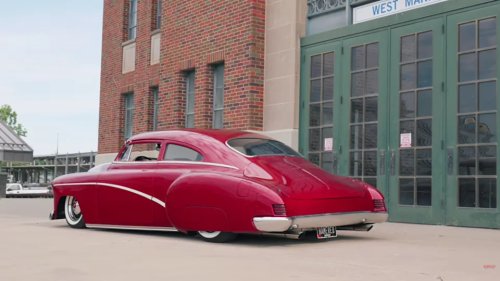
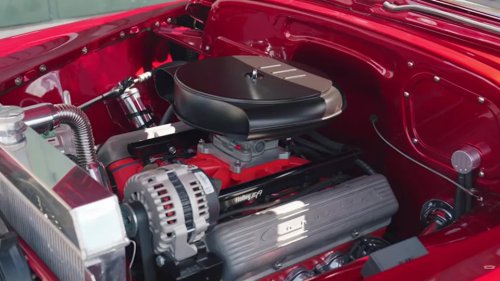
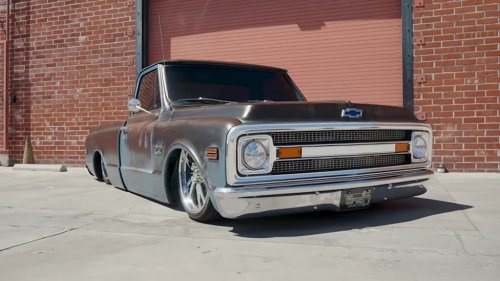
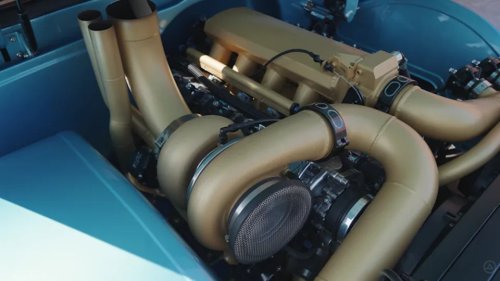
At some point early in a young future gearhead's life, he or she notices that some cars are just way cooler looking than others. More often than not, the first set of wheels to spark the interest of a budding fanatic is a Chevrolet Bel Air. It was maybe a favorite Hot Wheels toy, the baddest slot car, or perhaps seen in a movie like American Graffiti. Harris Ford's character's ride, technically a Chevy 150, in the George Lucas classic is one of the most killer-looking cars to ever grace the big screen, doing for the Bel Air what Smokey and the Bandit achieved for the Pontiac Trans Am, and that is to make people want one.The second-gen Bel Air "Tri-Five" Chevys, named after the three model years (1955, 1956, 1957) and the '50's decade from whence they came, were the first to adopt the muscle car ethos of aggressive styling, V8 power, and affordability. While the '57 Bel Air with its flamboyant tail fins gets more attention from casual observers, it's the '56 model that collectors consider the best year, mostly because it was the cleanest of the bunch. We tend to agree, with the value, performance, and collectibility of the 1956 Chevy Bel Air backing us up. Here's everything you need to know about America's first truly cool car and every little kid's dream machine. 1956 Chevy Bel Air Value Mecum Most people have heard of the Chevy Bel Air car and even recognize it as the coolest ride from the 1950s, but few realize that it is actually the top trim of the 1955-1957 Chevrolet. The 150 was the entry-level, which was mostly for fleet sales like police cars, the 210 was the mid-level trim, and the Bel Air was the delux top model. Though they had different nameplates, they were all essentially the same car, which came in two-door, four-door, and wagon configurations. Obviously, the two-door Bel Air coupes were the most awesome back in the day and just as evident is that they are the ones collectors want now. For a '56 Bel Air Sport Coupe, Hagerty tells us the values range from $22,500 for a beater to a $68,600 Concours condition show car. Those prices are based on a matching-numbers car with a 205-horsepower 265ci V8.The '56 Chevy also had a 225-horsepower dual-quad version of the 265, which is a little pricier, valued between $23,400-$84,800. Either way, the Hagerty prices skew a bit high, as sales in the real world are slightly less. Classic.com, which tracks auctions over the past five years, says that the average sale price is $70,967, but that covers all Bel Airs including convertibles and customs, which will be covered in just a sec. That black and white two-tone beauty pictured above sold for $77,000 at Mecum Kansas City 2020 and it's in perfect shape with the dual-quad V8, which is significantly under the Hagerty value. Of course, that was five years ago, so maybe the prices have aligned by now, but it's impossible to say for sure. In reality, it's difficult to find an all-original '56 Bel Air Sport Coupe as most of the hardtops are customs. '56 Bel Air Drop Tops Are Top Sellers Mecum As is the case with all collectible classics, the convertibles are the most sought after and expensive. Generally speaking, drop tops were produced in far fewer numbers, making them unicorn cars and with some models, like the one-of-two 1969 Corvette ZL1 convertible, are Holy Grails. The '56 Chevy Bel Air convertible was actually mass-produced with 41,268 units, but they still command a premium. The Hagerty Concours condition for a 205-horsepower drop top is $177,000, and $187,000 for the dual-quad version. Again, Hagerty is above the actual auction sales, but the 'verts are still going for a lot of scratch. There's maybe a dozen '56 Bel Air convertibles that have sold for over $100,000 in the past five years, including a turquoise and white example that dropped the gavel for $178,750 at Mecum Kissimmee 2025. Four-Doors are Bottom Floor Bel Airs Bring a Trailer Another constant theme with classic cars is that four-doors is two too many, and not remotely cool. This is true with the Bel Air as the four-door sedans are practically free on the used market. Hagerty claims that a cherry '56 Bel Air four-door sedan with the weeniest two-barrel version of the 265 is worth $53,200, but real-world sales beg to differ. Bring a Trailer has moved several Bel Air four-door sedans in recent years, with none selling for over $30,000. These are meticulously restored vehicles that are highly original, but the demand just isn't there for that many doors. With a little legwork, it's possible to find excellent-condition four-doors for under $10,000, but the problem is, not too many collectors are searching for one. '56 Chevy Bel Air Power And Performance Mecum We live in an age where Chevys, more specifically Corvettes, can run sub-10-second quarter-miles, but 70 years ago the performance standards were a lot slower. Cars like the Studebaker Goldenhawk, Ford Thunderbird, Chrysler 300B, and even the Corvette were the baddest rides in 1956, and they all ran in the 16s. These cars were, of course, luxury models that were too expensive for most folks, but the Bel Air was affordable. Even though the '56 Bel Air was the top trim, Chevrolet was GM's entry-level brand and a Sport Coupe started at $2,713, which is $32,314 adjusted for inflation. Compared to the $3,120 ($35,329 in 2025 dollars) sticker price of the '56 'Vette, the Bel Air was cheap. It also had back seats and comparable acceleration.A '56 Sport Coupe with the dual-quad 265ci V8 and three-speed manual could go from 0–60 in 7.9 seconds and rock the quarter-mile with a 16.3-second ET. A 1956 Corvette with the same engine was only a half a second faster, and it was an actual sports car, while the Bel Air was a shoebox on wheels. That kind of quickness being available to the masses was revolutionary in the mid-1950s and is a major reason why the Bel Air was such a success. At the time, hot rod culture was starting to heat up and something like a '32 Ford with a 150ish horsepower 239ci Flathead V8 could do a quarter-mile in the high-15s to low 17s. With a '56 Chevy, people could get that level of performance straight from the factory, with no tinkering or customization at all, and, it was already cool-looking. Chevy Small-Block 265 Mecum The Chevy 265ci "TurboFire" small-block V8, introduced in 1955, wasn't actually turbocharged, but compared to the 235ci "BlueFlame" six-cylinder it replaced, it sure seemed like it. The engine was the first V8 Chevrolet built since 1917 and was intended to give the Corvette some much-needed power, but the Bel Air was also the lucky recipient of it. In 1956, there were a whopping six versions of the 265 with two-barrel, four-barrel, and 2x4-barrel configurations ranging in output from 155-225 horsepower. As you've probably already guessed, the dual-quad 225-pony version was the tops, and what really made the Bel Air such a coveted ride. Available only with the "Super Power Pack", the performance upgrade included a high-lift camshaft and dual exhaust. Transmission options were a two-speed automatic, a three-speed automatic, and a three-speed manual, which really jumped it off the line. '56 Chevy Bel Air Production Mecum If you've ever wondered why so many hot rods are '32 Fords or the massive proliferation of third-gen Impalas in low rider culture, it's because both of those cars were produced in huge numbers, making them abundant, cheap, and ready to customize. The same is true with the Tri-Five Chevys, and we'll get to their adoption by the restomod movement in just a bit. Over 1.6 million 1956 Chevrolets were built, including 171,964 150s, 758,882 210s, and 692,530 Bel Airs. Even the Sport Coupe wasn't much of a rarity with 130,778 units that year. There is no breakdown of how many left the factory with a 225-horsepower dual-quad 265ci V8 engine, but the general consensus among collectors and historians is that they are rare. The '56 Chevy Bel Air Is A Collector's Dream Mecum As proven by the prices for all original '56 Bel Airs, this is a serious collector car, with nothing but growth potential. The thing is, it has to be the right Bel Air and that's a Sport Coupe or convertible with either the four-barrel or dual-quad 265ci V8. With so many 1956 Chevrolets produced, having the exact same body, it's kind of easy to fake a real Bel Air. Luckily, the VIN is a dead giveaway as any that don't start with "VC" are not Bel Air V8s, with the "V" standing for V8 and "C" for Bel Air. Next, is the cowl tag, which will have a 56-1037D code for the Sport Coupe and 56-1067D for the convertible. With the price difference between a 150 and a Bel Air being so astronomical, there are certainly some unscrupulous people out there trying to pull a fast one, but the tags don't lie.The other thing you want to look out for is assuming that any two-door Bel Air hardtop is a Sport Coupe. There is also a two-door sport sedan that looks similar, but is less desirable and collectible. The Sport Sedan has a B-pillar between the front and back windows, which makes it less attractive and actually alters the roofline, giving it a gooney bulbous look. Often you will see a '56 Bel Air advertised as either "Post" or "No post", which is a way to tell which model it is. No post is the way to go, because that's the Sports Coupe, which is the money Bel Air. With the convertible, there were no lesser-trim versions of it, so unless someone chopped the roof off one, there are no issues, and that's a preposterous situation, that would cost a ton of money and would be easily debunked by the cowl tag. '56 Bel Air Customs and Restomods Mecum It doesn't make sense to fully restore a 1956 Chevrolet 150 or 210 to original condition because they will never be worth the money sunk into them. Because they both look exactly like a Bel Air, it makes all the sense in the world to customize the hell out of them for some seriously kick-ass classic street rods. There is a huge restomod and custom '56 Chevy scene that is actually responsible for the top-selling cars. There are seven customs that have sold for over $200,000 in the past five years, including one that went for $352,000 at a Barrett-Jackson auction in 2022. The car has a 6.2-liter LS3 V8, upgraded suspension, as well as brakes, a custom luxury interior, and some sick rims. There's a real appeal to having a classic look with modern performance and comfort, which is why '65 Bel Air customs are so hot right now. Don't Forget About The '56 Chevy Nomad Mecum We can't end our discussion on the '56 Bel Air without mentioning the Nomad, which is actually the rarest and most valuable of the Tri-Five Chevys. As the wagon counterpart to the Bel Air, the '56 Nomad is arguably the coolest family ride to ever exist. With the same bold, aggressive styling of the Bel Air, it managed to avoid the inherent frumpiness of the station wagon and was, in fact, fairly badass. The Nomad wasn't all that successful back in the day, with just 8,103 units produced in '56, and the reason was simply that people in the market for a wagon in the '50s wanted four doors, while the 'Mad kept things on the rad side with only two doors.That lack of success in the '50s has turned the Nomad into money in the shape of a Chevy in 2025 with an average auction price of $100,256 and a high sale of $341,000. Hagerty fixes the Concours condition of a '56 Nomad with the 225-horsepower dual-quad 265ci V8 at $126,000, which is way more than their $84,800 valuation of the Bel Air Sports Coupe with the same engine. Much like the Sport Coupe, it's actually really difficult to find an all-original '56 Nomad. Nearly all the Nomads to go up for action in recent years are custom jobs, but that's okay. As cool as the Nomad was and is, it's a lot more awesome dropped, with 500+ horsepower under the hood.Source: Chevrolet, Classic.com, Hagerty, Mecum