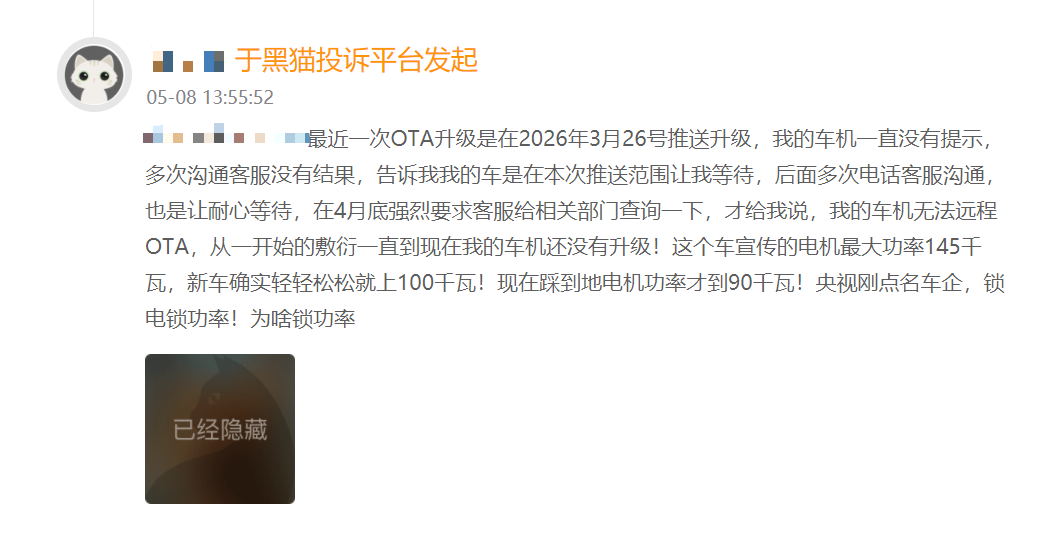



















Gasgoo Munich- It's 2 a.m. and the city is asleep, but the infotainment screen on a parked EV flickers to life: a "system optimization update" quietly completes without the owner's knowledge.The next morning, the driver slides into the cockpit as usual, only to find the full-charge range figure has plummeted from 510 kilometers to under 300.He refreshes the app and restarts the system, but the number doesn't budge. In that moment, he realizes the car he parked the night before isn't quite the same one he's driving now.The industry calls this "battery locking."Did 200 Kilometers of Range Just Vanish Overnight?Recently, reports of automakers using over-the-air (OTA) updates to lock batteries have sparked widespread debate.CCTV later issued a correction, clarifying that ambiguous phrasing in a previous article had caused confusion. It revised the claim that "eight automakers were summoned for talks, three were investigated for violations, and two withdrew controversial updates" to specify: "According to incomplete statistics, since 2020, eight automakers have been summoned over issues including sudden acceleration, battery fires, and remote upgrades (OTA); three were investigated for violations; and two withdrew controversial update packages and promised to restore performance."Liu Yan, deputy secretary-general of the China Association of Automobile Manufacturers (CAAM), responded to the controversy. She stated that the association has verified the situation with relevant authorities and enterprises. As of now, regulators have not launched any enforcement actions—such as summons or investigations—into the rumored OTA battery locking. The online reports lack official sources and are seriously inconsistent with the facts.Regardless, the furor has thrust the concept of "OTA battery locking" into the public spotlight.So, what exactly is "OTA battery locking"?It's when automakers exploit system updates to alter the battery management system (BMS) without explicit consent, capping charging limits and discharge power via software.Is this actually happening? And how widespread is it?According to a report by China National Radio, owners have complained that after years of driving and a recent OTA update, their vehicles—originally rated for 500 kilometers of range—can now barely manage 300. Fast-charging times, meanwhile, have dragged out from 40 minutes to 70.Other authoritative industry outlets, reviewing data from platforms like 12365 and Black Cat Complaints, found that grievances over "battery locking" are far from rare. Many owners report that after updates, their vehicles suffered reduced range, slower charging, and diminished power—often without any prior notice from the manufacturer.Image Source: Black Cat Complaints PlatformWhile it's difficult to gauge how pervasive the phenomenon is, even isolated complaint cases are enough to confirm its existence.In reality, "battery locking" is not a new concept.As far back as 2019, overseas owners were suing automakers over range reductions following software updates. Around 2021, China saw a wave of concentrated complaints stemming from range drops and power restrictions after OTA updates.WM Motor, for instance, used an OTA update to cap charging voltage and discharge power on its EX5 model after multiple spontaneous combustion incidents, drawing public criticism from the China Consumers Association.Previously, such complaints appeared as sporadic cases scattered across the corners of complaint platforms and social networks—far from the scale of a mass outbreak.Today, the intense focus on "OTA battery locking" is largely driven by the rapid surge in EV penetration.On May 11, the China Passenger Car Association (CPCA) released data showing that in April, retail sales of new energy passenger vehicles reached 849,000 units. While that's a 6.8% year-on-year decline, the retail penetration rate hit 61.4%—up 9.7 percentage points from a year earlier and 9.6 points from March. It marks a record high for monthly penetration in the domestic market.Put simply: for every 10 new passenger cars sold in China, six are new energy vehicles.An industry analyst told Gasgoo that the "battery locking" issue is inextricably linked to structural factors. On one hand, the growing EV fleet means a larger base for potential problems to emerge. On the other, automakers are increasingly using OTA updates to sidestep warranty costs. As early waves of EVs enter the back half of their warranty periods, these conflicts are hitting a tipping point.Crucially, the evolution of OTA technology itself is adding fuel to the fire.For automakers, OTA has morphed from a value-added tool that simply adds new infotainment features into a high-authority channel capable of deeply intervening in a vehicle's core control systems.If that channel is abused, the damage can ripple from a single model to millions of vehicles across an entire brand overnight. Consumers, often unaware, become passive recipients of this "remote control."The Economics Behind "Battery Locking"So, how does "OTA battery locking" actually work?Zhang Xiang, secretary-general of the International Intelligent Transport Technology Association and a researcher at the North China University of Technology's Automotive Industry Innovation Research Center, explained it this way: "Battery locking generally takes two forms: stopping the charge before the battery is full, or displaying zero charge before the battery is actually empty. The side effect is that the EV's performance metrics effectively shrink."One premise must be clear: OTA updates are generally a "good thing." The real question is whether the locking side effect is an accidental oversight or a deliberate strategy.Gasgoo put this question to DeepSeek, and here's what the AI model offered:1. Mitigating safety risks: Limiting overcharging or over-discharging is a low-cost "software patch" that can quickly reduce the risk of spontaneous combustion caused by known cell defects.2. Cutting warranty costs: Regulations typically mandate an 8-year or 120,000-kilometer warranty for power batteries. If degradation exceeds limit, automakers must replace them for free. By "locking" the battery to reduce charge-discharge cycles and slow performance decay, manufacturers can avoid the steep cost of battery replacement.3. Transferring potential crises: When a batch of cells has design defects that should trigger a recall, some companies use locking as a cover-up. It's an attempt to lower the probability of severe failures within the warranty period—or drag the issue out until the warranty expires.In other words, even though battery locking triggers consumer distrust and legal disputes, a few automakers still take the reputational risk. The answer lies in the deep industrial logic where battery costs, warranty chains, competitive pressure, and safety anxieties intersect.Image Source: TeslaLet's do the rough math.Today, the power battery remains one of the most expensive components in an EV, accounting for 30% to 40% of the total vehicle cost. Under current regulations, the warranty is typically 8 years or 120,000 kilometers. If degradation exceeds 20%, the automaker must replace the battery at no cost to the owner.Industry estimates put the cost of a single battery replacement between 30,000 and 50,000 yuan. That means even if only a fraction of vehicles require a new battery, the warranty liability could amount to a massive figure for an automaker.That is the economic allure of "battery locking."By tweaking BMS parameters via OTA and narrowing the usable charge-discharge window, automakers can significantly reduce the depth of each cycle—drastically slowing the aging rate of the battery cells.Beyond the economics, safety anxiety is a major driver pushing automakers to lock batteries.Certain early batches of battery cells carry a risk of thermal runaway under extreme conditions. The triple threat of high temperatures, a full charge, and high-power discharge can lead to overheating or even fire. A massive recall would mean not just direct financial losses, but potentially irreversible damage to the brand's reputation.Under that calculus, using OTA to apply a "software patch"—lowering charging caps and throttling discharge power—becomes an attractive alternative. In a sense, it offers a form of indirect protection to the owner: your car may not travel as far, but at least it's less likely to catch fire while you're not looking.The problem, however, is that this core trade-off is rarely disclosed to owners before the update.A "Rashomon" Effect: Who Is Right?Regardless, the issue is real.When a car gets "locked," most owners' first reaction is confusion. They often have no idea what has just happened to their vehicle.Their next step is usually to head to the dealership for answers.According to CCTV, when owners contacted dealerships to ask why, staff insisted the "vehicle had no issues" and blamed "low winter temperatures." They specifically emphasized that "the drop in power is due to system optimizations that improved battery safety and is a normal adjustment."As for whether BMS parameters were modified or the battery was locked, the representatives offered no direct response.This "standard response" reflects the industry's broader strategy for dealing with locking allegations: obscure the nature of the operation with vague terms like "safety optimization" or "system upgrade," then attribute range loss to variables like "low temperatures" or "driving habits." The goal is to dissolve consumer suspicion in a gray zone that is difficult to verify.When an owner discovers their car's range has "shrunk overnight," how does the law view it?Lei Wen, a lawyer at Guanghuaibo Law Firm, offered a clear legal assessment in an interview with Gasgoo. Vehicle range and performance are core technical parameters clearly defined in official manuals before purchase. If an automaker modifies this data via OTA without consent—causing a drop in range or charging speed—it constitutes a breach of contract. Furthermore, the act infringes on the owner's property rights and violates the obligation to inform, thereby infringing on the right to know and the right to choose. Since this constitutes both a tort and a breach of contract, the owner can choose which claim to pursue.Regarding the "battery safety" or "battery management optimization" excuses thrown out by some dealerships, Lei noted: these cannot serve as a shield for liability.Under Article 18 of the Law on the Protection of Consumer Rights and Interests, even if the intent is safety-related, automakers must fulfill their duty to inform and warn. They must clearly explain the update's content and potential performance impacts, and obtain the owner's genuine consent.She further defined the legal boundary between safety upgrades and infringement: first, prior notice and consent are mandatory; second, the manufacturer must provide an authoritative test report proving that a genuine safety risk exists without the upgrade, and that locking is the necessary and sole measure to eliminate it.Yet, an undeniable chasm exists between asserting legal rights and the practical efficiency of defending them.A core reason defending rights is so difficult for owners is the asymmetry of information.For instance, an owner claims their range dropped from 500 to 300 kilometers after locking. Where does this comparative data come from? And who verifies it?Automakers hold the keys to the backend: every charging record, every BMS parameter log, every OTA version history. The owner, meanwhile, has nothing but a car and their word.To counter locking issues, some owners seek independent third-party battery assessments. But exorbitant dismantling fees, long wait times, and the limited weight such reports carry in court make this path unrealistic for most. The inherent inequality in evidence gathering places consumers at a distinct disadvantage from the start.Given this, Lei specifically pointed out that claiming breach of contract is the more favorable path for owners. "Under a contractual claim, the burden of proof is lighter. The owner only needs to demonstrate that the post-upgrade range clearly deviates from the performance standards stated in the manual at the time of purchase."Unlike tort lawsuits, which require a complex chain of proof regarding fault and causality, the contractual route shifts the burden of proof significantly upstream—offering consumers a glimmer of hope in what often feels like an impossible task.Citing Article 95 of the Supreme People's Court's Provisions on Evidence in Civil Litigation, Lei noted that if core evidence is held by the automaker and withheld without justification, the court may presume the owner's claim of locking is true. However, before that happens, the owner must still take the critical first step of providing preliminary proof that "vehicle performance significantly declined after the OTA update." Only then does the burden shift to the automaker to prove the decline is unrelated to locking or that the locking was lawful.Image Source: General MotorsTo make this crucial preliminary evidence stick, Lei offered a set of concrete, actionable steps. Owners should record their full-charge range and charging times before an update, then repeat the test using the same charger afterward to compare the data. For video evidence, "trusted timestamps" can be used to solidify electronic records. Additionally, all recordings and chat logs with customer service or dealerships regarding the locking issue must be preserved, explicitly documenting the performance drop.These seemingly tedious steps are the keys owners need to pry open the technical black box.At the same time, Lei noted that current law does not explicitly grant owners the right to access core OTA data. With automakers holding a data monopoly, proving locking behavior is difficult. Furthermore, the connection between recalls and OTA is poorly defined: the law does not clarify if OTA constitutes a legal recall method, allowing automakers to potentially use updates to bypass statutory recall procedures without facing penalties.Faced with this new governance challenge posed by technological iteration, regulators are already demonstrating a systematic, institutionalized response.In February 2025, the Ministry of Industry and Information Technology and the State Administration for Market Regulation jointly issued a notice on strengthening the management of intelligent connected vehicle product access, recalls, and software online upgrades. It explicitly mandates "standardizing OTA upgrade applications to prevent enterprises from using OTA updates to conceal vehicle defects or evade liability."More powerful institutional support is accelerating. The mandatory national standard "Safety Technical Requirements and Test Methods for Internet of Vehicles Online Upgrade" (GB/T47325-2026) was released on March 31, 2026, and will take effect on October 1, 2026. It provides executable, testable technical standards for the safety of OTA upgrades.With the joint efforts and refinement of regulators and the entire automotive industry, there is confidence that the OTA upgrade process will become simpler—and more transparent.