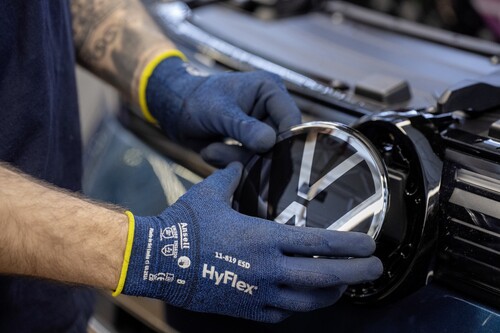
Earlier this year, it was announced that the VW plant in Zwickau would be expanded to include a dismantling and recycling site for pre-series and end-of-life vehicles. True to their word, VW have now officially opened the facility, making the location the central competence centre for VW’s circular economy.
Following a nine-month conversion and approval phase, operations are set to begin in 2027. Initially, 4,100 vehicles per year will be dismantled on an eight-stage dismantling line under a two-shift system; an operation that will require 100 new employees. A collective agreement finalised in December 2024 also contains provision for up to 1,000 jobs to be added to the new circular economy business unit in the long-term.
Danny Auerswald, Spokesperson for the Management Board of Volkswagen Sachsen GmbH, said at the opening: “The team at the Zwickau site is tackling the task with determination. We have leveraged our expertise to utilise all synergies between vehicle manufacturing and vehicle dismantling in terms of equipment and process design. Short distances at the site, specialist expertise, and the workforce’s and region’s long-standing experience enable us to transition dismantling from a workshop setting to an efficient serial process.”
The concept consists of two value-added areas. On the one hand, components such as engines, transmissions, doors or bumpers are recovered for the spare parts business in the after-sales sector, inspected, refurbished and distributed through dealer networks and independent workshops to enable cost-effective repairs of older vehicles. On the other hand, individual raw materials from the vehicles are recovered in as pure a form as possible so they can be reused in production.
Raw material cycle: the example of waste plastic
The dismantling process in Zwickau enables plastics to be separated by type before recycling. The extracted material is processed and used as a secondary raw material in the manufacture of new components. This reuse is gaining particular importance due to EU regulations coming into force in 2032, which mandate minimum proportions of recycled materials in new cars.
Since components for new vehicles cannot be made entirely from recycled material, the secondary raw material is mixed with new material. Through this partial use, the plastic recovered from one end-of-life vehicle is theoretically sufficient to meet the recycled material requirement for three new cars.
Reducing dependencies
The construction of the dismantling line involved the use of 94 tonnes of steel on an area of 1,200 square metres, and the floor was newly coated to enable environmentally friendly storage of raw and residual materials. To keep investment costs as low as possible, VW partially used existing plant technology from previous vehicle production.
In future, Volkswagen plans to establish a Europe-wide partner network for industrial circular economy. In addition to meeting stricter environmental and recycling requirements, the group also aims to reduce material costs and dependencies in supply chains and imported raw materials.