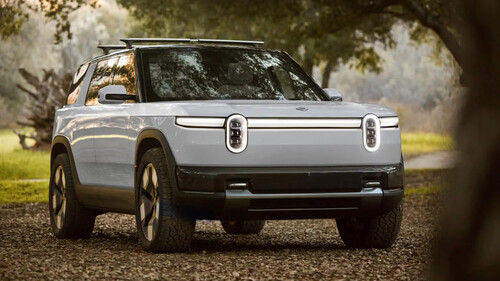
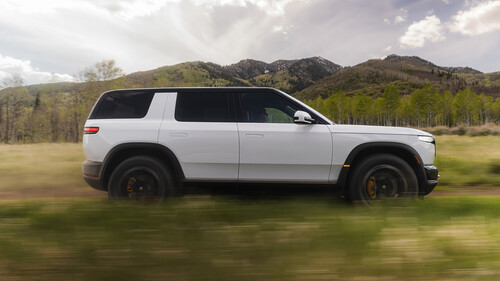
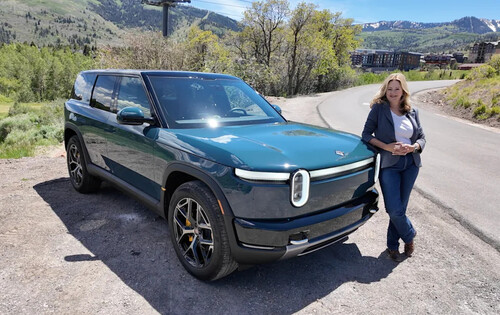
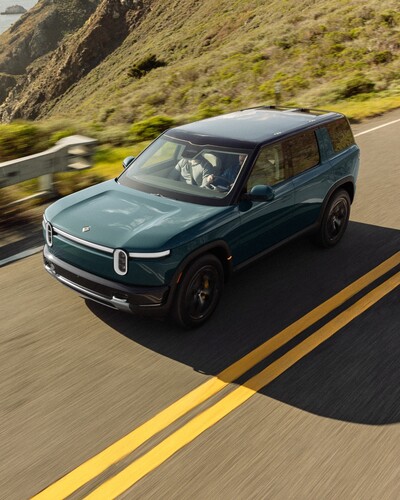
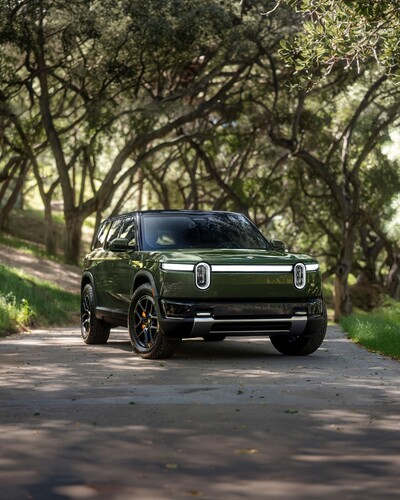
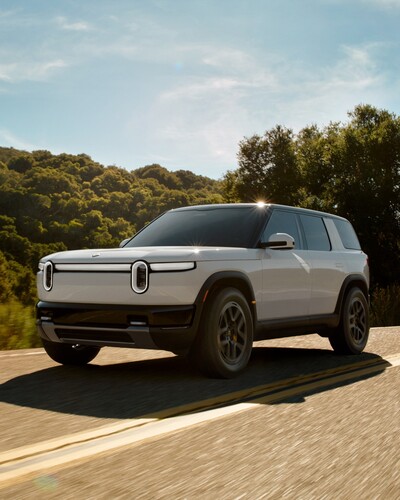
According to Rivian’s quarterly results, the US EV manufacturer produced a total of 19,751 electric vehicles in the third quarter of 2026 and delivered 19,248 units to customers. This represents an 84 per cent increase in production and a 46 per cent rise in deliveries compared to the same period last year, both setting new quarterly records for the company. A key driver of this growth is the new R2: the more compact and affordable SUV was already Rivian’s best-selling model in the third quarter, surpassing both the larger R1 models and the electric delivery vans (EDVs), primarily used by shareholder Amazon. Production of the R2 continued to ramp up at the Normal plant in Illinois, USA, thanks to a second production shift for the model also starting there.
Revenue climbed by 38 per cent year-on-year to $2.155 billion. The automotive business contributed $1.55 billion of this, a 36 per cent increase. However, this segment remains loss-making on its own: the gross loss in the automotive business amounted to $80 million, down from $130 million in the same quarter of the previous year. Rivian attributes the improvement to higher deliveries, better margins per vehicle, and additional revenue from regulatory credits. At the same time, the ramp-up of the R2 is weighing on costs. Rivian recorded approximately $120 million in additional manufacturing costs for the R2 in the third quarter compared to a normalised production level.
Rivian benefits from service business
The second pillar of the company continues to grow even faster than the automotive business. The Software and Services division generated $605 million in revenue, a 45 per cent increase over the same quarter last year. What is particularly notable is not just the revenue volume but also the profitability: the segment’s gross profit was $256 million, with a gross margin of 42 per cent. This means this business division generated more gross profit than Rivian as a whole, which achieved $176 million at the group level. Revenue drivers include the development of vehicle architecture and software, as well as repair and maintenance services and the paid software package Autonomy+, which has been available since April 2026. Declining revenue from the resale of used vehicles, however, had a dampening effect.
A significant part of the Software and Services business continues to be the collaboration with Rivian’s major shareholder, Volkswagen. In the third quarter, $354 million, or 59 per cent of the segment’s revenue, came from the joint venture with the Wolfsburg-based group. This marks a significant increase from the $308 million in the second quarter. The partners are jointly developing a zonal electronic architecture and software for future Volkswagen models.
VW licences parts of Rivian’s AI voice assistant
According to Rivian, the company will continue to generate revenue from the joint project until around mid-2028 for the further development, adaptation, and improvement of its vehicle architecture and software. The cooperation was also expanded in the third quarter: Rivian is now licensing components of its AI voice assistant to the joint venture. This extends the collaboration beyond the original development of the electronic architecture and software.
Volkswagen is also providing financial support to Rivian. On 7 October, a previously agreed credit facility of $1 billion was fully drawn down. The ten-year loan is provided through the joint venture and is available to Rivian for general corporate purposes. Additionally, Volkswagen plans to make a further equity investment of $460 million. This is expected to occur by January 2028 at the latest, or earlier when the first Volkswagen vehicle equipped with Rivian’s hardware and software hits the road – this refers to the planned €20,000 electric car, the ID. EVERY1. However, the payment remains subject to certain conditions. The significance of the German partner for Rivian thus extends well beyond ongoing development revenues.
Bottom line: a significant loss
Overall, Rivian reduced its net loss attributable to common shareholders to $913 million, compared to $1.173 billion in the same quarter of the previous year. Adjusted EBITDA improved from minus $602 million to minus $435 million. For the full year, the company is now slightly more optimistic: instead of 65,000 to 70,000 deliveries, Rivian now expects 67,000 to 70,000 vehicles.
The forecast for adjusted EBITDA has been improved by $100 million to between minus $1.85 billion and minus $1.75 billion. Rivian cites higher expected revenue from regulatory credits, a claim recorded in the third quarter for the refund of US import tariffs, and the prospect of more vehicle deliveries as reasons for the improvement. At the same time, planned capital expenditures are expected to be $300 million lower, now ranging between $1.4 billion and $1.5 billion.
rivian.com, rivian.com (Deliveries), rivian.com (PDF Presentation)