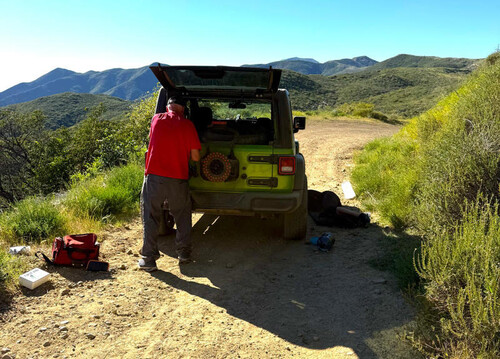
The Autonomous Vehicle drop-off spot at SJC airport where a Waymo left a rider without his bagsBrad TempletonWaymo has been scaling fast, now reporting that they do 500,000 rides/week. As this grows, we should expect to see more and more stories about mistakes. The good news is that these mistakes should result in all robots (not just Waymos) learning not to repeat that mistake. But some also offer lessons about the non-robotic part of serving riders.Two recent issues involving airport trips didn’t go well for passengers. In the first, a Waymo taking a passenger to SFO Airport detected a tire depressurizing. That was presumably due to road debris, since a robocar would detect any slow leak and go to its depot to deal with it. According to the passenger, the vehicle crossed several lanes of traffic to pull over on the left shoulder, which is not normally the best choice, but Waymo says they selected it because it was closer and wider than the right one.Not where you want to end up, and there are rules about picking up passengers on freeway shoulders. Waymo indicated to the passenger that a human rescue driver would come to their location, then take them off the freeway to a gas station where they could summon another Waymo. While human ride-hail drivers are known to pick people up who get stuck on a freeway, officially only emergency stops are allowed there, so you need a specially trained driver or tow truck. Waymo won’t be as “flexible" about the law for obvious reasons.AdvertisementAdvertisementThat’s not a great answer for somebody on the way to the airport. Fortunately for the passenger, a highway patrol officer came to the scene 15 minutes later and was willing to drive them to the airport. While that’s not a guaranteed service, CHP officers will sometimes assist motorists in this way. Because the Waymo is forced to drop passengers at the Airtrain station at the Hyatt hotel, a direct drop-off made up some of the extra time allocated and the passenger made the flight.But what should happen when a robotaxi faces a mechanical breakdown of this sort? Robotaxis should be able to do better than humans. The closest alternate robotaxi should be dispatched to the location within a second, before the vehicle has even pulled over all the way. In a full-sized fleet, wait times should be just a few minutes, and a passenger needing rescue should get top priority. If possible, the rescue ride should even pay an extra fee to drop off directly at the airport curb (SFO does not yet allow this for Waymo, it does allow that for Uber pickups.) In addition, the riders should get a free ride and another free ride coupon, so they actually almost feel lucky that they got stranded. When companies are running well, they should always work to turn every problem into a superior experience, not afraid to lose money fixing things. Indeed, the more it costs a company to fix a problem, the better message it sends that problems must be rare.Indeed, if there isn’t another robotaxi from the same company close to the passenger, all the competing robotaxi companies should have a mutual rescue agreement, where they will, for a reasonable fee or even for free, rescue the passengers of their competitor. If a Zoox was in the area, it should come to minimize the delay to the airport. Or a human driven Uber.The original Waymo pick-up/drop-off spot at SFO. The new one is closer but still requires an AirTrain ride, adding extra time so you don't want to be late.Brad TempletonIn fact, if none of those or close, a company should get radical. Normally there will be several occupied vehicles driving by every minute n any busy area. Passengers in one of those should get an alert if their vehicle has room: “Are you willing to help a stranded fellow traveler? This ride is free if you agree to let your vehicle pull over ahead to pick somebody up, then quickly drop them off a bit further down the road, where we are sending another vehicle to help them complete their journey. We estimate you’ll be delayed about 5 minutes.” I’m pretty sure somebody would say yes, and get the poor stranded passenger on their way literally in seconds. That would be service. And all parties involved would come away with a positive view of the company and the experience.AdvertisementAdvertisementA robotaxi like the new Waymo Ojai, with sliding doors, could accomplish a freeway rescue just fine, opening the doors away from traffic. The Jaguar used today has doors that swing out.Bags in the TrunkA different fate awaited a Waymo passenger to SJC airport. Di Jin reported that he placed bags in the trunk of his Waymo, but when he got out at the SJC drop-off area, the open trunk button in the Waymo app did not work, and the car drove away. He attempted to contact Waymo, but was told the car was going to the depot at could not return to him. Waymo has a lost-and-found system for items left in cars, where they place the items in lockers at their depots, and in Jin’s case, offered him two free Waymo rides to get to the depot for pickup, but would not send the bags to his flight destination in San Diego. He had to take his flight without luggage, he complains.Several things went wrong here, so there’s lots to learn. Jin did not respond to questions. Waymo has indicated it is possible that the passenger opened the door before the vehicle had come to a full stop, and that sometimes in such cases the trunk will not open. That’s obviously a bug they will want to fix. People open doors early all the time. Indeed, since Waymo knew the passenger asked to open the trunk at the start of the ride, that should have indicated there were probably bags there, and it’s clearly an error for the vehicle to leave until the passenger has opened the trunk and confirmed they have their bags. (I and others will not even close the passenger door until bags are extracted, as that prevents any departures.)It can be argued that a robotaxi should either have sensors in the trunk (low cost weight, ultrasonic or radar sensors can do it) to detect if there is something there. Waymo had a strange incident last year where an unstable person climbed in the trunk of a Waymo and the next passenger was very surprised to see a strange man in the trunk making odd claims. New sensors would only come in a new hardware generation, however.AdvertisementAdvertisementA robotaxi actually should be able to sense weight in the vehicle that’s not supposed to be there from how it changes the driving characteristics of a car. A stowaway should be easy to detect, carry-on bags might be a bit harder.It’s also a strike against Waymo that they could not send the vehicle back to the customer, and that, failing to do that, they didn’t go all out to get him his bags. Waymo reports they did eventually ship the rider’s bags back to him, but based on interviews, clearly not soon enough for his satisfaction. It’s hard to imagine a reason not to send the vehicle back, unless it was entirely out of charge, but even then, it would make sense to send a human rescue driver to get the bags. Airport situations are very tricky; modest delays can mean missed flights.Once again, any robotaxi company should work to use their tools to make problems like this “more than fixed.” This is not a problem that happens with human drivers, and robotaxi companies need to pay special attention to those situations. (The Uber app has a button that lets you phone the driver of your prior ride, and usually they are quite willing to drive back to you with your lost item.)This article was originally published on Forbes.com