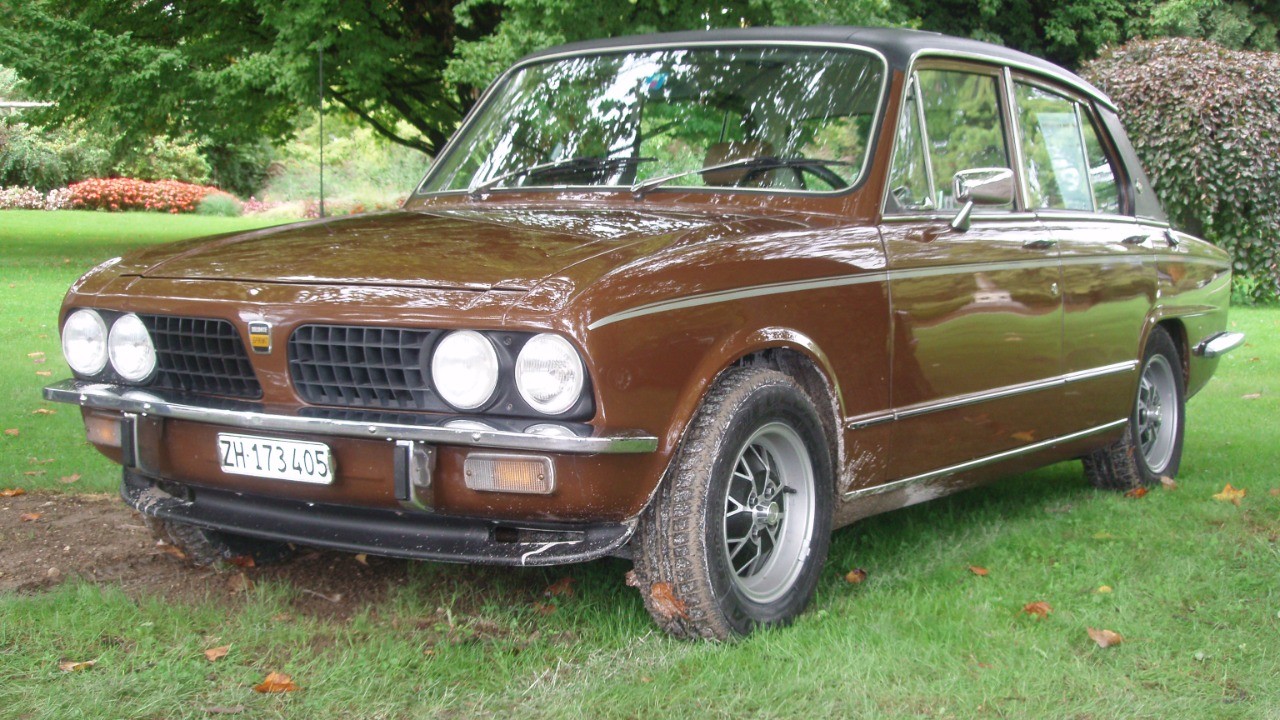
Mention Triumph and most people picture a TR roadster or a Spitfire with the top down. Yet from the late 1940s to 1980, the company also built the Triumph saloon for everyday buyers. Some of those four-doors were braver than the sports cars. Standard-Triumph tried razor-edged coachwork after the war, then Italian styling, front-wheel drive, fuel injection and a 16-valve head. Some ideas sold well, while others barely sold at all. Either way, most of these cars sold in modest numbers, and the oldest one on our list now survives only in the low hundreds. These are our picks: seven rare Triumph saloon models that, in our view, changed how people saw the brand. The verdict is our opinion. However, the years, engines and build figures come from marque histories, museum and club records and the references linked in each entry. 1. 1972 Triumph 2.5 PI Mk2 saloon Fuel injection on a family car was a bold move for a British maker in the late 1960s. Triumph fitted the Lucas mechanical system, with a separate injector for each cylinder, to its 2,498 cc six. The 2.5 PI arrived in the fall of 1968. At launch, Ate Up With Motor’s history of the car puts its output at 132 net hp. That made the saloon quicker than a Rover 2000TC, even though the Rover cost a bit more. The Mk2 body followed in October 1969. Giovanni Michelotti reshaped the nose so it echoed the coming Stag. Triumph then built 49,742 of the Mk2 2.5 PI between 1969 and 1975. Factory-entered cars also finished second and fourth in the 1970 London to Mexico World Cup Rally. The injection carried a price, though. According to a Triumph club history of the big saloons, the PI earned a reputation for unreliability and poor fuel economy. Its electric pump also overheated in hot Australian summers. Triumph dropped it in May 1975. In our view, that short, troubled run is exactly why a tidy PI turns heads today. 2. 1951 Triumph Renown TDB saloon Few post-war saloons were built the way the Renown was. Mulliners of Birmingham hand-built each body by fixing panels over an ash wood frame, a coachbuilding method from another era. As Hagerty’s profile of the Renown explains, steel was scarce after the war, so much of the skin used aluminium left over from RAF aircraft stock. The name arrived in October 1949, when Triumph renamed its 1800/2000 saloon. Power came from the Standard Vanguard’s 2,088 cc wet-liner four, which drove a three-speed gearbox with a column shift. Buyers could add overdrive from June 1950, and the car cruised happily at 75 mph. Hagerty counts approximately 9,301 cars from 1949 to 1954, including 191 limousines. Its sharp “razor edge” profile recalls 1930s Hooper-bodied Rolls-Royce saloons, Hagerty notes, yet the car cost less than a Riley RM. Triumph built it in right-hand drive for the home market only, so it never caught on in North America. Fewer than 200 are known to survive worldwide, according to Hagerty. For that reason, a 1951 TDB is the car on this list we’d most like to see in the metal. 3. 1951 Triumph Mayflower saloon Standard boss Sir John Black believed small-car buyers in America would love razor-edge styling. So the company shrank the look onto the Mayflower, which debuted on 28 September 1949, the first day of the Earls Court Motor Show. Leslie Moore, chief body designer at Mulliners, drew it. It was also the first Standard or Triumph with unitary construction. Fisher and Ludlow built the shells at Castle Bromwich, and one of nine prototypes covered 5,000 test miles across Europe in 1950. The car looked grand but drove gently. Its 1,247 cc side-valve four made 38 bhp. Meanwhile, Honest John’s classic review notes a top speed of just over 60 mph, with “shrunken Rolls-Royce styling” to match. In Britain, The Motor’s test car cost £505, while a Morris Minor was advertised at £382. In the US, it listed at $1,750, more than a basic two-door Chevrolet. Sales missed Standard’s hopes, and production ended in 1953 after about 35,000 cars. Meanwhile, Triumph built just 10 drophead coupés in 1950. We think the Mayflower showed that Triumph could think small and upmarket at the same time, even if buyers weren’t ready for it. 4. 1969 Triumph 1300 TC The 1300 was Triumph’s first front-wheel-drive car. It debuted at the London Motor Show in October 1965 as a more grown-up replacement for the Triumph Herald, with a crisp body by Michelotti. Unusually, its engineers mounted the engine lengthways, sitting above the gearbox. The TC joined the range in 1968. It used the same 1,296 cc four, but twin SU carburettors and a higher 9.0:1 compression lifted the advertised output to 75 hp. Triumph claimed 90 mph, and one road test recorded 93 mph with 0 to 50 mph in 10.5 seconds. The recommended UK price was £909. By comparison, the single-carburettor engine made 61 hp, so the twin SUs added a useful 14 hp. Triumph built 35,342 of the 1300 TC before the 1500 replaced it in August 1970. By comparison, the single-carburettor 1300 sold 113,008. As John Simister points out in his Goodwood column on the family tree, this front-drive layout soon gave way to rear drive. Our take: the TC was the moment a small Triumph saloon felt quick, refined and modern at once. 5. 1968 Triumph 2000 Mk1 saloon Triumph introduced the 2000 on 15 October 1963, a week after Rover showed its P6 2000. Unlike the four-cylinder Rover, the Triumph had a smooth 1,998 cc straight-six. It made 90 bhp, up from 80 bhp in the Standard Vanguard. Twin Stromberg carburettors and 8.5:1 compression made the difference. Michelotti styled it, and to our eyes it looks crisp next to the British executive cars of its day. Triumph showed it at the London Motor Show that October, and volume sales began in January 1964. An estate followed in 1965, with Carbodies building part of its shell. Buyers could also pick a four-speed manual with overdrive or a Borg-Warner three-speed automatic. Later, Triumph stretched the stroke from 76 to 95 mm to create the 2,498 cc six for the 2.5 PI. The car and its Rover rival helped define a new class in Britain, offering luxury with lower running costs. In our view, the 2000 is the car that made Triumph a serious name in company car parks. That mix sold strongly, too, and Triumph built 120,645 Mk1 2000s before the Mk2 took over in 1969. 6. 1978 Triumph Dolomite Sprint One camshaft working 16 valves was the trick behind the Sprint. That layout kept the 2.0-litre engine cheaper to build and, according to Hagerty UK’s buying guide, more reliable too. Early tests suggested about 150 bhp, but Triumph settled on 127 bhp at 5,700 rpm for longevity, with 122 lb-ft at 4,500 rpm. The Sprint arrived in June 1973 at £1,740, with alloy wheels as standard. Its cylinder head also won a Design Council award for the team led by Rover’s Spen King. The Dolomite’s engine family reached beyond Triumph, too, since a slightly smaller version went to Saab for the Saab 99. On track, Andy Rouse won the 1975 British Saloon Car Championship in one. Total production reached 22,941, yet only 1,352 Sprints left the line in 1978. Hagerty’s guide puts a very clean driver at around £11,000. We’d call it the car that gave Triumph’s sensible saloon a genuine performance badge. If you’re shopping, Hagerty warns that overheating can warp the head, so check the viscous fan and the Sprint-specific radiator first. 7. 1976 Triumph 1500 TC This is the car that ended Triumph’s front-drive experiment. The 1500 TC replaced the front-wheel-drive 1500 in late 1973. It kept the 1500’s body, with its four-headlamp nose and smart interior, but sat on Toledo-type underpinnings with a conventional front engine and a beam rear axle. Meanwhile, the Dolomite combined that same 1500 body with Toledo rear drive and a new 1,854 cc engine. So the TC sat right in the middle of the family. Under the hood, a 1,493 cc four with twin SU carburettors made 64 bhp. As a result, the car reached 91 mph and could return up to 30 mpg, according to Classic & Sports Car’s A to Z entry. It was no hot rod. Still, it was a comfortable, well-trimmed small saloon with a smart cabin. Few people notice the switch today, because the 1500 TC looks almost exactly like the front-drive car it replaced. Look underneath, though, and the whole layout has changed. In our opinion, that makes it one of the quirkiest Triumph saloon models ever sold. Triumph built 25,549 of them between 1973 and 1976, when the model became a Dolomite like the Toledo.

 Liked by Nathan Morgan, Kayla King







 Liked by Nathan Morgan, Kayla King