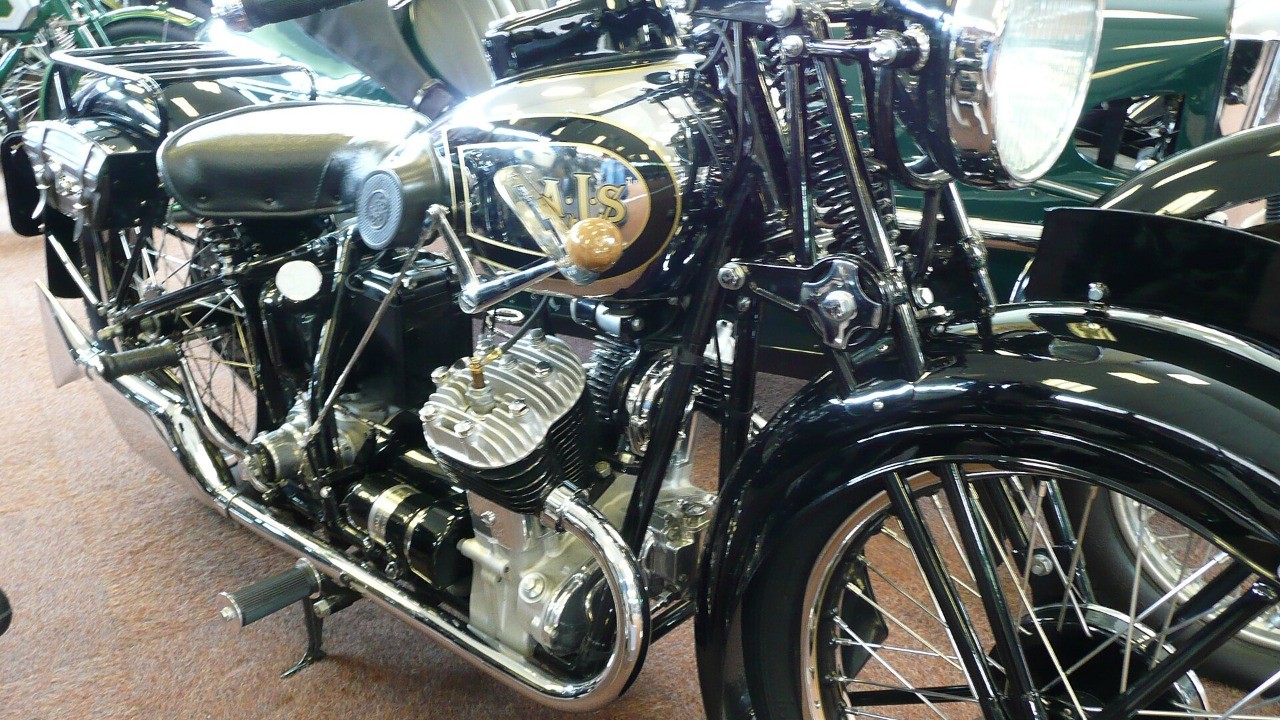
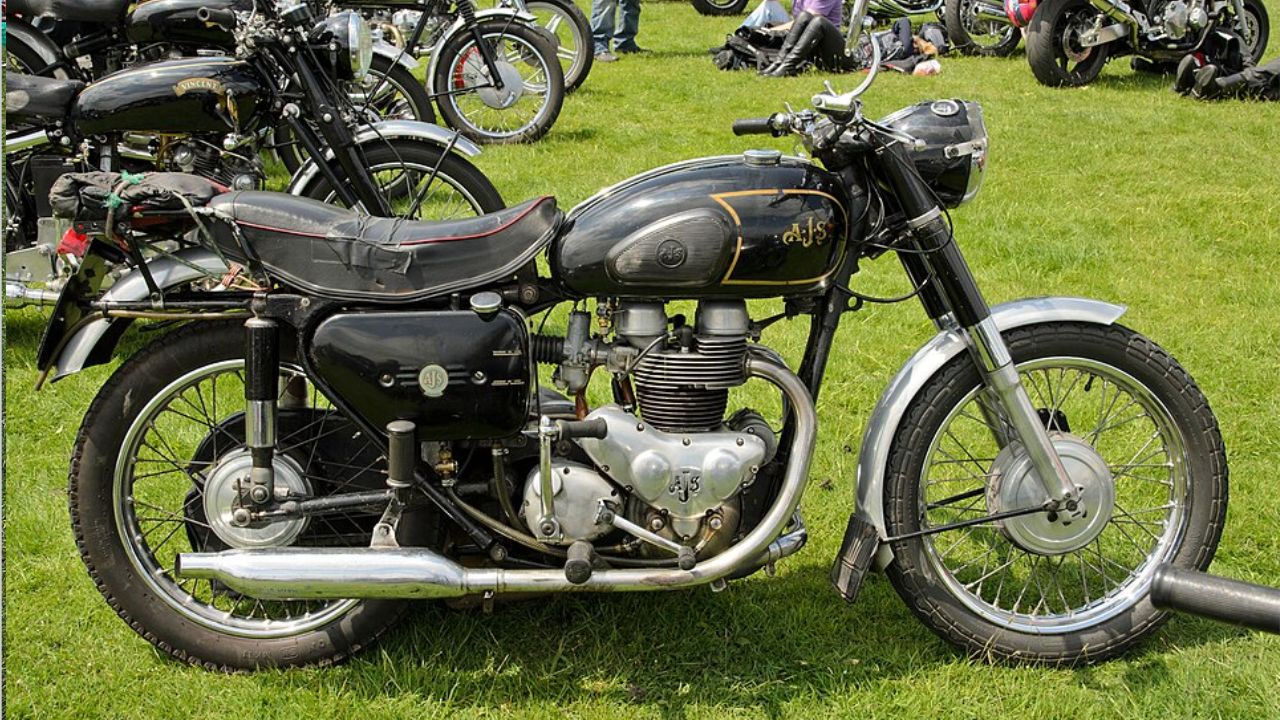
AJS began in Wolverhampton in 1909, and the Stevens family’s little company went on to hold 117 motorcycle world records. Its riders also won at the Isle of Man TT within five years of the first AJS reaching the Motor Cycle Show. The name had a bumpy ride after that. The original firm went into liquidation in 1931, and the Collier brothers of Matchless moved the badge to London. From then on, many AJS models shared their engines and frames with Matchless twins and singles. Then, in 1966, the name ended up with Norton-Villiers. That makes AJS easy to overlook next to Triumph, BSA or Norton. However, the badge sat on some clever racers and some honest, hard-working road bikes. These are our picks, ten AJS models we admire, and the admiration is our opinion. Our years, engines and figures come from museum records, marque histories and the period sources linked below. 1. 1925 AJS Big Port The Big Port took its name from one obvious feature: a large-diameter exhaust port on its overhead-valve 350 cc single. The design first appeared in 1922 and stayed popular for the rest of the decade. It was also the mainstay of AJS racing until 1927. Road riders got a bike closely based on those race machines. According to the National Motor Museum’s record of its 1927 H6, the road model could reach 80 mph and cost £53 new. AJS also offered a racing H7 that never appeared in the catalogue, and plenty of Big Ports ended up in club racing. The museum’s own example shows how long these bikes kept working. It ran in grass track racing in the 1930s, came back for vintage events from 1972 to 1976, and finished a restoration to original condition in 2020. In our view, the 1925 Big Port is the purest expression of what made the Wolverhampton company special. It was a simple single with a racing pedigree, sold to ordinary riders at a sensible price. Brooklands Museum also keeps a 1928 Big Port that Terry Gardiner raced there in 1938, with a listed top speed of 90 mph. 2. AJS S3 V-twin The S3 was the bike AJS hoped would win over touring riders. It used a transverse V-twin, with the cylinders sticking out either side like a car engine. A shaft primary drive fed a spiral bevel, which turned the power through a right angle to a fully enclosed final drive chain. As RealClassic’s history of the AJS V-twin describes, it weighed 355 lb, topped out at 65 mph and cruised easily at 45 to 50 mph. The engine also used chain-driven camshafts. In our view, the whole package was refined and modern for 1931. Unfortunately, the timing could hardly have been worse. The S3 was expensive to develop and slow to sell. Meanwhile, AJS’s 1931 accounts showed a loss of nearly £80,000, and the business went into liquidation that autumn. BSA bid for it, but the Collier brothers bought the name and manufacturing rights for £20,000. We admire the S3 because it shows how ambitious AJS was right at the end of its independent life. By contrast, RealClassic notes that the 1933 AJS V-twin owed more to the Matchless Model X than to the Wolverhampton bikes. 3. 1954 AJS E95 Porcupine The Porcupine began life as the E90S of 1945, a 500 cc twin with horizontal cylinders. AJS designed it for supercharging. Then the sport’s governing body banned superchargers in 1946, so engineers had to rework it to run without one. It won anyway. Jock West first raced it at the 1947 Isle of Man TT, finishing 15th despite setting the third-fastest lap. Then Les Graham took the inaugural 500 cc World Championship in 1949 on an E90, and that remains AJS’s only world title. The nickname came from the earlier bike’s spiked cylinder head, and it stuck when the E95 arrived in 1953 with its cylinders inclined at 45 degrees. That version moved from the E90’s open frame to a loop frame with a lower-mounted engine, and it claimed 55 bhp at 7,600 rpm. According to Motorcycle Classics, AJS built only four 1954 E95 race bikes. One of them went to a 2011 Bonhams sale with a $750,000 estimate, while another E95 sold in 2000 for about $258,500. In our opinion, few British racing motorcycles pack this much history into so few machines. 4. 1948–1963 AJS 7R Boy Racer Riders knew the 7R as the “Boy Racer,” and it was a 350 you could actually buy and race. Phil Walker designed its chain-driven overhead-camshaft 350 cc single. At launch it made 32 bhp at 7,500 rpm, and later factory versions reached 40 bhp at 7,800 rpm by 1954. The 1957 version made 38.5 bhp at up to 7,800 rpm. Racers won on it from the start, both factory teams and privateers. In 1951, Ike Hatch developed a three-valve version, the 7R3, as an answer to the Italian multi-cylinder bikes. Later, after AMC pulled out of works road racing at the end of 1954, AJS kept building a two-valve 7R for private riders until 1963. The bike’s range is the surprise. For example, Bill Nilsson converted a 7R into a motocross machine and won the first FIM 500 cc Motocross World Championship in 1957. On the road circuits, 7Rs also won the Junior Manx Grand Prix in 1961, 1962 and 1963. A 500 cc version even sold as the Matchless G50. We’d call the 7R the privateer’s ticket into serious racing in that era. 5. 1947 AJS 16M The 16M arrived in 1945 as the AJS version of the wartime Matchless G3L. It used a 348 cc overhead-valve single with a rigid frame at the back. Up front, however, it had AMC’s Teledraulic forks. The numbers were modest. According to the National Motor Museum’s entry for its 16M, the engine made 16 bhp at 5,600 rpm. Top speed was 78 mph, and the price new was £125. Telling one apart from a Matchless is easy, too. The AJS has its magneto in front of the cylinder, while the Matchless carries it behind. AJS Motor Cycles Ltd built it in London, where production had moved after the 1931 takeover. Later, the Model 16 line gained a new gearbox in 1956 and an alternator with an alloy primary cover in 1957. The museum’s own bike shows the 16M’s staying power. It was first registered in February 1946 and stayed with one family from 1947 until 2010. Our take: that kind of ownership record says more about a bike’s toughness than any brochure. If you want an easy first British classic, a 16M is a sensible start. 6. 1953 AJS Model 16MS The 16MS was the 16M with rear suspension. In fact, the “S” stood for “sprung,” as The Classic MotorCycle’s profile of the 16MS explains. Swinging-arm rear suspension became an option soon after the war, and the 350 single gained a far more comfortable ride. The rear units changed over time. Early “candlestick” dampers gave way to the fatter “jampot” units in the early 1950s, which held more oil. Girling shocks came later. For 1953, the Model 16 also gained a dual seat. AMC built the AJS and its Matchless twin, the G3/L, on the same line at Plumstead. Once again, the main visual difference is the magneto position. An April 1958 Motor Cycling advert, quoted by the magazine, sold it as the “fully sprung 350cc OHV Model 16MS.” This is the bike we’d choose for real riding. It keeps the simple 350 engine, adds a sprung rear end, and wears the AJS badge that fewer people expect to see. The Classic MotorCycle noted a 1959 example for sale at £2,850 at a specialist dealer. Clearly, these bikes don’t have to cost a fortune. 7. 1960 AJS Model 31 The Model 31 was the 650-class AJS twin. It replaced the 600 cc Model 30 in 1959, and its 646 cc engine made 34 hp at 6,500 rpm, according to webBikeWorld’s profile of the 1959 model. Its Matchless twin was the G12. One detail stands out. AMC gave its twins a centre main bearing to cut crankshaft flex, which let the company use cast-iron cranks. AMC used that design on the Matchless G9, the AJS Model 20 and later twins up to 750 cc. The 646 cc engine also made 33 lb-ft at 5,500 rpm. It was a thoughtful piece of engineering on a bike built for everyday riders. We’ve included the Model 31 before among British motorcycles you’ve probably never seen in person. Sales were the problem. The AMC twins struggled in the American market against Triumph, BSA and Norton. In our view, that is exactly why the Model 31 deserves a second look. If you buy one, check the oil level and pressure closely, because Classic Bike Hub links snapped cranks on these twins to low or old oil. 8. 1958 AJS Model 30 The Model 30 arrived in 1956 with a 593 cc parallel twin. Its Matchless twin was the G11. That year, AMC also gave its range a new frame with a longer seat, twin “jampot” rear dampers and Teledraulic forks. Ownership had its quirks. According to Classic Bike Hub’s guide to the G11 and Model 30, the bikes became known for oil leaks over the engine. Their brakes were “not great,” and the frame “was not the stiffest.” The rigid bottom end could also pass a lot of vibration to the rider. On top of that, the guide links snapped cranks to low oil levels, old oil or low pressure. Even so, the 600 had a short, interesting life before the 646 cc Model 31 replaced it in 1959. We like the Model 30 as an affordable way into an AMC twin. Classic Bike Hub suggests between £3,500 and £5,000 for a runner, the same range it gives for the 500 cc G9 and the 646 cc G12. Our buyer advice: budget for gaskets and a careful look at the bottom end, and keep fresh oil in it. 9. 1965 AJS Model 14CSR The Model 14 brought the AJS badge to the 250 cc class. It arrived in 1958 alongside the Matchless G2, and production continued in various forms until 1966. The bikes looked like unit-construction machines, but according to the AJS and Matchless Owners Club, they were not. They weren’t especially light either, weighing about 322 to 328 lb. Over their production life, they changed very little. Matchless sold its own version as the G2, so the club’s knowledge covers both badges. The club also praises the “nice clean lines” of these 250s. Yet the sporty CSR had its moment. In 1964, a factory-modified 14CSR ridden by Peter Williams and Tony Woods won the 250 class of the Thruxton 500-mile race, averaging 61.6 mph. That class win is why we admire this one. A heavy-ish 250 from a company known for bigger singles and twins went the full 500 miles and beat its class rivals. For a rider who wants a smaller, sporty-looking AJS, the 1965 14CSR makes a strong case. The CSR badge carries real racing credit behind it, from a genuine endurance race. 10. 1954 AJS 500 Model 18 The Model 18 was the 500 cc partner to the 350 Model 16. AJS released the 18S in June 1945 alongside the 16M. At first, these post-war bikes were essentially pre-war designs fitted with the new Teledraulic forks. Its Matchless counterpart was the 497 cc G80, and the two bikes were nearly identical apart from the magneto position. The 18S engine shared that 497 cc capacity. Rear suspension followed, first with “candlestick” units and then the “jampot” dampers. The singles also gained a Burman gearbox in 1952. By 1954, the Model 18 had settled into its role as AJS’s big everyday single. On the AJS, that magneto sits in front of the cylinder. You can see the Model 18 in our list of British motorcycles that were years ahead of their time. We admire the Model 18 for its lack of fuss. It did the everyday job of a big British single, without the reputation of a Gold Star or a Manx Norton. AJS kept the name on Matchless-based bikes for years afterward. Eventually, in 1966, the AJS name and its parent company passed to Norton-Villiers.

 Liked by Carter King, Victoria Campbell










 Liked by Carter King, Victoria Campbell


