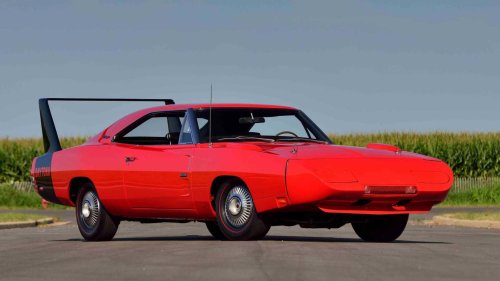
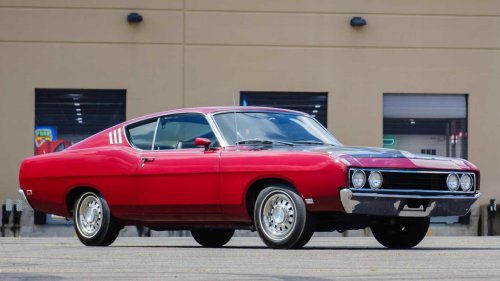
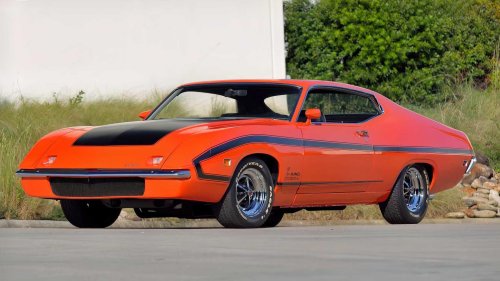
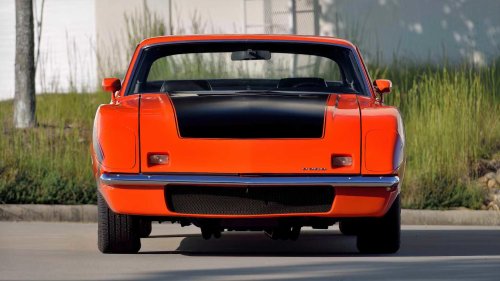
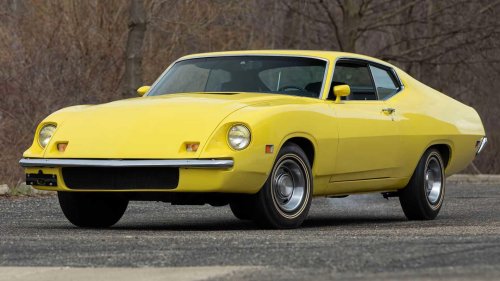
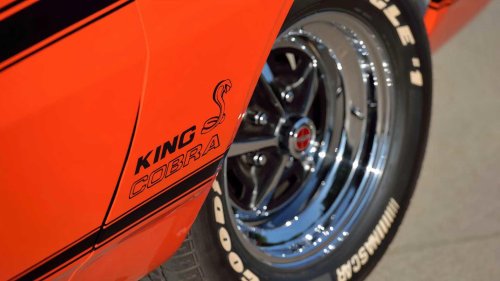
















Ford was the most successful NASCAR manufacturer of the 1960s, but that wasn’t enough for the Blue Oval. As NASCAR's aerodynamic arms race intensified, Ford found itself facing increasingly sophisticated rivals from Chrysler, as cars like the Dodge Charger Daytona and Plymouth Superbird could match—and sometimes surpass—Ford's best efforts on the series' fastest tracks.By the late 1960s, NASCAR’s so-called “aero wars” were in full swing, as manufacturers searched for every possible advantage in top speed and stability. Ford had played a major role in starting this with the Torino Talladega, and was determined to stay ahead as rivals pushed development even further. The problem was that the car it made proved too extreme even for NASCAR's wild aero-war era. Ford Wanted To Beat Dodge And Plymouth On The Superspeedways MecumWhen you think of aerodynamics today, you probably think of Formula 1. Maybe you think about some of the more track-focused supercars, like the Porsche 911 GT3 RS, or the Aston Martin Valkyrie. Something with intricately designed tunnels, meticulously tested wings, and painstakingly-crafted channels funneling the air exactly where the automaker wants it to go for optimum grip.Back in the late 1960s, however, aerodynamics was more primitive. It essentially boiled down to "making it sleeker and chucking a big wing on it," leading to designs like the pointed nose on the Charger Daytona or the two-foot wing on the back of the Superbird.But while other manufacturers had started experimenting with wings to aid aerodynamics, Ford hadn’t quite subscribed to the mindset by the late 1960s. Its Torino Talladega was dominant but wingless. Rather than rely on increasingly tall wings to generate downforce, Ford instead focused on subtler improvements like a reshaped nose, revised grille, and a sleeker overall profile. Ford Needed Something Wild, Aerodynamic, And Experimental MecumAs beautiful as the Torino was, its design was considerably different to competitors. While some contemporaries at the time were favoring wings that would make an F1 car blush, Ford opted to omit any kind of wing, either front or back. Instead, it elongated and lowered the nose, and adjusted the grille slightly to provide more aero without adding drag. The car, known in 1969 as the Torino Talladega, was dominant. It won both the drivers' and manufacturers' championships that year (the drivers' championship being taken by David Pearson).But competitors were closing the gap. The Torino Talladega had ignited an aerodynamic arms race, and had forced competitors to escalate development. To remedy this, Ford created a car that was so wild that it had to be killed almost as soon as it was started. The 1970 Ford Torino King Cobra Was Supposed To Dominate MecumWith the task of making the already quick Torino quicker, Ford turned to legendary designer Larry Shinoda. With the Corvette C2 already under his belt, his task was simple: create a Ford capable of exceeding 200 mph on superspeedways.To that effect, the car was reshaped into something far more slippery. The nose was lower and more pointed, with the grille getting a “bottom-breather” style with the opening below the bumper. The headlights were moved deep into the hood, which itself was integrated with the nose of the car to create one swooping line from the front to the windscreen. The rear of the car remained largely similar, retaining the sloping fastback but gaining a concave rear window in an attempt to extract more downforce.It wasn’t just visually that the King Cobra would change, though, as Ford knew that what’s under the hood was equally important. With the Torino King Cobra still in the prototyping stage, Ford tried it with three big-block engines: the 429 Cobra Jet, the 429 Cobra Super Jet, and the Boss 429. Though they were all 7.0-liter V8s, the Boss 429 was the most likely NASCAR engine, given its power and racing pedigree, having been used in 1969.MecumAt this stage, the car was still very much a prototype. Weight was kept down with fiberglass body panels, and early wind tunnel testing suggested that the car could reach the 200 mph speed that Shinoda had been set. With three mules ready, the next step would be to test them. Even NASCAR’s Cale Yarborough Said It Was Too Crazy MecumCale Yarborough was no wallflower behind the wheel. He had 560 NASCAR Cup Series races over 31 years, with 83 wins and 319 top ten finishes. The three-time consecutive Cup Series champion was known as a relentless competitor that took no prisoners, and so he was the perfect driver to test the King Cobra.Ford and Yarborough went to Daytona in the summer of 1969 to test this new machine and, unfortunately, it was too much even for Yarborough. He reportedly got out of the car shaking his head, noting that the car was “super squirrely” (“squirrely” being racing jargon for unstable or twitchy). It's theorized that this was because, as the car's speed increased, air got stuck underneath the car's elongated nose rather than pushing it down. This caused front-end lift, making the car unstable in corners and more difficult to drive the faster it went. Others place the blame on the concave rear window possibly not providing the rear downforce required at over 200 mph, but whichever camp is correct, the Torino King Cobra's handling was a major concern—particularly if a driver as notoriously tough as Yarborough was complaining.But while Yarborough was shaking his head at the car’s unpredictability, political changes were afoot. NASCAR’s homologation rules were to rise from 500 cars to 3,000 for 1970, which made the Torino King Cobra not only dangerous for drivers, but unfeasible financially for Ford. It would kill the King Cobra with just three prototypes made, and scale back its NASCAR program considerably for 1970. The King Cobra’s Bite Was As Bad As Its Bark Link ImageWith the Torino King Cobra project shelved, the cars were surplus to requirements. NASCAR team owner Bud Moore bought two of the three (though there are rumors of a fourth) for $600 each, though their incredible rarity means they're astonishingly valuable today: one was listed on eBay for $456,000, while another sold at auction for an astonishing $525,000 in 2016.The Torino King Cobra remains a great “what if” of NASCAR. A car conceived during a time of intense competition that never had the chance to develop into what it could have become. Ultimately, it pushed Ford to a point that it couldn’t justify continuing from, forcing the company to not only abandon the project but to step back from an arms race it had helped to create. It stands today as something exceedingly rare: a car that was simply too extreme for 1970s NASCAR.Sources: Hemmings, The Gentleman Racer, HotRod