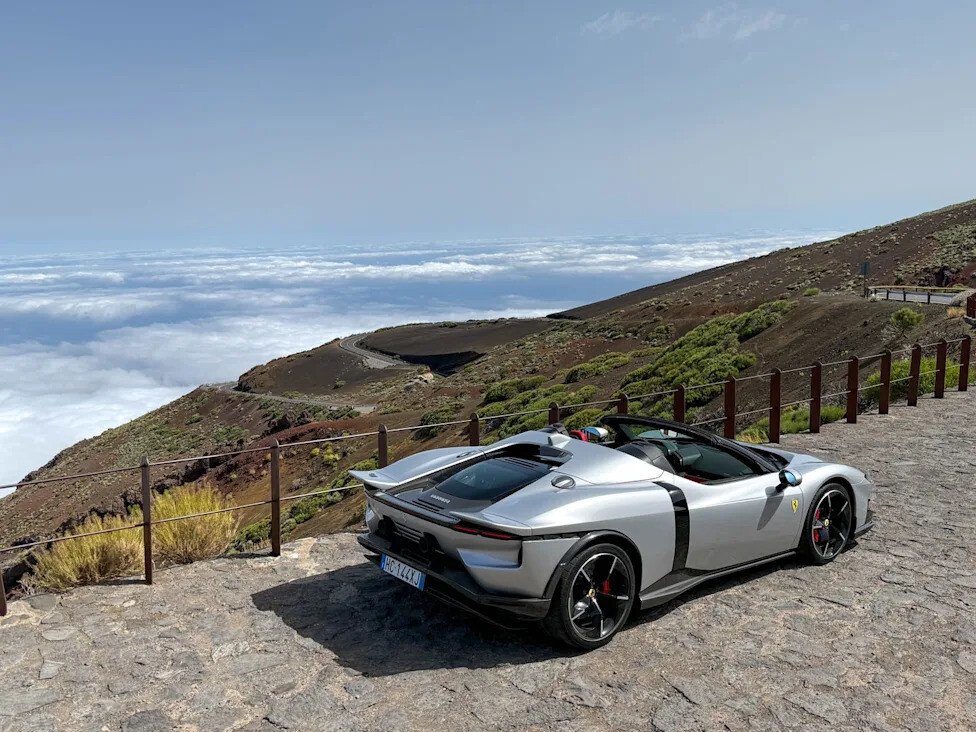
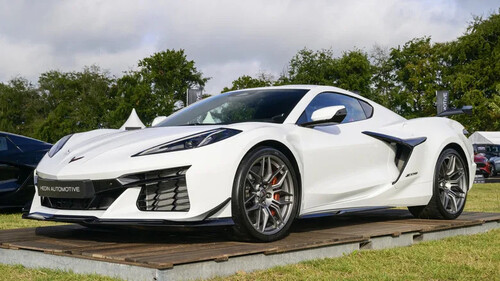
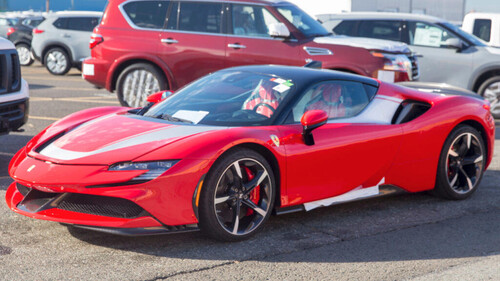
The Ferrari 849 Spider Is Trying Too HardFerrariThe Ferrari 849 Testarossa and its more whimsical Spider variant are cars that, despite their many, many talents on the road, leave me scratching my head.Courtesy of FerrariLook. I understand. The SF90 needed an update. Sure. It's easy to see causation in a very obvious response: making the SF90 look different, changing its name to something more grandiose yet also familiar. And adding just enough extra power to push the output into four figures to justify the additional expense.That's my best guess as to how we arrived at the 849 Testarossa. But that doesn't excuse the problems I have with it.AdvertisementAdvertisementLet's start with the name. Because 849 defies Ferrari's standard three-digit convention, which is normally displacement followed by cylinder count. So the 328 was a 3.2-liter V-8, the 512TR was (just a hair under) a 5.0-liter V-12. Even the 296 follows the rules, being a 2.9-liter V-6. There have been exceptions over the years—the "8" in 812 referenced power output (800 cv) rather than that car's 6.5-liter displacement, as 6512 would have looked like a typo and 612 was already taken. But for the 849, Ferrari has switched the cylinder count to the front and then added displacement per cylinder—499 cc—after it. Which seems contrived.And Testarossa? There had been two cars in Ferrari's history with the name: one a late-Fifties/early-Sixties racer (spelled Testa Rossa) and the other a car you probably know well from the Eighties. Apart from crinkle-coated red valve covers, a feature on every Ferrari for half a century, there's no indication at all why the new car gets the historic name. No styling cues, no mechanical references, no Easter eggs. It just seems like a familiar, famous name they had lying around.Courtesy of FerrariThen there's the styling, which is definitely different but doesn't commit to the bit fully. The greenhouse is carried over from the SF90 pretty much unchanged. That makes it look like Ferrari has tried to lay a new, squarish car on top of the old, rounded one—like a testing prototype wearing a shape-shifting disguise. Likewise, the blacked-out bar across the 849's nose is "paying homage" to pop-up lights. Call me crazy, but either lights pop up or they don't, and these don't, so you might as well have just designed a nose for that.Suffice to say that if you want to enjoy an 849 Testarossa Spider, my advice is to get into it as quickly as you can. Because the view, and indeed everything else, improves vastly from the driver's seat.Matt FarahThe cabin is familiar Ferrari with comfortable seats, decent legroom, and a full digital gauge cluster in front of the driver that, thankfully, is controlled by real buttons on the steering wheel. One day, maybe Ferrari can earn enough profit to turn the remainder of the buttons across the dash, such as for the mirror controls, nose lift, and climate, back to physical switchgear as well. There is, thankfully, a real, red start/stop button, although it ironically powers the car up into a silent EV mode. You then have to press a haptic non-button on the steering wheel to fire the engine in Performance or Qualifying mode.AdvertisementAdvertisementThat engine, the latest version of Ferrari's 4.0-liter twin-turbo V-8, is quite the spicy little number, particularly when paired with three electric motors. Dishing out 819 horsepower and 621 lb-ft worth of particulate-filtered hydrocarbons by itself, the V-8 has 10 percent bigger turbos than on the SF90, which is a huge increase, with a fine-tooth look at weight reduction to the block, cams, and crankshaft to offset the turbos' physical heft.FerrariInterestingly, the new engine doesn't suffer from the issues that come with big turbos—loss of low-end torque—thanks to a clever blow-by system in the cylinder head that spools the turbos early with extra air the engine won't need. Even without the three motors, this car would still be very, very fast.But it has the electrical assistance anyway, with a 133-hp unit driving each front wheel and a 201-hp motor-generator between the engine and gearbox. With everything flowing, peak output is 1036 hp, which puts the 849 Testarossa in the same ballpark as the hybrid all-wheel-drive Aston Martin Valhalla, Lamborghini Revuelto, and Chevrolet Corvette ZR1X. And as the Testarossa Spider is just 200 pounds heavier than the coupe, it is barely any slower.Matt FarahThe Spider's two-piece hardtop goes up and down quickly and can be operated at speeds of up to about 30 mph. As with nearly all mid-engine cars, lowering it greatly improves the experience, particularly somewhere as blindingly stunning as the island of Tenerife, where I drove it. Having prepared my aerodynamic head with SPF 50, I dropped the top once and left it there for the day. Ferrari offers a variety of seats, most of which are comfortable once you've completed the training course on how to adjust them.AdvertisementAdvertisementDynamically, I have few notes. There was not enough road on Tenerife to responsibly explore the limits of what 1000-plus horses can really do. But I'll list a few things. It makes it easy work to pass two, three, or four cars at a clip on the highway, to blast past a slow-moving truck on a mountain pass, or to keep up with a superbike on a 30-mile downhill section of road I can only describe as being like Pikes Peak with Spa's tarmac. That much horsepower will also thrill a selection of young kids when you spin all four wheels on a launch, and, should you have few moral scruples about extreme speed, allow you to quadruple most speed limits with ease.Courtesy of FerrariShould you find yourself at a track day with limited talent, the car's staggering straightaway pace might put you into the advanced group by default.Even past the 849's ridiculous power output, I found a lot to like. For instance, it is extremely pleasant to drive slowly. That may seem silly to say, but historically, cars that run nine seconds in the quarter-mile would not be nice to operate at lower speeds. Now they are. The Ferrari is beautifully balanced and damped with the "bumpy road" mode in town feeling about equivalent to the ride of a Porsche 911 Carrera and only slightly firmer in the regular mode.Matt FarahThe new car also has vastly improved integration between gas and hybrid motors compared to the SF90, which was much clunkier. The five years of further development have been kind to this platform. Ditto the brakes, which are fully by-wire but with a beautiful blend of regenerative recuperation and disc chomping that is all but imperceptible unless you have a totally full battery and are, say, going downhill at very low speeds, with ice-cold pads. And the DCT gearbox, which used to shift smoothly but just slightly differently each time, now acts more like Porsche's PDK dual-clutch, where every shift is exactly the same. Qualifying mode comes with the SF90 XX's shifting program and its aggressive bangs and burbly tunes.AdvertisementAdvertisementThe steering ratio is sharp but not twitchy, while the two motors up front invisibly add or drag torque as needed to get through a corner better while also remaining a bit more relaxed on the highway. Crucially, thanks to the new steering wheel, I wasn't summoning Siri by accident every time I turned left.Matt FarahDownsides? Fortunately, once driving, there are few. But there is the littlest jiggle with the top down—just a tiny amount to remind occupants that the 849's metal structure does not have carbon-fiber-tub levels of rigidity. There's also the frustration that, despite the ability to tweak a digital display, the gauge cluster can't display both a tachometer and a navigation screen at the same time. Want to shift manually while not getting lost on an unfamiliar exotic island? You're out of luck.Buyers should also prepare to spend another $15,000 for an aftermarket exhaust, because the particulate filters make this engine quieter than it was in the F8, even with 50 percent more power output overall. I spent a half hour with Ferrari engineers going over their preferred choices. Ultimately, they recommend the Akrapovič system.Matt FarahFrankly, a Corvette Z06 at under a third of the money sounds better and is as fast a road car as anyone could ever want, while a Corvette ZR1 makes a strong argument for a better performance machine at under half the spend (and with a rear trunk). GM is on a tear, with the ZR1X both outaccelerating the SF90 while also keeping alive the naturally aspirated flat-plane V-8—an engine variant Ferrari carried an essential monopoly on for three decades before surrendering in 2015.AdvertisementAdvertisementIf the 849 Testarossa (or the F80, or the 12Cilindri) were jaw-droppingly gorgeous objets d'art like the SP2 Monza, SP3, and LaFerrari, I wouldn't dare bring up a Corvette comparison. But they aren't, so I have.Matt FarahCrucially, although I'm the one sharing my opinions, I recognize that tastes do vary. Based on Instagram comments, a significant portion of the online population does believe the 849 Spider in Argento Nürburgring is a beautiful car. Maybe time will determine I have had a bad take here. But even after the most idealized driving day imaginable, the styling of this car isn't speaking to me.But if it speaks to you, rest assured, it drives fabulously, is packed with cutting-edge technology, and is one of the fastest cars money can buy. Also, because it now looks so different, everyone will be able to tell it apart from the cheaper 296, so that's one worry crossed off the list.You Might Also LikeIf You Can Only Own One Car, Make It One of TheseThese Are the Most Popular Cars by State