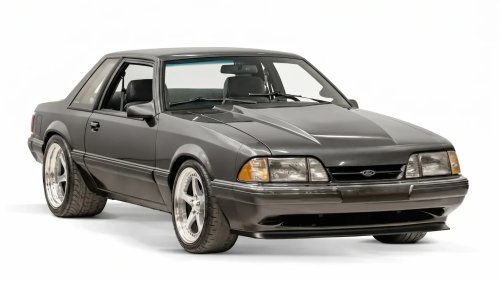
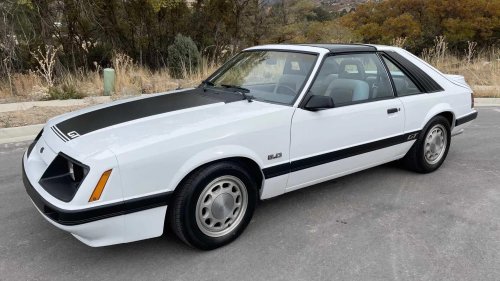
Despite its status as one of the least iconic versions of the Ford Mustang, the fourth-gen pony was actually a major milestone. There was the revised platform, many enhancements made compared to the Fox Body generation, an exciting new engine, as well as serious performance, courtesy of the later high-performance versions. What used to be the slightly frumpy, intermediate cousin between the Fox Body and S-197 has now become a more sought-after pony with a potential for lots of fun, and, further down the line, potential investment opportunities.In order to give you the most up-to-date and accurate information possible, the data used to compile this article was sourced from the manufacturers and other authoritative sources, while values were sourced from auction site Classic.com and insurers/valuators Hagerty. The Fox Body Mustang Set The Stage 1985 Ford Mustang GT coupe, front 3/4Released in 1979, the Fox Body - named after the new Fox platform - would eventually signal the return of the Mustang's mojo. It was relatively lightweight and agile, and its styling received a modern overhaul, which set it apart from its aging predecessor. Running from 1979 to 1993, the Fox Body gained a following for its decent performance, ease of modification, and, of course, its affordability. Convertible, coupe, and hatchback versions were produced, with the convertible available from about 1983.A large change was the reintroduction of V8 power, with the pushrod 'Windsor' V8 that offered up to 225 horsepower in later trims. The 4.9-liter V8 was initially offered alongside the lesser engines, then replaced with a 4.2-liter V8 for 1980-1981. Luckily, the high-output 4.9-liter returned in 1982, in time for the return of the 'GT' trim. The 1993 SVT Cobra produced 235 horsepower and a huge 280 pound-feet of torque. Also interesting is the Mustang SVO option - a 2.3-liter, turbocharged four-cylinder with up to 205 horsepower. A Clear Styling Evolution Changed Things Up Bring A TrailerMost enthusiasts and non-enthusiasts will be familiar with the changing face of the Fox Body Mustang. To give more life to the platform and bring the Mustang in line with Ford's other products like the Taurus and Thunderbird, the car received various styling changes, the principal being the redesigned front end. This is known as the 'Aero Nose' styling feature. Introduced in 1986, it radically altered the look of the car by swapping out the quad-headlight design and altering other elements of the car's design. There are fans for both the pre-Aero Nose facelift and the latter, which featured in the music video for Vanilla Ice's track Ice Ice Baby. Notable changes for the 1987 facelift included: New, composite headlamp units, which replaced the previous quad-light units Restyled body panels, including bumper, hood, and fenders Revised interior with new instrument panel, dashboard, wheel, and other components The GT received an aggressive front bumper with fog lights, side skirts, and louvered taillights Fox Body Mustang: Pricing Ford Unleashes The SN-95 Mustang rtr-1Ford called the new Mustang for 1994 the SN-95. As it rolled out of the factory gates and began to appear at dealers and in brochures, there was no denying the big styling evolution here. It was inevitable to some extent, as many models from the 90s adopted a rounded 'jelly mold' styling ethos. Despite its new look, it was still a Mustang and more familiar underneath than it would at first seem.Underneath was the Fox-4 platform, a fancy new name for a heavily revised version of the Fox platform from the third-gen Fox Body. The Blue Oval engineers made efforts to improve it, and the chassis was stiffer, and the track was wider. Its suspension was improved, and the car came with features like disc brakes all around. Another change to the lineup was the eradication of the notchback, hatchback, and convertible body style options, with a coupe and convertible being the standard choices. Despite gaining some weight, the car was also more comfortable - increased comfort was also achieved through a more refined interior with improved sound insulation, better seating, and more ergonomic interior design. Overall, the SN-95 was a considerable refinement over the previous model.A returning feature was the '5.0' V8, which returned to the lineup once more, but only for the first two years before a new engine, the modular V8, appeared.Other key changes during the SN-95's lifecycle were: A new SVT Cobra model for 1994-1995, with 240 horsepower and various performance upgrades The second Cobra R model was produced in 1995, with a 5.8-liter V8 and 300 horsepower In 1996, the car received the new modular engine Taillight design revised to vertical bar style in 1996 Automatic transmission upgraded - changed from AOD‑E to 4R70W in the same year Various incremental improvements over time and changes to interior features The modular engine reached 225 horsepower by 1998 SN-99 Mustang New Edge, New Features Ford Mustang Convertible (2000), front 3/4A major facelift occurred in 1999 that brought the car's styling ethos in line with Ford's then-current design philosophy - 'New Edge'. It was used on various models from the Ford Focus to the Ford GT90 concept. Shaper lines and creases were back, which gave the jelly-shaped SN-95 a slightly more muscular appearance, most noticeable in the updated front lights and fascia as well as at the rear.Ford also introduced the 'PI' version of the modular engine for the Mustang GT - not a private investigator, but 'Performance Improved', which raised the bar to 260 horsepower, a welcome improvement.The SVT Cobra models continued to be produced, although there was a debacle for 1999 where the model was overrated by Ford - as such, it skipped 2000 and returned in 2001 with its true, revised engine output figure. At this time, the impressive SVT Cobra R was also produced, the second time the Cobra R appeared for the fourth-gen Mustang (the first was in 1995). It was the most powerful of the 4th-gen Mustangs, until the arrival of the supercharged Terminator for 2003/2004 (see below). Other notable versions of the Mustang include the 2001 Bullitt and the 2003-2004 Mach 1. The Hardware Under The Hood 1994 Ford Mustang GT engine (Windsor)A controversial change initially, the modular engine (above, right) was a big step up from the small block (sometimes called the Windsor) pushrod V8 from the Fox Body and the first two years of the fourth-gen pony. Its major differences up front were the switch to an overhead camshaft instead of a pushrod design and its smaller displacement, dropping from 4.9 liters to 4.6 liters. The goal here was to design an engine from the ground up to meet stricter emissions regulations and also improve fuel economy.Features included more precise valve timing, a higher potential for higher RPM/airflow, and the result was also a smoother, quieter engine. This change occurred in 1995, but the engine had already debuted in the Lincoln Town Car earlier in the '90s. Its power output at first was identical to the 302 pushrod engine, but later on, this would climb significantly. A potential downside, if there was one, was that the low-down torquey nature of the small block had disappeared, but this was a superior engine by most metrics for the time. It was later overtaken by the 5.0-liter Coyote for the 2005 Mustang, another further evolution of the modular engine. 1998 - power bump from 215 horsepower to 225 horsepower 1999 - Performance Improved (PI) - engine power was now up to 260 horsepower Performance was similar by the 0-60 mph metric for most fourth-gen Ford Mustang GT models up to 1998, with times in the high-six-second range. When the car received the smaller power bump in 1998, there were times recorded of about six seconds. Again, in 1999, with the new PI version of the engine, the commonly recorded times drifted to about 5.5 seconds. These times were based on period road tests, but results varied. Other Notable Engines 1995 SVT Cobra - This model broke with tradition and used a 5.8-liter V8 - the lightweight, zero-frills car used the larger Windsor engine and was the largest engine in a Mustang since the Boss 351, as well as the largest engine of the fourth-gen Mustang. It made about 300 horsepower.2000 Cobra R - A track-focused Mustang with the 5.4-liter, naturally aspirated modular engine. A double-overhead camshaft design, and hand-built with forged internals, a high-flow intake manifold, and Ford GT-style heads2003-2004 'Terminator' SVT Cobra: These were the final SVT Cobra models, not track-focused like the 2000 Cobra R, but offered big power thanks to supercharged versions of the smaller modular engine. Their power overtook the 2000 Cobra R by a small margin, rising to 390 horsepower (the Cobra R produced 385 horsepower). SN-95 / SN-99 Ford Mustang GT: Basic Specifications Values For The Fourth-Generation Ford Mustang North Shore Classics There is growing collector interest in the fourth-gen Mustang across the entire generation, with particular attention to the high-performance models. Considering their performance and rarity, the SVT Cobra R models and the Terminator Cobra models are the most sought-after, with the standard SVT Cobra and special editions like the Mach 1 / Bullitt also being more valuable than a GT. SN-95 / SN-99 Mustang Variants: Average Values Nostalgia plays a large part in the SN-95 / SN-99's values, but the fourth-gen Mustang also displays various traits that are slowly making many other cars appealing today: the raw, analog nature of the design and powertrain. These cars were engineered for the most part without complex, forced-fed engines and offered manual transmissions, with less of the electronics and features inherent in cars today. We can expect the SVT Cobra R / 2003-2004 Cobra models to appreciate most significantly, but the rest of the range is likely to follow the lead.
























 +64 others