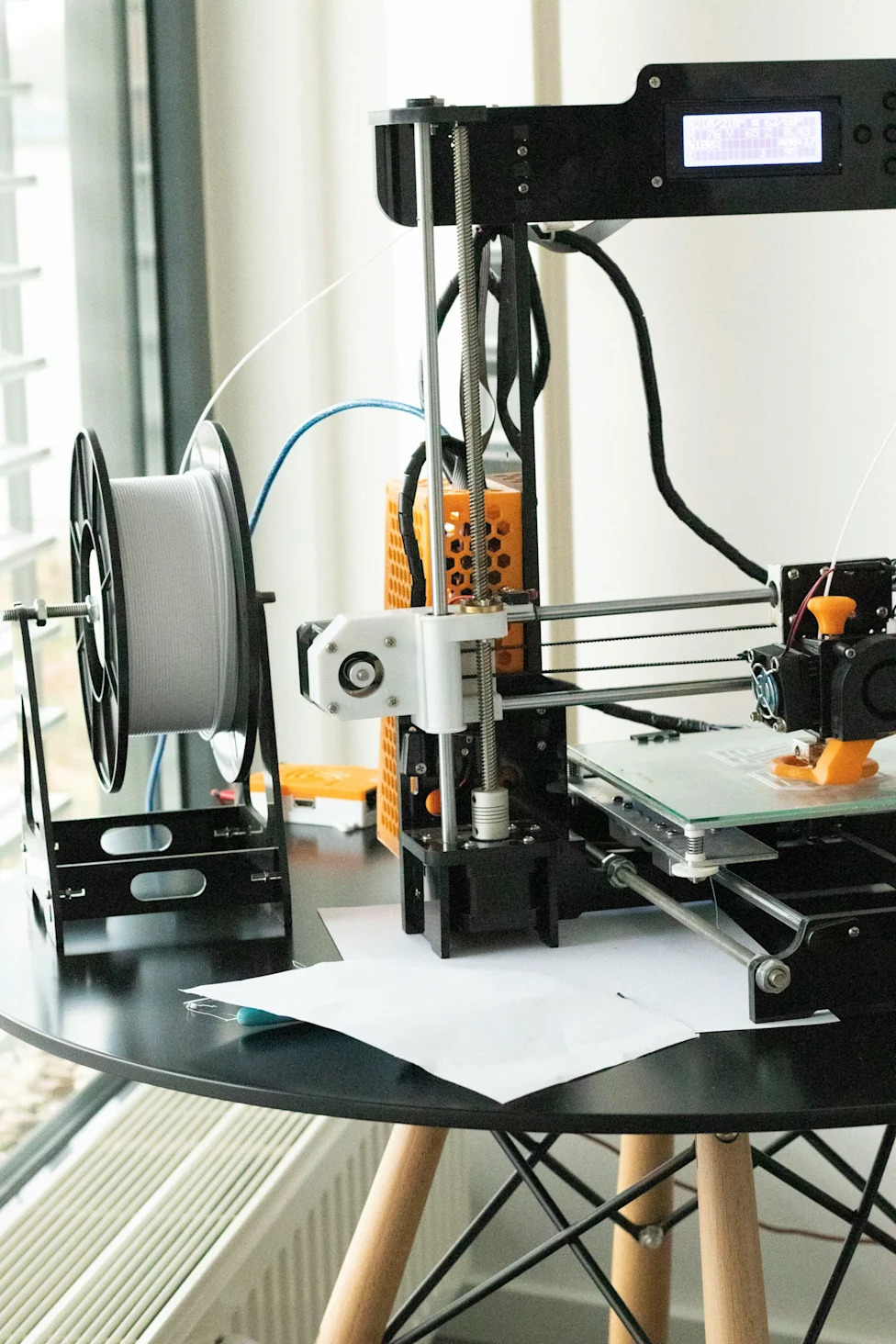
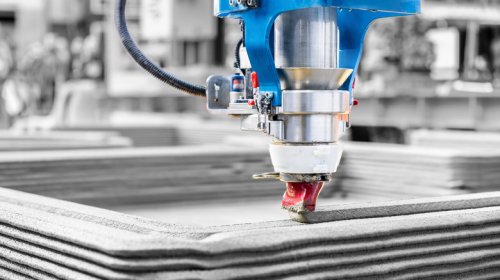
The 3D-Printing Revolution in Cars Already Happened. It's in the Tool Crib, Not on the Car.The Auto WireShawn HenryThu, September 17, 2026 at 12:00 PM UTCAdd us on GoogleThe 3D-Printing Revolution in Cars Already Happened. It's in the Tool Crib, Not on the Car.Ten years ago the promise of 3D printing in cars was that one day your car would be printed. That did not happen and is not going to.What happened instead is that the things which build cars are increasingly printed, and the economics of that turn out to be far larger than a printed car part would ever have been.Stratasys has just launched a machine that exists entirely for that job, and the most revealing thing about it is that it is not bigger than the one it joins.The same box, 159 kilograms heavierThe new F870 has a build volume of 1,000 by 610 by 610 millimetres. The F770, which Stratasys already sells, has a build volume of 1,000 by 610 by 610 millimetres. The two machines have identical footprints.AdvertisementAdvertisementThe F870 weighs 817 kilograms against the F770's 658. An extra 159 kilograms, in the same-sized cabinet, with the same-sized build chamber.All of that mass is thermal. Insulation, heating, chamber control and integrated dryer bays for the filament. The chamber runs at 95 degrees Celsius, and Stratasys describes its purpose plainly: it "maintains a consistent thermal environment across the full 1,000 mm build length. Critical for dimensional accuracy and warp-free results."The constraint was never the size of the box. It was holding enough heat, across a metre of part, for long enough.Why heat is the whole problemThis is the physics, and the authoritative source is the US National Institute of Standards and Technology, which has studied it precisely.AdvertisementAdvertisementA fused deposition printer lays a bead of molten polymer onto a bead that is already cooling. The two only become one solid if polymer chains have time to diffuse across the boundary between them. NIST frames the process as "polymer interdiffusion under conditions of rapidly changing mobility" and developed the concept of an equivalent isothermal weld time to describe it.Chain mobility collapses once the polymer cools below its glass transition temperature. Below that point the weld simply stops developing, wherever it had got to.The consequence, in NIST's words: "the strength of the weld formed by the deposition of one layer of extruded material on top of the previous layer is typically the strength limiting location of the part."A heated chamber buys weld time on every layer. And the longer the part, the more it matters, because thermal contraction scales with length. If the bottom of a metre-long part is at room temperature while the top is still molten, the part shrinks unevenly, builds internal stress, and either warps or splits along a layer line.AdvertisementAdvertisementThe headline material for this machine is a nylon reinforced with 35 percent chopped carbon fibre by weight. Its glass transition temperature, per Stratasys' own datasheet, is 37.5 degrees Celsius. The chamber is held at 95. The part spends the entire build roughly 58 degrees above the point at which the welding would stop.The dryer bays address the other half. Nylon absorbs water from the air, and wet nylon foams at the nozzle. Stratasys is blunt about the setting: "Factory floors aren't climate-controlled labs."Where these machines actually earn their keepNow the part that matters commercially, and the numbers come from the users.Factory investment in this industry usually buys something less visible than a new model — as a billion-dollar paint shop shows. General Motors replaced a machined aluminium hemming tool for the Chevrolet Equinox rear wheelhouse with a printed one. Total cost down 74 percent. Lead time from ten to thirteen weeks down to three. Weight from 75 pounds to 33 — which, per the case study, "eliminated the need for lift assistance during assembly, significantly improving ergonomics of the assembly operation."AdvertisementAdvertisementNote what actually produced that 74 percent. It is not material cost. A one-off machined tool carries CAD-to-CAM programming, a machinist's setup, fixturing and a queue position in a job shop, all amortised across exactly one unit. Most of that ten-to-thirteen-week lead time is queue, not cutting. A printer amortises nothing because there is nothing to amortise: it runs unattended overnight.Toyota has deployed at least sixteen printed tools in production. Read the list and the pattern is unmistakable: a transmission assembly alignment tool, a battery module test and fitment tray, a weld test alignment jig, an end-of-arm robotic tool, a weld tip cleaner blower nozzle, a paint masking jig, clamping jaws, a door adjustment fixture. The robotic end-of-arm tool cut lead time by six weeks and, being lighter, let Toyota use a smaller and cheaper robot to carry it.Two of the sixteen are a two-colour wear-indicator assembly tool and a stud poka-yoke assembly tool. Poka-yoke is the Toyota Production System term for error-proofing. Additive manufacturing has not disrupted lean manufacturing; lean manufacturing has absorbed it. A printer that makes a fixture overnight is, in Toyota's terms, a lead-time reduction on kaizen itself — you can change the jig as fast as you can change your mind about the process.BMW has gone furthest in scale, and it publishes the figures. It reports 1.6 million parts produced at its Additive Manufacturing Campus since 2020, and separately 100,000 components a year produced decentrally at the vehicle plants themselves. Printers on the shop floor, not in a central lab.Why the parts stay in the tool cribIf printed parts are this useful, the obvious question is why they are not in the car. Stratasys publishes the answer in its own datasheets, and it deserves credit for doing so.AdvertisementAdvertisementEvery one carries the same line: "Parts created using FDM are anisotropic as a result of the printing process." Strength depends on which way the layers run.For the carbon-fibre nylon, measured in-plane versus across the layers: tensile strength 83.5 against 32.7 megapascals. Flexural strength 153 against 62.4. Notched impact 106 against 24 joules per metre. And flexural modulus 11.1 gigapascals against 2.34 — across the layers, about a fifth.That flexural modulus row is the crux. The chopped fibres align with the direction of extrusion, so in-plane you have a genuine fibre composite and through the thickness you have unreinforced weld. The carbon fibre buys you almost nothing in the direction the layers stack.The ASA datasheet contains something starker than a percentage. In-plane, the material yields before it fails. Across the layers, the entry for tensile yield reads "no yield." In one direction the part bends and warns you. In the other it snaps.AdvertisementAdvertisementThat is a difference in failure mode, not in numbers, and it is precisely why nobody puts a printed polymer part in a crash structure.What is genuinely on cars, and how little of it there isThere are real production parts, and they are instructive for their limits.Porsche built an electric drive housing additively: around 40 percent lighter than a conventional casting, stiffness doubled in highly stressed areas, wall thickness of 1.5 millimetres, roughly 40 assembly steps eliminated. Its project manager called it proof that additive manufacturing "is also suitable for larger and highly-stressed components in electric sports cars."Porsche also sells a 3D-printed bodyform bucket seat at roughly €2,678 a side, more than 8 percent lighter than the conventional item, in three rigidity grades. Look closer at the construction, though: only the comfort layer is printed. The structural base is moulded expanded polypropylene and the outer skin is fabric.AdvertisementAdvertisementBugatti printed a titanium brake caliper: 45 hours of printing, 2,213 layers, four 400-watt lasers, wall thicknesses from one to four millimetres — followed by eleven hours of five-axis milling. Even the showcase printed metal part needed conventional machining afterwards, on a car built in the hundreds.The pattern holds across all three. Where additive appears on a road car, it is a low-volume, high-value, geometry-driven part, and it is usually still finished conventionally.The qualification gap, and who this machine is really forThere is also a standards reason the line stops where it does. The qualification machinery that exists for additive manufacturing was built overwhelmingly for metal powder bed fusion, because that is where aerospace money went. For polymer extrusion there is a general vocabulary standard, a three-part standard covering feedstock and process equipment, and a generic site qualification standard. There is no polymer equivalent of the metal equipment qualification specification.A jig does not need one. A suspension component would.AdvertisementAdvertisementWhich brings us to the business context, because it explains the launch. Stratasys reported 2025 revenue of $551.1 million, down from $572.5 million, with a GAAP net loss of $104.3 million. Its own filing tells the SEC that "the 3D printing market has not grown as much as expected" and that the company needs the market "to return to its prior trend of growth for our revenues to once again grow."The one line that is setting records is consumables — $66.3 million in the second quarter of 2026, driven by manufacturing materials.Seen that way, the F870 is a razor and the carbon-fibre nylon is the blade. It is the company's only large-format machine that runs that material, and a metre-long fixture eats a great deal of it. That is why a machine with the same build volume as one Stratasys already sells is worth a launch.Worth noting too: the launch release is headlined around Toyota and Rivian adopting the machine, while the body says the two are "assessing the platform." No unit counts, no contract values, and no price for the machine published anywhere.What to rememberForget the build volume. Remember where the technology actually landed.AdvertisementAdvertisementThe promise was printed cars. The reality is a printer on a factory floor turning out a fixture overnight that would have taken a job shop three months and cost four times as much — and which weighs half as much, so nobody needs a hoist to lift it.That is a smaller story than a printed car, and a much bigger business. The revolution did not arrive on the vehicle. It arrived in the room where the tools are kept.Would you want to see 3D-printed parts on the car itself, not just the tools that build it? Sound off in the comments.Join our Newsletter, follow our Instagram page, and connect with us on Facebook.