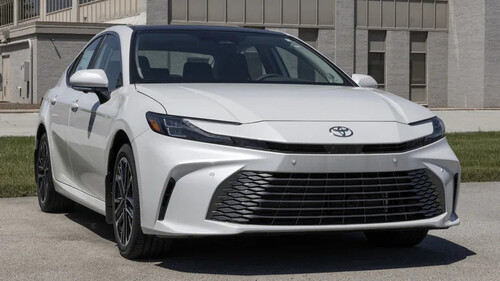
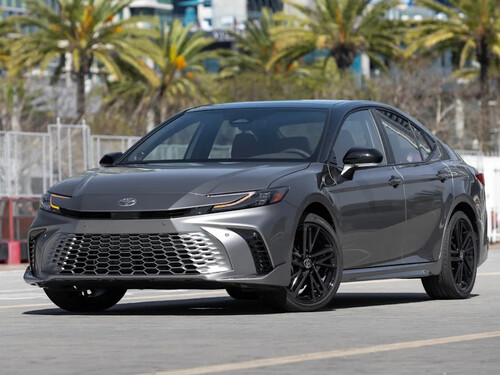
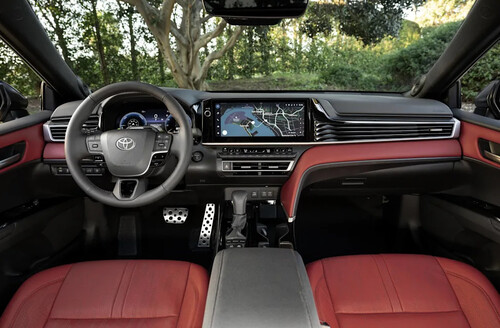
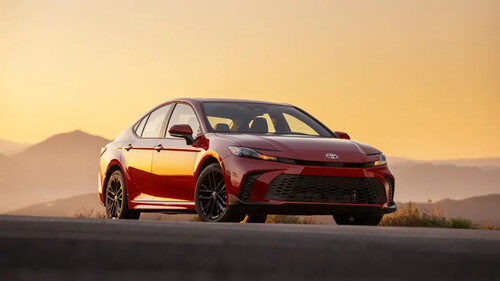
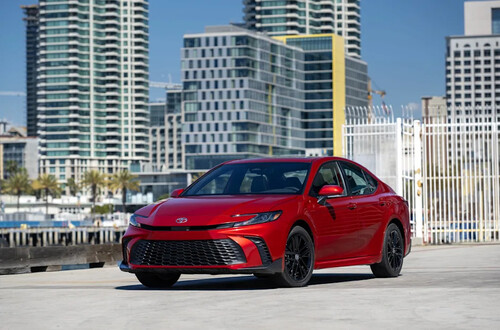
Autoblog and Yahoo may earn commission from links in this article.I wouldn't ever say I was a fan of the Toyota Camry. To me, that would be like saying I was a fan of vitamins, or those greasy, flavorless "calzones" they served for lunch in middle school. Growing up in a car-loving family, I understood that the Camry was reliable, safe, and efficient, the same way we're born knowing how to smile or cry—it's just an innate fact that everyone, even non-car people, generally understands. ToyotaView the 2 images of this gallery on the original articleAdvertisementAdvertisementWhen I moved back to California from Oregon, my father-in-law loaned us his 2014 Toyota Camry XLE to help save on gas while my husband and I scrambled for jobs. Frankly, that experience didn't do the car's reputation many favors. The only thing we actually liked about it was the mileage, though it admittedly crushed the commute, regularly averaging 46 mpg around the San Francisco Bay Area. So, when I learned a 2026 Toyota Camry Nightshade would be delivered to me for review, I had very low expectations. And the changes Toyota made to the midsize sedan since 2014 ironed every single issue I had with it out with one fell swoop. I can enthusiastically tell people, "The new Toyota Camry is fun to drive, drop-dead gorgeous, and worth every single penny," and mean it.Related: Road Ethos Launches: The New Automotive Lifestyle Site You Should ReadFirst, the Camry's grown by a few inches all around—meaning more space in some places, while it's tighter in othersThe first thing I noticed when my family's 2014 model was next to the 2026 Nightshade was how much Toyota's favorite midsize sedan has been stretched out. The 2014 model comes from an era when midsize sedans still kept a relatively tight footprint, wrapping up at just 189.2 inches long. The 2026 version, though, now leans into a low, wide, aggressive look. It spans 193.5 inches from bumper to bumper—gaining more than 4 inches in length—and pushes its wheels way out to the corners with a much longer wheelbase (109.3 inches vs. 111.2 inches).ToyotaBut while it got longer and a bit wider, Toyota actually dropped the roofline to get that sleeker silhouette. My father-in-law's old car stands a bit taller at nearly 58 inches, while the 2026 sits a full inch lower. That shift changes the interior dynamics by quite a bit. The new one uses its extra length to give you greater legroom upfront, but that chopped roof means you lose some of the upright headroom and airy cabin space that made the 2014 version feel so boxy and utilitarian.Kristen BrownOne thing remained the same after over a decade: a spacious trunk. My father-in-law's 2014 Camry was a bit of a pack mule, offering a generous 15.4 cubic feet of trunk space, but the 2026 Nightshade actually edges it out slightly with 15.1 cubic feet—effectively a wash, though the new hybrid battery packaging changes the shape of the floor a bit. The real separator is the rear seat comfort. While the 2014 model gave backseat passengers 38.9 inches of legroom, the 2026 version tightens things up to 38.0 inches. Combine that loss of nearly an inch of legroom with the lower roofline, and the back seat of the modern Camry feels noticeably more snug than the airy, unpretentious cabin of the old 2014.Even with that, I appreciated the interior layout a whole lot moreThe interior of the 2014 Camry felt so odd to me. The overall design is dull, but what really got to me was the weird seating position. Yes, the roof was higher, but the seat is low, while the window frames and hood looked and felt like they were right at my eye line. It's insanely difficult to see out of. I'm 5'8", and I had to raise the driver's seat considerably to be able to tell where the corners of the hood were. I felt like I was sitting on the floor, standing on my tippy toes to see out of it. To add insult to injury, the A and B pillars looked like they were designed to hold up the entire weight of the car; they were so thick. For it being a 2014 model, the center screen must have felt like a leap forward in time when it was new, but it's definitely dated now. Though I did like the hybrid information display a lot.Kristen BrownView the 2 images of this gallery on the original articleAdvertisementAdvertisementBy contrast, I enjoyed driving the 2026 Toyota Camry Nightshade a whole lot more. It felt and looked like an entirely different car. The seating position this time was much higher, the window frames were lower, and the sleeker, sportier hood was easy to see over. I didn't even have to raise my seat. The A and B pillars were thinner, thankfully, and the optionally larger 12.3-inch center infotainment screen and standard 10-inch driver information display helped it feel more like a $43,000 car and not a $35,000 sedan. The piano black trimmings, leatherette seats, leather-wrapped steering wheel, white accent stitching, and color contrast accents on the seats gave it such a fun personality. I found myself impressed by the interior of a "cheap" Toyota for once.Related: Toyota Camry Hybrid Vs. Honda Accord Hybrid: One Clearly Wins on ValueYou can still see the past design shining through, but the new language suits it so much moreIt carries just enough of that familiar, dependable Camry DNA so you know what you're looking at, but Toyota's new "hammerhead" design language wraps the midsize sedan in a low, aggressive silhouette that actually looks intentional. The headlights have a sporty-chic look to them, which makes the Camry more attractive to more buyers. It turns a car that used to disappear in rental lots into something you might actually look back at after you park it. Especially in the Nightshade trim, which adds a black mesh grille upfront, blacked out door handles, mirror caps, handsome, glossy black wheels, black badging all around, and a fun spoiler on the trunk lid.Kristen BrownNow, the Camry looks like something you'd be excited to inherit from your grandma. It's no longer a boring, soulless appliance that doesn't provoke emotion in anyone anymore. After driving the Nightshade around, I started building one on Toyota's website in Ocean Gem. I was down that bad.With more options and high-tech features, the Camry is, shockingly, less expensive than it used to beWhen you look at the sticker price, the 2026 Camry Nightshade rolls onto the scene with a starting MSRP of $32,300. It occupies a pretty clever middle ground in the modern lineup, sitting just above the sport-tuned SE base but well under the $35,200 flagship XSE. My tester, with the larger screen, convenience package, premium paint, and California's emissions fee, came out to $35,858. Comparing that to the 2014 lineup reveals just how much the automotive market has shifted.ToyotaComparing that to what a Camry Hybrid cost back when my father-in-law bought his car brand-new reveals that the price gap has actually shrunk quite a bit over twelve years. In 2014, if you wanted the fuel-sipping tech, the base LE Hybrid started at $26,330, while the top-of-the-line XLE Hybrid climbed to $28,625. Back then, opting for the hybrid powertrain meant paying a steep premium over the standard gas versions. Today, because Toyota made the 2026 Camry exclusively a hybrid, that entry barrier is gone. For $32,300, the Nightshade gives you a highly styled, modern hybrid setup for only about $3,600 more than what a top-trim Camry Hybrid went for brand new twelve years ago—which is practically a steal when you factor in standard inflation and a decade's worth of new tech.Kristen BrownTL;DR: The hybrid powertrain used to be a premium option for buyers, while now, it's standard. So, theoretically, the Camry is a much better bargain than it was when my father-in-law was shopping around for his. I just thought that was interesting.AdvertisementAdvertisementRelated: The 5 Best Toyota Models That Still Define the Brand in 2026Mileage is still excellent, but for this generation, there's a lot more horsepower. And all-wheel drive!Back when my father-in-law was commuting around the Bay Area in his 2014 hybrid, its powertrain was managing a perfectly respectable, if completely uninspiring, 200 combined horsepower. Fast forward to the 2026 Nightshade, and Toyota's fifth-generation hybrid system bumps that output up to 225 horsepower in standard front-wheel drive, or 232 horses if you opt for all-wheel drive. That extra punch gives the modern car a genuinely snappy, confident acceleration that the old model desperately lacked—all while keeping fuel economy pinned right around an impressive 46 combined mpg. It means you no longer have to sacrifice driving dynamics just to get stellar efficiency.Kristen BrownAnd let's circle back to all-wheel drive for a second: my tester had the optional all-wheel drive, and that didn't negatively impact the mileage by much at all. The FWD 2025 Camry is rated for up to 52 mpg around town, which is miles ahead of my father-in-law's FWD Camry's average—but even with AWD, I averaged the same. Why is this a big deal? All-wheel drive wasn't even an option back in 2014. Which annoyed my father-in-law, because that's something he said would make his older model the perfect car. So, more power and optional all-wheel drive make the 2026 Camry a compelling, versatile choice for more buyers who live in more diverse regions.Of course, the 2026 model is miles ahead in the safety departmentIf you want to see where twelve years of automotive evolution really matters, look past the redesign and glossy black wheels and straight at the safety tech. Back in 2014, "state-of-the-art standard safety" basically meant you got ten airbags and a backup camera. If you wanted advanced driver-assist features like a Blind Spot Monitor or Rear Cross-Traffic Alert, you had to pony up for the highest, most expensive trim packages. The car was undeniably safe in a crash, but it relied entirely on your own eyes and quick reflexes to prevent one from happening in the first place. Kristen BrownJump into the 2026 Nightshade, and the car practically feels like it has an electronic safety bubble around it. Toyota Safety Sense 3.0 comes completely standard across all trims, even the base, so every single model that leaves the factory comes with predictive tech that was the stuff of science fiction in 2014. It actively keeps you centered in your lane, automatically handles stop-and-go traffic with adaptive cruise control, and watches out for pedestrians or crossing traffic at intersections. Instead of just waiting to deploy an airbag, the modern Camry is constantly reading the road ahead, subtly nudging the steering or pre-charging the brakes to handle the chaos of the Bay Area commute for you. The adaptive cruise control with active curve control was enough to have him looking up how much his 2014 would be worth as a trade-in for a new one.AdvertisementAdvertisementRelated: Toyota Camry, Prius, and Corolla Hatch Hit With Price HikesFinal thoughts: The new model shows that Toyota's been listeningFor decades, the Camry's reputation was built on being the ultimate appliance—unbelievably reliable, perfectly safe, and utterly invisible. It was a car you bought with your head, never your heart. But with this newest generation, and the Nightshade in particular, they've managed to inject some genuine personality into the formula without breaking what made it a legend in the first place. They took the stellar fuel economy we loved in my father-in-law's 2014 model and wrapped it in a design that actually turns heads, backed up by a sharp, responsive drive and cutting-edge safety tech that handles the modern commute with ease.Ultimately, the 2026 Camry proves you don't have to choose between a sensible daily driver and a car you actually enjoy looking at in your driveway. It kept the legendary baseline DNA that my car-loving family always respected, but finally added the character, styling, and horsepower it desperately needed. It turns out a vitamin doesn't have to taste like a middle school calzone—with the right execution, it can actually be something you look forward to every day. If I owned a 2026, I'd be thrilled to drive it everywhere. Even to the dentist's office.This story was originally published by Autoblog on Jul 4, 2026, where it first appeared in the Features section. Add Autoblog as a Preferred Source by clicking here.