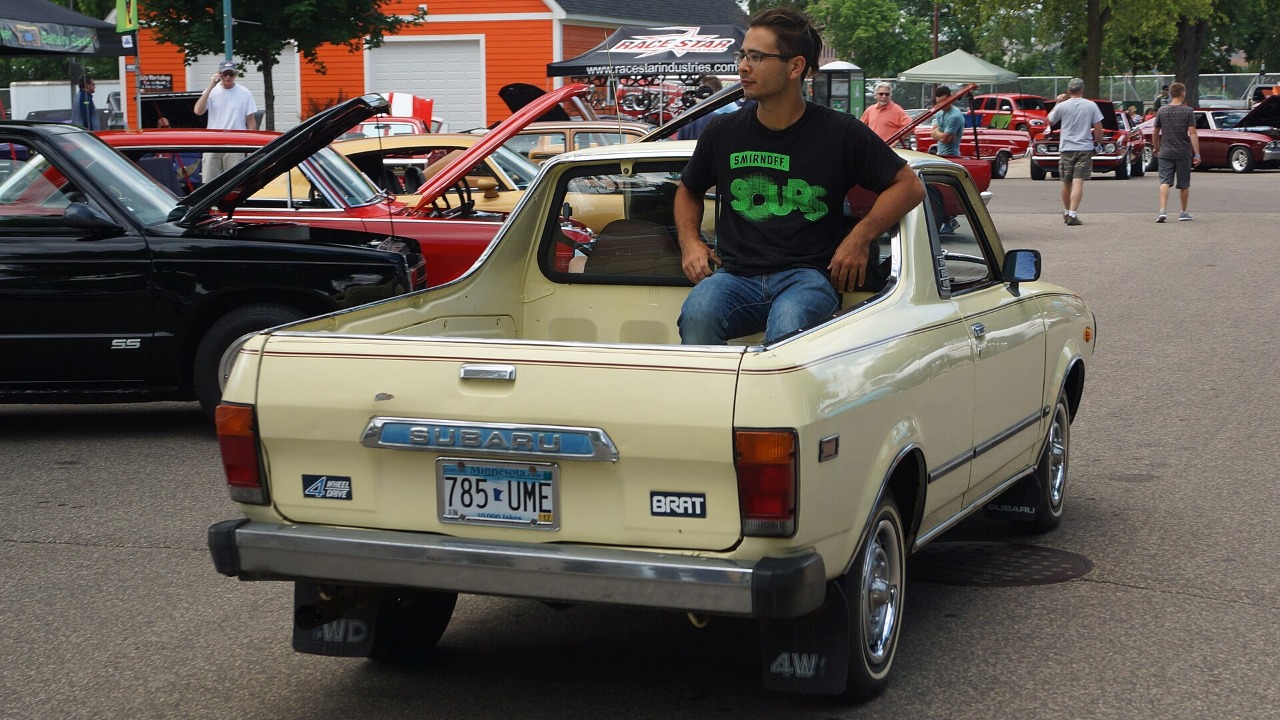
Subaru sold about 100,000 examples of the Subaru BRAT in North America, and it did that with a little four-wheel-drive pickup built on a station wagon. It was small, odd and cheerful. It also had something no rival offered: two plastic seats bolted into the bed, facing backward. That was only the American chapter. Outside the US, the same truck kept going for years under other names. Australians and New Zealanders called it the Brumby. Buyers in Britain knew it as the MV or the Shifter, and in other parts of Europe it wore a 284 badge. Meanwhile, Subaru kept building it in Japan, even though Japanese buyers never got it officially. These are our picks: eight BRATs and BRAT cousins from different years and markets that, in our view, showed what Subaru could really build. The verdicts are our opinion. However, the years, engines and sales figures come from Hagerty and other references linked below. 1. 1978 Subaru Brumby pickup The story started at the top of Subaru’s American arm. According to the reference histories, Subaru developed the truck in Japan in 1977 because the president of Subaru of America asked for one. He wanted a rival for the small pickups Toyota, Nissan and Mazda were selling. Subaru based it on the Leone wagon, and every example came with four-wheel drive. Australia got its version right away. Imports there began in 1978, and Australians knew it as the Brumby. A New Zealand parts retailer’s history notes that farmers liked it for its reliability and compact size. It also says the Brumby ended up as the last ute Subaru sold in Australia. The first trucks used the 1.6-liter EA-71 flat-four. Hagerty puts its output at 67 hp, which is modest by any standard. In our view, though, standard four-wheel drive mattered far more than horsepower in a truck like this. Our take: a 1978 Brumby is where it all began outside the US, and it shows how far Subaru could stretch one wagon platform. That mix of a wagon’s front end and a small bed would carry the truck all the way to 1994. 2. 1979 Subaru BRAT The 1979 truck is the classic first-generation BRAT, with round headlights and those famous jump seats. The seats existed for a tax reason. In 1964, the US had put a 25% tariff on imported light trucks, the so-called Chicken Tax. With seats and carpet in the bed, Subaru could class the BRAT as a passenger car. As a result, it paid a 2.5% tariff instead. The trick worked on paper, but owners found a downside. As Hagerty’s BRAT buyer’s guide points out, the bed carpet trapped water and caused rust. Many owners pulled it out and cut the seats away so they could use the bed for real work. Early trucks also had a simpler drivetrain. The 1980 and earlier models used a single-range transfer case. Meanwhile, the Leone-based unibody gave it a car’s manners rather than a truck’s. Our take: a 1979 BRAT with its seats and carpet intact is a rolling lesson in clever trade policy. It is also proof that Subaru could solve a business problem with a few pieces of molded plastic. For the full launch story, read our look at how the 1978 Subaru BRAT introduced a very different kind of utility vehicle. 3. 1983 Subaru MV 4WD In Britain, the BRAT went by the MV Pickup or the Shifter. A 1983 MV belongs to the second generation, which arrived with a restyle in 1981. It had rectangular headlights in place of the round lamps. More important, it had a bigger engine. Subaru swapped in the 1.8-liter EA-81 flat-four. Hagerty says output rose about 8 percent to 73 hp, while torque climbed from 81 to 94 lb-ft. In addition, the better-equipped GL gained a dual-range transfer case from 1981, while the DL kept a single range. That low range made the truck far more useful off the pavement. 1983 also marked the start of the turbo era. Subaru offered a turbocharged 1.8 in 1983 and 1984. Car & Classic’s BRAT guide lists it at 95 hp and 123 lb-ft, paired only with a three-speed automatic. Our take: the 1983 MV is the European face of the BRAT’s best years. It got the stronger engine and the low range, so it could do farm work on a Monday and still be fun on the weekend. That is a lot of capability from a truck that started life as a Leone wagon. 4. 1985 Subaru BRAT The 1985 model year was the end of an era. According to Hagerty, Subaru removed the jump seats from the bed after 1985. That makes this the last BRAT to carry the feature that defined it. Collectors have noticed. In Hagerty’s valuation guide, an excellent-condition 1985 GL was worth $15,800, up 48 percent from $10,700 a year earlier. By contrast, an excellent 1986 without the seats was valued at $14,600. In other words, the seats carried a 7.6 percent premium. Hagerty also notes there is no real value difference between pre- and post-facelift trucks. The BRAT’s other party piece was an optional T-top that Subaru sold as the “halo-twin roof.” Then there is the second-generation truck’s spare tire, which lived under the hood, and a spring-loaded hidden step that helped you climb into the bed. Our take: if you want one Subaru BRAT for a collection, the 1985 is it. It is the final year with the seats, and the market already prices that in. For more Subarus with a reputation for toughness, see our list of 10 classic Subarus that proved their toughness. 5. 1988 Subaru Brumby utility By 1988, the BRAT had left America. Subaru ended North American sales after the 1987 model year, according to Hagerty. However, the truck kept going in Australia, Europe and other markets. That second life is why a 1988 Brumby matters. It is the BRAT after its main market walked away, and it lived on because buyers, farmers among them, kept choosing it. Subaru also built the truck outside Japan. The reference histories list assembly in Pretoria, South Africa, and in Waitara, New Zealand, where production ran until 1987. The Brumby also found a second audience much later. Hagerty notes that Japanese enthusiasts often import BRATs, mostly right-hand-drive Australian trucks. That is a funny twist, since Subaru never sold the BRAT officially in its home market. Japanese buyers back then preferred station wagons. Our take: a 1988 Brumby is the proof that the BRAT was a real product, not a tax dodge. It sold on its merits for years after the American tariff trick stopped mattering. Today, it is also a right-hand-drive truck that collectors in Japan go out of their way to find. 6. 1990 Subaru Brumby A 1990 Brumby is the Australian ute in its mature form. It still carried the second-generation body from 1981, and it still came with four-wheel drive. Meanwhile, Australian buyers could dress it for real country work. The reference histories describe Ag-quip packages for Australia, with graphics, a roo bar, a sump guard and a rear step bar. Optional wagon wheels were part of the menu, too. Those parts tell you who the truck was for. It was a working ute for farms and back roads, not a beach toy. The Brumby has also found a racing life. In 2014, Settlement Creek Racing ran one in desert racing. Its “Gold Brumby” uses an Impreza WRX STI powertrain, 30-inch tires, a dry sump and Porsche CV joints, according to the same New Zealand history. Our take: a 1990 Brumby shows the BRAT at its most honest, a small farm truck that did its job for over a decade. The racing build only proves how much the basic shell could handle. If we found one with its original Ag-quip parts still fitted, we’d keep it exactly as it is. 7. 1990 Subaru 1800 MV 4WD The 1800 MV was the European cousin of the 1990 Brumby. The name told you the engine. It carried the 1.8-liter EA-81 flat-four, which Car & Classic lists at 1,781 cc. A four-speed manual drove a part-time four-wheel-drive system, and a manual gearbox was standard on every BRAT. Subaru kept shipping it to Europe longer than most people realize. According to the reference histories, imports to Europe, Australia and New Zealand continued until February 1994. So, a 1990 MV comes from the last few years of a truck that had been around since the late 1970s. Clever packaging was part of the appeal. The spare tire sat under the hood, which kept the bed clear. In our view, that small touch says a lot about how carefully Subaru planned such a compact truck. Our take: the 1990 MV is the BRAT for anyone who wants the quirkiness in a slightly newer, more usable package. In our view, it deserves more love than it gets, because it does everything the American BRAT did with a few more model years behind it. 8. 1994 Subaru 284 4WD pickup The 284 was the BRAT’s final name. Car & Classic lists the 284, Shifter and MV badges among the European names, and the truck wore about six names around the world in total. A 1994 truck comes from the very end of production. Subaru’s Ōta plant in Gunma, Japan, kept building the BRAT until 1994, according to the reference histories. That gave the design a run of 17 years, from 1978 to 1994, with only one major restyle. The BRAT never got a direct replacement in North America. Subaru showed a two-door pickup concept called the Suiren in 1993, but it never reached production. Instead, the four-door Baja arrived in 2002. A New Zealand retailer’s history says the Baja sold about 30,000 units from 2002 to 2006, against an expected 24,000 a year. Our take: a 1994 284 closes the loop on a truck that outlived its original reason for existing. A late 284 in good shape is the BRAT we’d hold onto longest, because it is the final chapter of the story. Hagerty dates the Subaru BRAT’s run in Europe and Australia to 1994, and this is the last of them.

 Liked by Ava Anderson, Gabriel Carter
 Liked by Ava Anderson, Gabriel Carter