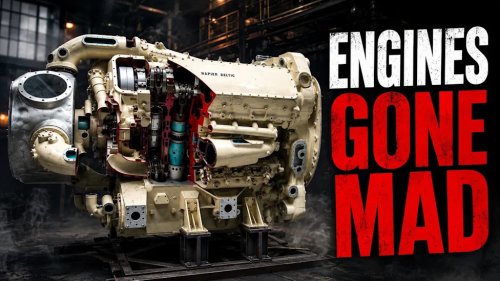
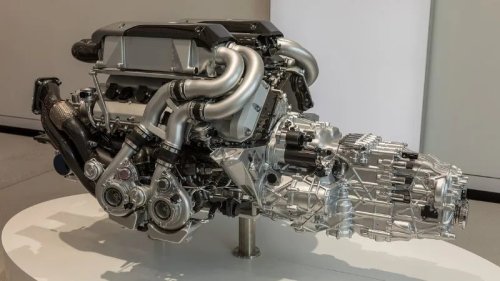
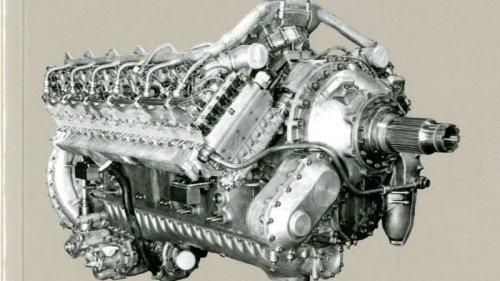
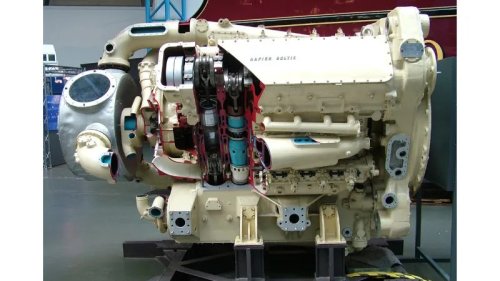
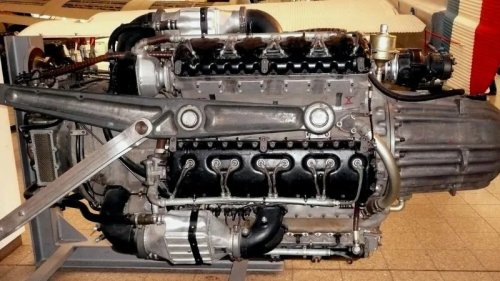
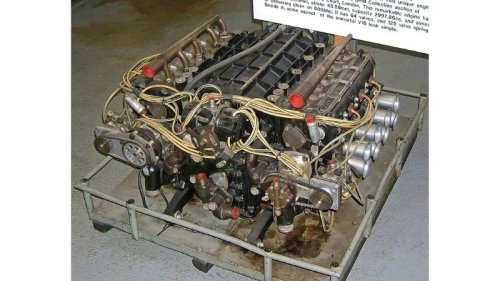
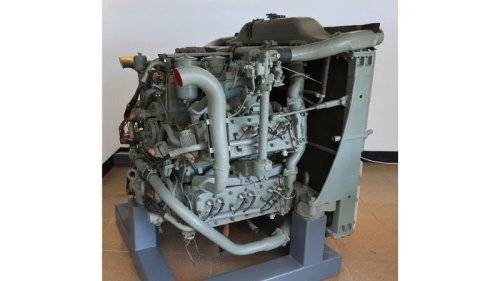
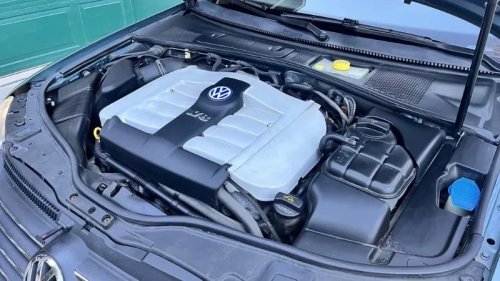
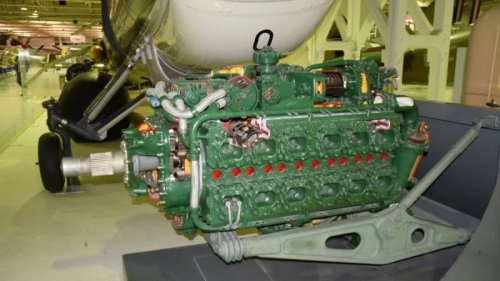
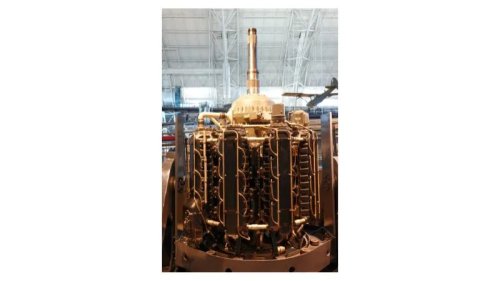
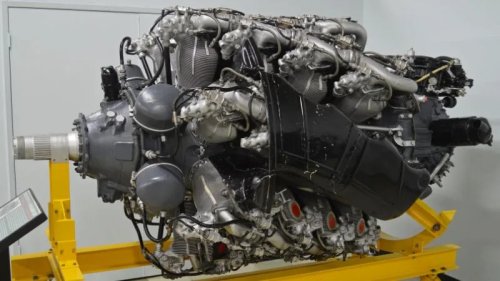
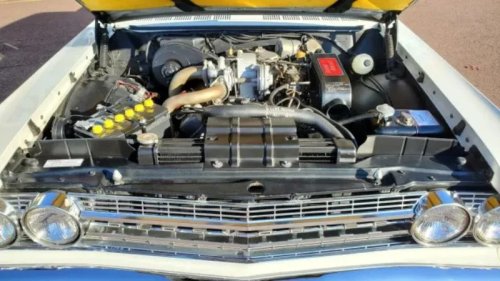
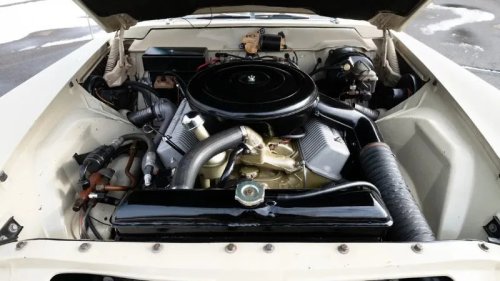
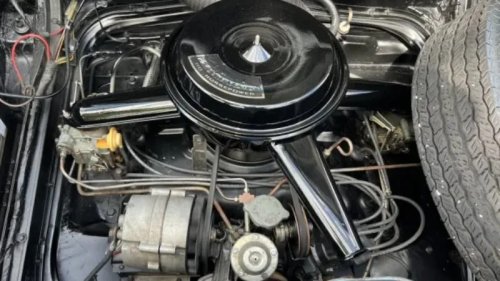
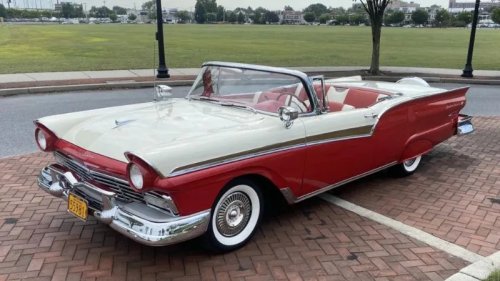
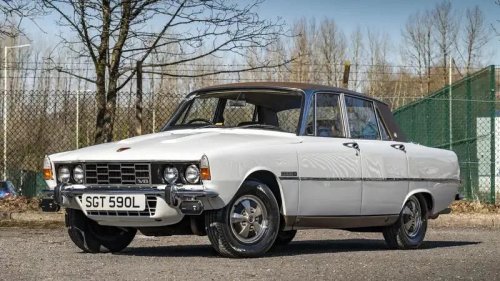
Image: Gadget ReviewSome engines are masterpieces of engineering, elegantly solving problems with just enough complexity to get the job done. Then there are machines like the Napier Deltic. This British beast, launched in the 1950s, looks less like an engine and more like a triangular nightmare. It packs 18 cylinders and 3 crankshafts into a layout so intricate that even experienced mechanics would break a sweat just looking at it. But hey, at least it had a high power-to-weight ratio, right? The automotive equivalent of trying to swat a fly with a sledgehammer.13. Bugatti W16Image: Wikimedia CommonsThe quad-turbocharged masterpiece that turned engine bays into engineering art galleries.When Volkswagen revived Bugatti, they aimed for unparalleled performance, resulting in the W16 engine. This behemoth effectively merges 2 narrow-angle V8s, creating a quad-turbocharged 8.0-liter beast arranged in a W configuration. Debuting in the Veyron, it featured 4 turbochargers, 10 radiators for engine, intercooler, transmission, and A/C systems, and a wiring harness weighing more than some engines.AdvertisementAdvertisementThis complexity powered the Veyron to unimaginable speeds, demonstrating that with unlimited resources, extreme engineering can yield phenomenal results. Today, it continues in the Chiron, pushing 500 horsepower more than its predecessor, a monument to cost-no-object engineering.12. Rolls-Royce CrecyImage: eBayThe two-stroke, sleeve-valve V12 that was too ambitious for its own good.During World War II, Rolls-Royce threw some serious engineering spaghetti at the wall with the Crecy engine. This two-stroke, sleeve-valve V12 was supposed to churn out over 2,500 horsepower from a tight 26 L displacement. That's like squeezing a V8's power into a compact car engine bay, but with way more moving parts and considerably more potential for disaster.Unfortunately, the Crecy's innovation became its downfall. Those sleeve valves, crucial for airflow, had a nasty habit of seizing up tighter than a politician's wallet. The cooling system apparently needed more help than a contestant on a reality show, and it guzzled oil like it was going out of style, measured in gallons per hour. By the time Rolls-Royce figured this out, jet engines were already taking off, making this piston-powered radical obsolete before it even got off the ground.11. Napier DelticImage: Wikimedia CommonsThree engines bolted into a triangular setup that pushed boundaries and broke mechanics' spirits.AdvertisementAdvertisementEngineers in the 1950s apparently decided that "simple" was for amateurs, leading directly to the Napier Deltic. Essentially three engines bolted into a triangular setup, pushing out 3,500 horsepower from its 88-liter displacement. This beast of an opposed-piston diesel engine, with its 18 cylinders and 3 geared crankshafts, was originally slated for naval duty but found its way into locomotives and patrol boats.Anyone who's ever tried to tame a wild engine knows that massive power often comes with a massive headache. The Deltic was no exception. Keeping this behemoth running required mechanics who could probably solve advanced calculus problems while blindfolded, as a simple tune-up was akin to performing open-heart surgery. Despite its complexity, the Deltic ran for decades, a testament to its sheer engineering audacity, but maintenance demands eventually outpaced the availability of sufficiently qualified technicians.10. Junkers Jumo 222Image: Wikimediia CommonsTwenty-four cylinders in a hexagonal arrangement that turned maintenance into archaeological expeditions.World War II German engineering often veered into the absurdly complex, and the Junkers Jumo 222 aircraft engine is a prime exhibit. This ambitious beast packed 24 cylinders in a hexagonal, 6-row arrangement, a setup designed to churn out over 3,000 horsepower in its later iterations. Getting to some cylinders meant removing others first, which is about as user-friendly as a tax audit.AdvertisementAdvertisementThe Jumo 222 weighed over 2,000 lb, and its sheer complexity turned maintenance into a nightmare. Plus, the cooling system constantly battled to keep all 24 cylinders from overheating, leading to frequent breakdowns. Only a few hundred were ever built, and most of those never even got to taste actual combat.9. BRM H16Image: WikipediaTwo flat-eight engines stacked and geared together in a mechanical balancing act.The British Racing Motors (BRM) H16 engine was what happened when engineers decided stacking 2 flat-eight engines on top of each other was a brilliant idea. It churned out a fearsome sound and a decent amount of power when it decided to cooperate. However, its sheer weight and high center of gravity, like a bodybuilder attempting ballet, made handling a nightmare for the cars it powered.With 32 valves and twice the parts of a typical engine, reliability was less a feature and more a distant hope. This mechanical beast met its match in complexity, even after Jackie Stewart managed to wrestle a single victory at the 1966 U.S. Grand Prix.8. Chrysler A57 MultibankImage: WikipediaFive inline-six engines married into one monstrous 30-cylinder star formation.AdvertisementAdvertisementDuring World War II, Chrysler unleashed the A57 Multibank engine, a testament to brute-force engineering that married 5 of their standard inline-six engines into one monstrous 30-cylinder unit. This beastly arrangement, shaped like a star, used proven components but was a logistical headache. Syncing 5 separate ignition systems and cooling loops while the whole contraption weighed more than a small truck.This absolute unit, however, proved reliable enough to power thousands of M3A4 Sherman tanks and their variants. It demonstrated that sometimes, piling on more of what works, no matter how absurdly, can actually get the job done.7. Volkswagen W8Image: Bring a TrailerA compact W setup that turned routine maintenance into expensive puzzles.Volkswagen's Passat W8 from 2001–2004 packed a 4.0-liter W8 engine, essentially 2 narrow-angle four-cylinder banks kissing on a single crankshaft. This compact W setup meant it needed 2 cylinder heads, which, naturally, meant twice the complexity. The timing chain system was a labyrinth of guides and tensioners, a ticking time bomb waiting to stretch and fail.AdvertisementAdvertisementThe dense packaging also cooked the rear cylinders like forgotten leftovers. While this W8 did produce a smooth 270 horsepower and a sound that turned heads (a rare feat for a Passat), its intricate guts and thirst for expensive maintenance meant its time on the road was shorter than a TikTok dance trend.6. Napier SabreImage: Wikimedia CommonsTwo flat-12 engines stacked into an H-shape with sliding sleeve valves instead of sanity.The Napier Sabre engine strapped a blistering 2,000 horsepower onto the wings of WWII aircraft, and it did so with a design so bonkers it could only be British. 2 flat-12 engines stacked and crammed into an H-shape, all powered by an array of sliding sleeve valves instead of the usual poppet valves. This setup required an oil system that guzzled lubricant like a college student at a frat party and pushed material limits with its insane boost pressures.While it gave fighters like the Hawker Typhoon some serious get-up-and-go, its complexity meant maintenance was a nightmare. Any mechanic working on this beast needed specialized tools and a patience usually reserved for cloud-watching.5. Lycoming XR-7755Image: Wikimedia CommonsThe 36-cylinder, 127-liter radial monster that was too ambitious for its own era.AdvertisementAdvertisementOnly 2 of these behemoths ever left the drawing board, but the Lycoming XR-7755 remains the undisputed king of piston aircraft engines. Conceived during World War II, this 36-cylinder, 127-liter radial monster was designed to churn out a mind-boggling 5,000 horsepower. A mechanical octopus with 9 banks of 4 cylinders each, all arranged in 2 rows, requiring a crankshaft so complex it looked like a Picasso sculpture.The sheer scale of the XR-7755 meant that every system had to be overbuilt. You're talking about 72 spark plugs firing in sequence, multiple carburetors working in tandem, and a cooling system that would make a supercomputer blush. Developing this beast cost a fortune, but before it could even fly, the jet age arrived, making its extreme piston-powered ambition feel like a relic from a bygone era.4. Pratt & Whitney R-4360 Wasp MajorImage: Wikimedia CommonsTwenty-eight cylinders in four rows that demanded 56 quarts of oil to stay happy.This behemoth, nicknamed the "corn cob" for its appearance, packs a staggering 28 cylinders spread across 4 rows. A testament to an era when engineers wrestled with mechanical forces like a pit crew fighting a runaway monster truck. To keep this beast lubricated, you're looking at 56 quarts of oil. That's more than you'd find in a small apartment building's heating system.AdvertisementAdvertisementThe R-4360 Wasp Major was the pinnacle of piston engine complexity. Its intricate valve train and cooling systems demanded a week of specialized attention just for routine maintenance. Despite the headaches, this engine powered everything from massive bombers to racing planes, proving that if you threw enough engineering at a problem, you could make it fly.3. Oldsmobile JetfireImage: Bring a TrailerAmerica's first turbocharged production car that needed special fluid to prevent self-destruction.When the Oldsmobile Jetfire rolled out in 1962, it carried the banner for U.S. turbocharged production cars. This wasn't just a car; it was a rolling experiment packing a Garrett turbocharger spinning up to 100,000 RPM. To keep that madness from detonating, it injected a special "Turbo-Rocket Fluid"—a water-methanol mix that, if you ran out, could spell doom for the engine.Your car's fuel tank was just the start; you also needed a separate fluid level check. It was the kind of complexity that made mechanics sweat and owners wary, with only about 9,000 units produced over 2 years before the concept largely faded.2. Lincoln Continental Mark IIImage: RM Sotheby'sHand-assembled perfection that cost Ford $1,000 for every $10,000 they charged.AdvertisementAdvertisementFord lost approximately $1,000 for every $10,000 Lincoln Continental Mark II sold, a testament to its obsessive, bank-breaking build quality. These 1956–1957 coupes were essentially rolling sculptures of excess, hand-assembled over 3 painstaking weeks. Every component, from the engine's innards to the transmission, underwent meticulous balancing and reassembly. Panel gaps were tighter than a celebrity's grip on a lucrative endorsement deal, and the paint job involved days of hand-application and polishing.Fewer than 3,000 of these automotive masterpieces ever left the factory, a stark indicator of their astronomical production cost. The engine's power plant, a 368 cubic inch Lincoln V8, felt smooth and potent, but the real story was the chassis and bodywork. Built with an almost spiritual devotion to perfection, it was a stark contrast to the efficiency-driven assembly lines churning out mass-market vehicles.1. Chevrolet CorvairImage: Bring a TrailerRear-mounted, air-cooled engineering that dared to be different in 1960s America.This American compact car, sold from 1960–1969, dared to be different. Instead of the usual American V8 up front, the Corvair opted for a rear-mounted, air-cooled flat-six engine. This engineering choice, while novel, created a world of complexity. Keeping that thing cool without a radiator demanded precise temperature management to prevent warped heads.AdvertisementAdvertisementAnd then there were the turbocharged Corsa models. To cram a turbo into that tight rear compartment, engineers had to redesign cylinder heads, swap in special pistons, and modify the exhaust. Servicing that turbo often meant partial engine disassembly, making routine maintenance a genuine undertaking. The suspension was no picnic either, evolving from tricky early swing axles to a more complex independent setup.From the coolest cars to the must-have gadgets, GadgetReview's daily newsletter keeps you in the know. Subscribe - it's fun, fast, and free.