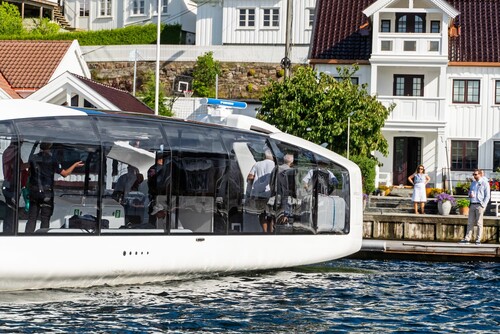
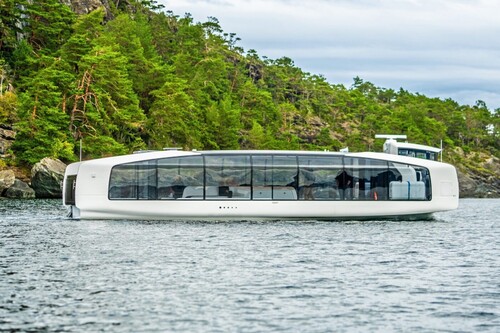
Jacob Rogers · 6 months ago@jacobrogers233Norway just ordered 20 'flying' electric ferries in historic deal Liked by+17 othersPost commentRelated PostsThis futuristic-looking electric ferry just proved boats beat bridges in cities 41 · Ava Tremblay · 6 months agoMea Culpa: Correcting The Ferry Battery Orderbook Still Leaves A Strong Electrification Story 30 · Emily Tremblay · 6 months agoFast Hydrofoils, Floating Logs, & Canada’s Ferry Electrification Challenge 19 · Abigail Fortin · 6 months agoCandela’s new P-12 Business electric ferry is luxury soaring just above the waves 80 · Victoria Campbell · 6 months agoMackinac Bridge walkers can ferry to St. Ignace, Mackinaw City. How to book service 116 · Carter Smith · 1 years agoNorway Found A Real Bus Cyber Risk. It Didn’t Show It Was Chinese. 12 · Annabelle Hall · 27 days agoNorway Sealed a Chinese Bus Inside a Mountain to Find Its Kill Switch. A Romanian SIM Card Was Holding It. 80 · Nathan Smith · 28 days agoIn Norway, BMW iX3 stretches past Mercedes GLC Electric and Volvo EX60 on highway range 92 · Jacob Scott · 29 days agoNorway’s Car Market Is Now 98.7% Electric. These Models Are Winning 36 · Adam Fortin · 1 months agoNorway's Passenger Car Market in August 2026: XPENG Ranks Fifth, Chinese Brands' Share Exceeds 21% 57 · Victoria King · 1 months agoCheap 2019 Hyundai Ioniq in Norway hits 65kW, making the tiny-battery EV hard to ignore 48 · Lucas Wright · 1 months agoNorway's capital has 2,500 curbside chargers to support a fleet that's now 50% electric 27 · Lucas Hall · 1 months agoNorway's older Hyundai Ioniq can charge in 25 minutes, and sell for under 10,000 euros 84 · Madeleine Gagnon · 1 months agoNorway Went Hunting for a Chinese Kill Switch in a Bus. It Found Out Every Connected Vehicle Already Has One 18 · Evan White · 3 months agoNorway Tested a Chinese Bus Inside a Mountain and Found a Foreign SIM Card Holding the Kill Switch 28 · Mason Johnson · 3 months agoNorway Found a Remote Kill Switch in a Chinese Bus. Your Car Has One Too. 29 · Mason Mitchell · 3 months agoXPENG L03 Launches With Strong German Pricing & Shocking Prices In Norway 20 · Ella Leblanc · 3 months agoEVs At 98.3% Share In Norway – Tesla Model Y Leads 93 · Benjamin Hall · 3 months agoNorway test finds Kia EV5 gets the job done, but its range may not be great for highway road trips 64 · Henry Leblanc · 3 months agoIn Norway, a gas station ripped out pumps, and made room for a new bank of EV chargers 56 · Morgan Young · 3 months ago




 +17 others