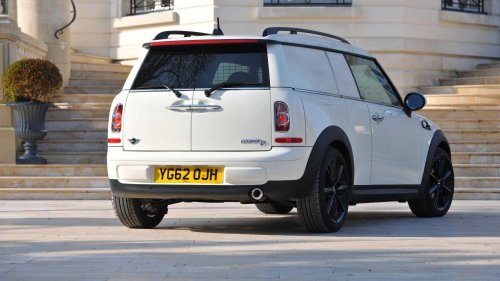
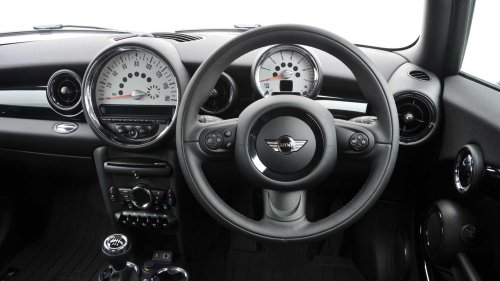
Mini has never been backward in coming forward as it tries to shock the automotive world into buying some of its leading-edge products. And it has – from time to time – come up with some truly zany ideas that someone on the product team clearly thought would sell.Such was the case with its Mini Clubvan project from 2013, where someone clearly thought that Americans would like a premium two-seat commercial van rather than a car. Designers added a small amount of cargo room in the place of some rear seats, and while Mini went ahead with this factory product based largely on an initial concept, the market was far from convinced.In the end, the company only sold 50 units in the US before it pulled the plug, as people viewed its Clubvan as a commercial oddity that didn't deserve the time of day. But if you can find one on US soil today (which is a very tall order), you'll have discovered a collector's curiosity that's almost guaranteed to be a conversation starter. The Clubvan Was A Genuine Factory Concept Brought To Production BMW GroupMini engineered and homologated the Clubvan as a legitimate production variant of the R55-generation Clubman. As such, this wasn't a dealer-led gimmick, and it certainly wasn't an aftermarket conversion, which gives the car plenty of collector credibility today beyond simple novelty. The Clubvan was, from the A-pillar forward, a run-of-the-mill Mini. You could choose to fit the familiar 1.6-liter four-cylinder under the hood, with manual and automatic transmissions available. And importantly, the Clubvan drove like any other Mini from that era, with all the special chassis dynamics and the model's sharp front-wheel drive character.Behind the front seats, however, things were a bit different. Mini took out the rear bench entirely and instead installed a flat carpeted cargo floor with a few tie-down points here and there. Designers also took out the rear side glass and added panels to make the car look more like a true panel van. A sturdy metal mesh partition sat in between the cargo area and the cabin, and at the back, traders could take full advantage of the Clubvan's distinctively split barn doors. This would have made loading and unloading easier and justified the vehicle's intent.Clearly, Mini wanted to create a compact and stylish delivery vehicle for urban environments and to give buyers a dynamic solution so they wouldn't have to choose any traditional work van. Over in Europe, that formula seemed to work quite well, where small vans were commonplace in dense cities, but the commercial market in America spoke a very different language. Too Commercial For Lifestyle Buyers And Too Lifestyle For Commercial Buyers BMW Group Perhaps Mini was trying to be far too niche in its positioning and trying to appeal to a very definitive audience. It might have envisioned boutique buyers lining up to buy the Clubvan in the form of florists, photographers, artisanal coffee roasters, and the like. Or perhaps Mini thought that such buyers would appreciate a premium badge on a small urban runabout, which might help them stand out in their field.Whichever way you slice it, small business operators tend to be a little more pragmatic and typically look for durability and space, with cost a much bigger consideration than image.Ford filled much of this niche in 2013 with its Transit Connect offering, which had greater cargo volume (129 cu-ft vs 33 cu-ft), while being very popular with fleet buyers. It looked and felt like a work vehicle from the outset, while the Clubvan just looked like a hatchback that was pretending to be a van.Worst still, the Clubvan cost a lot more than a standard Clubman in general configuration, despite the fact that it was far less versatile for everyday buyers. Much of that differentiation appears to be down to the 25% chicken tax, which applied to imported commercial vehicles.The Clubvan may have been a reasonable purchase for solo Americans, but as soon as you removed the rear seats, you were taking a large number of enthusiasts and most families out of the picture. And for commercial operators, it was tough to justify the premium spend when the Clubvan didn't really offer too much in the way of actual space.Mini completely missed the mark with the Clubvan and only managed to sell around 50 units across the whole of the US. Even limited-run performance variants tend to sell in the hundreds or perhaps thousands, so, 50 across an entire continent is a very disappointing result, to put it mildly. Rarity Is Only Part Of The Equation BMW Group Today, the Clubvan ought to be collectible as it combines rarity, brand identity, and a very distinct visual configuration. The fact that Mini only sold 50 could put the Clubvan in the realm of limited homologation specials or ultra-low-volume editions, even though Mini never intended the project to turn out that way.The Clubvan also looks very different from one angle over another, which should add to its collectible appeal. From the front, you might think that you're dealing with a standard Clubman, but from the side you'd notice the absence of rear seats and those solid rear quarter panels to make the distinction clear.Importantly, the Clubvan also represents a specific moment in the company's history. The early 2010s was certainly an experimental period for Mini, and it turned out a variety of roadsters, coupes, Pacemans, and niche trims to explore the formula as much as possible. A Clubvan was one of those experiments before the company would rein itself in and consolidate its offerings. Values Are Hard To Pinpoint BMW Group You can't get a much smaller sales footprint, and this means that the Clubvan doesn't have any sprawling owner community to provide anecdotes and real-world vehicle information about it. Some buyers appeared to be diehard Mini loyalists who just wanted the strangest variant they could possibly buy, while others may have been intrigued by the company's bold approach from day one and felt that the Clubvan was an instant collectible.Perhaps the Clubvan would have been better off as a European footnote, without taking its bolder journey across the Atlantic, but instead, its story revolves around sheer improbability.Where versions occasionally appear for sale in the UK, they'll typically change hands for between $5,000 and $12,000 equivalent, depending on mileage and condition. That means that they're broadly the same kind of money as a comparable Mini Clubman model.The vehicles are so scarce in the US that it's impossible to reveal any reliable pricing pattern, but if you were to find a clean one in low-mileage spec, you might pay in the low five-figure range to take it home. For reference, two appeared in US auctions back in 2023 for around the $11k mark, each. From Commercial Miscalculation To Cult Artifact BMW Group In 2013, it was easy to roll your eyes and categorize the Clubvan as yet another bold Mini experiment. You could view it as a misguided attempt on behalf of the company to carve out a new niche without any solid reasoning to back that up. And you'd see that the American market took a raincheck, causing the Clubvan to disappear almost as fast as it appeared.But where examples might survive to this day, they'll certainly be some of the rarest modern Minis. And when you pair that rarity with strong branding, such a vehicle ought to age well.It may certainly be hard to find living examples, especially if some of the original owners used them as intended. More than a decade of wear and tear, accidents, or neglect could quietly reduce an already tiny population, and there are sure to be very few low-mileage and unmodified examples around.Today, the very idea of a tiny gas-powered lifestyle van feels strange and like a relic from a different era. And while the Clubvan didn't fail because it was poorly engineered or anything like that, it missed the mark because it didn't align with American commercial expectations as they stood.At the end of the day, it does seem unfair to completely ignore the Mini Clubvan. After all, whatever you think of its look and presentation, it represented a bold attempt to redefine what a commercial vehicle could look like in the States. And it doesn't seem unreasonable to think that a humble van like this could be stylish in a world where almost everything else was blandly utilitarian.