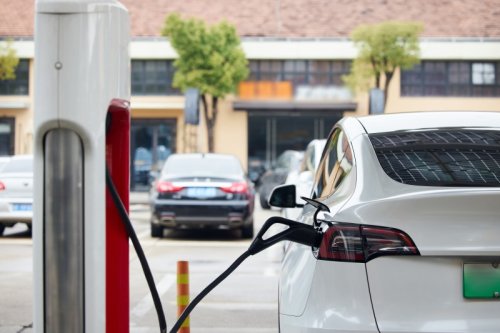



















Gasgoo Munich-on August 26, the State Council Information Office hosted a press conference focused on the 15th Five-Year Plan. Attendees included Xin Guobin, vice minister of the Ministry of Industry and Information Technology (MIIT), along with directors Yao Jun and Liu Yulin. They outlined efforts to implement the 15th Five-Year Plan and accelerate new industrialization, taking questions from the press.When asked how the government will drive high-quality development in the intelligent connected NEV sector during the 15th Five-Year Plan period, Xin noted that during the previous plan, China's NEV industry scaled up dramatically—shifting from the millions to the tens of millions. Annual sales surged from 1.367 million to 16.49 million, capturing 47.9% of new car sales, up from just 5.4%. The industrial ecosystem has matured, with technologies like vehicle integration, power batteries, and LiDAR now ranking among the world's best. Production of NEVs, batteries, and key materials accounts for over 70% of the global total. With exports reaching more than 100 countries and regions, the sector has cultivated competitive leaders and become a flagship of Chinese manufacturing.Image Credit: XPENGYet Xin acknowledged that the sector faces mounting headwinds. "Irrational competition remains a stark issue," he said, noting that some radical innovations are being deployed in vehicles without sufficient experimental validation. Incidents involving product quality and autonomous driving safety continue to spark public concern. These challenges cannot be ignored or avoided, he stressed, adding that they are priority issues the 15th Five-Year Plan must address.To that end, the MIIT has drafted the "15th Five-Year Plan for the Development of the Intelligent Connected New Energy Vehicle Industry." Xin outlined four key initiatives:First, improving product quality. The ministry will support key enterprises in tackling technical hurdles—specifically enhancing the low-temperature adaptability and durability of power batteries, as well as the safety and reliability of autonomous driving. It will also actively yet prudently advance pilot programs for market access and road operations of intelligent connected vehicles.Second, optimizing the usage environment. This involves promoting vehicle trade-ins, NEV adoption in rural areas, and pilot programs to fill gaps in county-level charging infrastructure. The goal is to achieve full charging station coverage across all counties and full charging pile coverage across all townships, while also optimizing insurance policies and reducing maintenance costs.Third, refining the industry governance system. The ministry will push for reforms in the group management of automaker production qualifications, strengthen scrutiny of innovative designs, and enforce strict testing and verification management—banning products that haven't been fully validated from entering the market. Fourth, deepening international cooperation. Leveraging multilateral mechanisms, China will increase coordination on international standard-setting and steadily advance cooperation in global trade and investment.