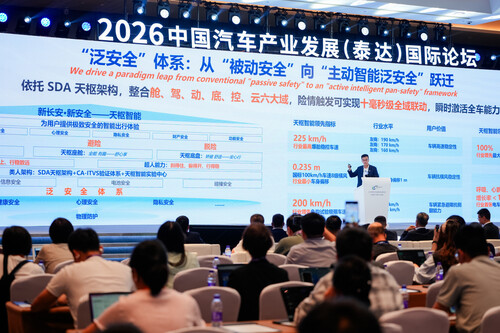
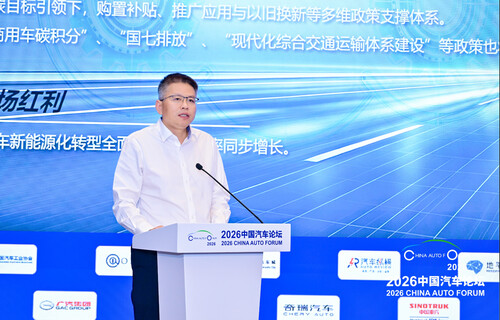
Alexander Morgan · 2 months ago@alexandermorgan30MIIT Talent Exchange Center's Ren Lihua: Key NEV Tech Talent in Short Supply | 2026 China Auto Forum Liked by+14 othersPost commentRelated PostsChina-branded next-gen flagships to take center stage at Auto China 2026 65 · Adam Martin · 5 months agoWhat to expect from Chinese car brands at the Paris Auto Show 2026Morgan Rogers · 15 days agoMIIT launches 2026 NEV safety hazard inspections; AITO M6 deliveries exceed 20,000 in first month 22 · William Côté · 4 months agoChina Auto Industry Profit Down 16% in Jan-Aug 2026 67 · Carter Lewis · 17 days agoMIIT advances "AI + Manufacturing," focusing on NEVs and other sectors 44 · Jacob Scott · 5 months agoWang Du: Auto Market Enters Shakeout, Distribution Industry Urgently Needs to Restructure Profit Model | 2026 TEDA Forum 25 · Nicole Scott · 23 days agoComplaints over OTA Battery Locking Surge; MIIT Summons 8 NEV Makers 89 · Sophie Lavoie · 5 months agoZhang Guohua: Premium Cannot Be Self-Defined; Auto Marketing Must Shift from Spec Stacking to User Spiritual Resonance | 2026 TEDA Forum 72 · Madeleine Hall · 24 days agoDong Yang: Auto industry needs high-quality development, opposes blind full-stack in-house R&D | 2026 TEDA Forum 68 · Adam Johnson · 24 days agoRen Shuojin: Auto and Low-Altitude Aircraft Share 70% of Components, Industry Can Deeply Empower | 2026 Teda Forum 36 · Nathan Johnson · 25 days agoWhat Will Keep China's Auto Industry Moving Upward? | TEDA Forum 2026 71 · Lauren Rogers · 26 days agoI'm an Auto Expert: These Used Cars Could Get Cheaper Throughout 2026 84 · Thomas Clark · 28 days agoKey takeaways from Auto Shanghai 2026 87 · Liam Smith · 29 days agoToday at The Auto Wire: Full Recap (September 15, 2026) 79 · Lucas Turner · 1 months agoToday at The Auto Wire: Full Recap (September 14, 2026) 40 · Ava Gagnon · 1 months agoToday at The Auto Wire: Full Recap (September 12, 2026) 74 · Kaitlyn Wilson · 1 months agoBYD’s Fang Cheng Bao unveils interiors of Formula S and Formula S GT at 2026 Chengdu Auto Show 10 · Claire Green · 1 months agoChina's passenger vehicle exporters overview (Jan.-Jun. 2026): Chery Auto surges 274.1% in Europe丨Gasgoo Automotive Research Institute 87 · Lucas Hill · 2 months agoTested: The 2026 Corolla Cross Hybrid Is the Agreeable Gray of the Auto Industry 11 · Mia Tremblay · 2 months agoChina’s passenger vehicle exporters overview (Jan.-May 2026): Chery Auto surges 277.5% in Europe丨Gasgoo Automotive Research Institute 16 · Morgan Scott · 2 months ago


 +14 others+14 others
 +14 others