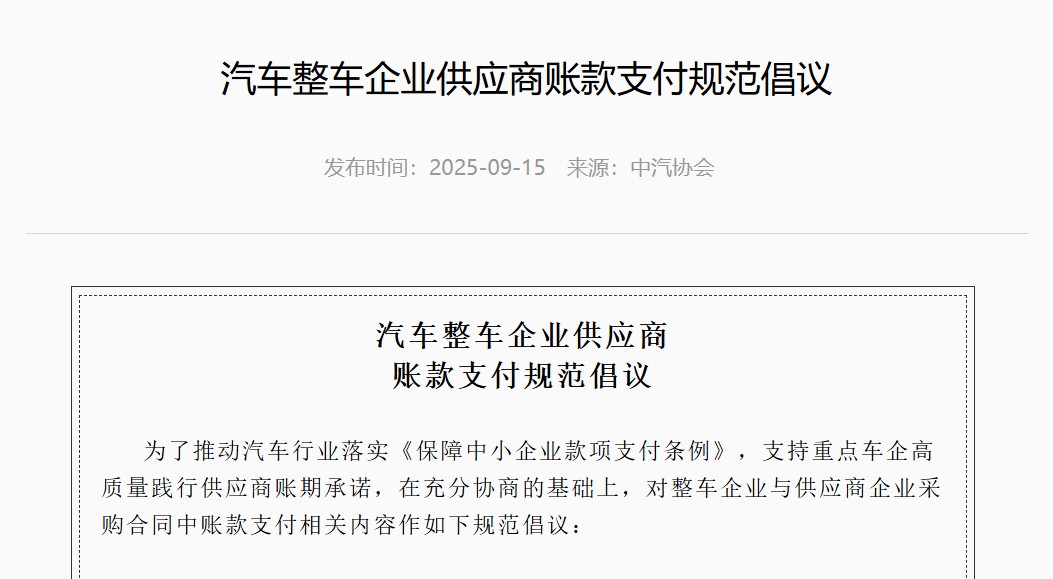
Gasgoo Munich- On Nov. 16, the China Association of Automobile Manufacturers (CAAM) issued a notice launching a survey and evaluation of supplier payments by automakers. The directive requires 17 key automakers under review to report their payment status for the 2026 fiscal year and the fourth quarter by Jan. 31, 2027, paving the way for the association's first formal assessment. This signals a shift: the "60-day payment" pledge made in June 2025 is now entering an institutionalized evaluation phase—moving from promises to annual, order-based accounting. Why an "Annual Exam" is Needed After the Pledges On June 1, 2025, the revised Regulations on the Payment of Accounts to Small and Medium-Sized Enterprises took effect, mandating that large enterprises pay SMEs within 60 days of delivery. That same month, 17 key automakers pledged to cap payment periods at 60 days. FAW Group, for instance, stated in a June 10, 2025 release that it would enforce a "60-day payment" deadline across its subsidiaries, using digital dashboards to track contracts, invoices, and payment milestones. Image source: China Association of Automobile Manufacturers On Sept. 15, CAAM issued the Proposal on Standardizing Supplier Payments for Automakers, translating high-level requirements into operational rules. These included a cap of 60 natural days from delivery and acceptance, and a mandate that acceptance verification be completed within three working days in principle. The pledges have had an impact. A CAAM research report released in Feb. 2026 shows the average payment period for the 17 automakers dropped to roughly 54 days—about 10 days shorter than the previous year. Four companies fell below 50 days. Fifteen settled payments entirely in cash or bank acceptance drafts, while the two using electronic accounts payable vouchers committed to phasing them out. While most automakers have moved quickly, progress remains uneven across the industry and between parent companies and subsidiaries. The Ministry of Industry and Information Technology (MIIT), in interpreting related guidelines, noted that the industry still lacks a standard start date for payment periods—varying between delivery acceptance, centralized reconciliation, and invoice receipt. Ambiguous acceptance criteria and prolonged verification cycles can also drag out the actual payment timeline. Image source: Doubao AI Yet the problem isn't limited to the number of days written on a contract. A July 2026 survey of several parts makers by an industry body revealed that some OEMs delayed key milestones—such as confirmation, reconciliation, invoicing, and acceptance—or used quality verification and approval processes to drag out settlement. For suppliers, the actual comprehensive payment cycle can stretch to around 180 days. Some Tier 1 suppliers may have contracts stipulating 70 or 120 days, but if they receive acceptance drafts with terms exceeding six months, actual cash arrival can take 250 to 300 days. Payment pressure amplifies down the supply chain. Industry insiders note that Tier 1 suppliers often add another two months to their own payment terms, shifting the burden further upstream to smaller suppliers and service providers. If Tier 1 suppliers face blocked payments, those further down the line—Tier 2, 3, and 4 vendors—find it even harder to stay afloat. It is precisely these issues that make the "annual exam" necessary. In the second half of 2026, curbing payment arrears and regulating non-cash payment instruments moved higher on the agenda, with deployments made at meetings on July 30 and Aug. 21. Subsequently, the MIIT and the State Administration for Market Regulation issued a notice in September to standardize supplier payments and optimize payment period management. The directive outlined a clear mechanism: "corporate self-inspection reports, third-party evaluation and publication, and government supervision and verification." The newly released notice on surveying and evaluating payments marks the first implementation of this mechanism. It signals a shift in payment governance from "corporate pledges" to "institutional verification." What's New About This "Audit" Compared to previous surveys, this evaluation offers a much finer degree of granularity. Image source: China Association of Automobile Manufacturers The notice specifies that the accounting unit will be "accepted purchase orders during the evaluation period," moving beyond a simple look at average corporate payment periods. For each company, at least 15 sample suppliers will be randomly selected. Evaluation teams can review contracts, acceptance notes, reconciliation records, invoices, ledgers, and payment vouchers, and are authorized to conduct site visits. The assessment focuses primarily on verifying payment periods, payment methods and their proportions, and the scale of accounts payable. Crucially, the results will be reported to the MIIT and "publicly released in accordance with procedures." According to the document, companies dissatisfied with the initial assessment can apply for a review within five working days of receiving feedback; CAAM aims to provide a conclusion within 15 working days. Companies can also raise objections to the evaluation process itself with the MIIT. The earlier notice on standardizing payments focused on three specific nodes: acceptance, price negotiation, and payment methods. For acceptance, general parts must be verified within three working days of receipt; failure to do so implies they are deemed qualified. For parts requiring vehicle verification, off-line inspection must be completed within five working days to prevent acceptance from becoming a tool to delay payment. During price negotiation, if a price hasn't been agreed upon, interim payments must still be made—no less than 90% for continuous supply and 70% for non-continuous supply—to prevent "ongoing negotiations" from being used as an excuse to stall payments. Regarding payment methods, the earlier notice encouraged payments to SMEs within 30 days—maxing out at 60—and advocated for full cash settlements. The new notice adds a specific evaluation criterion for non-SMEs: the ratio of cash and bank acceptance draft payments must be no less than 80%. Image source: China Association of Automobile Manufacturers According to the notice, Jan. 31, 2027, marks the first submission deadline, with the first annual evaluation results to be formulated and published based on this data. At that point, public attention will focus not only on the average payment periods of the 17 automakers but also on the actual payment recovery of sample suppliers and the structure of payment methods used. Compressing contract payment periods to 60 days is merely the first step. The real test will be the first annual evaluation results—which will lay bare who is actually paying within 60 days, who is still stalling, and who is using commercial paper to bypass the rules. In the view of industry insiders, payment periods are just a symptom; the deeper issue lies in the transformation of OEM business models. This process requires a "soft landing"—one that demands stronger regulatory enforcement but also relies on government support to manage risk disposal. It remains to be seen whether payment governance can move from "paper compliance" to "actual cash in the bank," and whether these standards can expand from the 17 key automakers to a broader swath of the industry.

 Liked by Owen Rogers, Madeleine Lavoie

















 Liked by Owen Rogers, Madeleine Lavoie