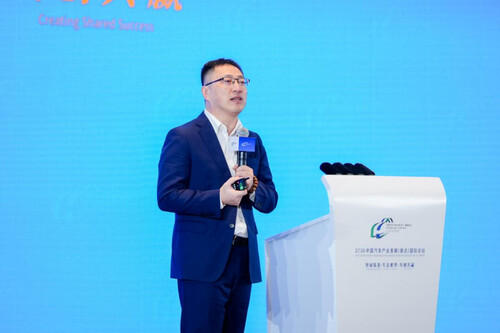
Gasgoo Munich-At the Gasgoo 4th AI-Defined Vehicle Forum on Sept. 18, Jeffrey Wang, Global ADAS Head, Ningbo Joynext Technology Corporation, delivered a keynote titled "AI-Defined Cars Supported by Central Computing Platforms." He shared Joynext's cross-domain central computing solution built around the FlexBlade architecture, while outlining his views on the commercialization paths for L3 and L4 autonomy and the competitive landscape.Wang pointed out that central computing architecture is rapidly becoming the cornerstone of the smart vehicle's digital base, gradually replacing traditional distributed architectures to boost safety, streamline software update cycles, and enhance functional flexibility. He emphasized that a central computing platform isn't merely a stack of hardware; it requires deep software integration to tackle challenges like underlying communication and mixed functional safety design. Essentially, it's about building the "digital chassis" of a smart car.Riding this trend, Joynext has launched a cross-domain central computing platform solution centered on its FlexBlade architecture. By enabling cross-domain fusion through a single-chip system, the approach creates a more efficient central processing architecture. It drastically reduces the number of control units and simplifies electronic complexity, while fundamentally improving coordination efficiency—what Wang calls the "super central brain" of software-defined vehicles. The nCCU series, built on Qualcomm's latest high-end platform, supports deep fusion of smart cockpits and ADAS domains. It combines flexible resource allocation, AI multimodal interaction, and robust computing power, meeting the customization needs of different models.Wang mapped the evolution of central computing platforms into three stages: Phase 1.0 is the "mechanical fusion" One-Box model; Phase 2.0 is "hardware fusion" via cross-domain integration; and Phase 3.0 will move toward "capability fusion," achieving deep software-hardware decoupling and dynamic computing power scheduling. He noted that standardizing underlying communication and functional safety design is critical under this architecture—this is the core value of the "digital chassis."Regarding the commercialization of L3 and L4, Wang offered a clear assessment. He stated that the core value of L3 lies in freeing up the driver's time—a key customer demand and commercial driver for autonomous driving. However, safety and intelligence are inextricably linked; at the same cost point, boosting safety can limit intelligence levels. This dynamic dictates that L3 and L2++ will follow divergent paths: L2++ pursues broader scenario coverage and the ultimate user experience, while L3 focuses on limited scenarios to fully liberate the driver. Wang revealed that Joynext built in safety redundancy during its L2+ phase and is now advancing L3 domain controller upgrades for existing models with automakers. The L3 products are slated for mass production by mid-2027, debuting on models from a leading automaker.As for L4, Wang acknowledged that the primary bottleneck isn't the technology itself, but the drag of comprehensive operational costs. Citing L4 logistics trucks as an example, he explained that even if vehicle costs drop, low automation rates in loading and unloading or insufficient range compared to human driving can drive the cost per shipment above manual levels. That is the real barrier to deployment. He stressed that a successful L4 model must treat the "autonomous system plus scenario operations" as a whole package—only by balancing the books can sustainable commercialization be achieved. On the ground, Joynext's partnership with Siann at the Ningbo Port smart port project stands as a prime example of L4 moving from the lab to the market. Their jointly developed digital management platform, based on "V2X plus L4 autonomous driving plus smart cloud scheduling," is already in stable operation at the port. Wang disclosed that an L4 domain controller will support low-speed unmanned logistics vehicles, potentially becoming the first mass-produced L4 domain controller based on a domestic chip platform. The technology is set to expand horizontally into robotics, with future scenarios including mining zones, industrial parks, and airports.Facing the "second half" of the smart driving competition, Wang defined Joynext's three-pronged strategy for 2026: cost control through continuous optimization based on mass production experience; deep technological focus on central computing platforms and V2X; and ecosystem stickiness through deep binding with partners. On the ecosystem front, Joynext has teamed up with Huawei, Qualcomm, Horizon Robotics, Black Sesame, Momenta, QNX, Elektrobit, Baolong Tech, and others. Wang emphasized moving beyond superficial "you want the price, I want the client" deals to solving pain points from the partner's perspective. Globally, Joynext pushes overseas business with a "China R&D plus global deployment" model. Its Poland plant has undergone a second expansion in five years, with a client roster that includes Volkswagen, Audi, BMW, NIO, BYD, and Toyota.Concluding his speech, Wang stated that Joynext will anchor its strategy on central computing platforms and V2X technology. By solidifying the three pillars of technical accumulation, ecosystem stickiness, and global capabilities, the company aims to steadily advance L3 and L4 commercialization. Joynext strives to become a top global smart driving supplier within the next three to five years, delivering industry value through actionable technology and verifiable results.