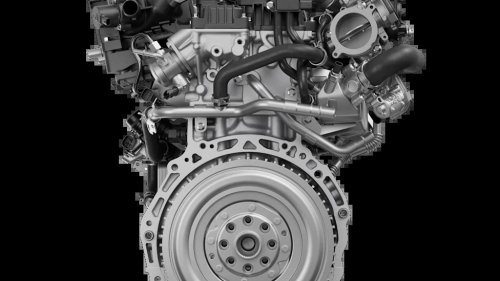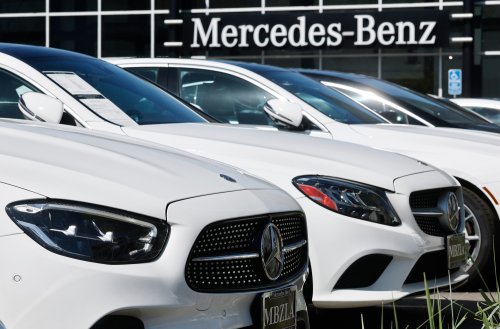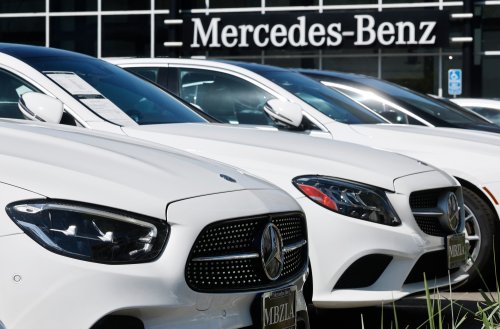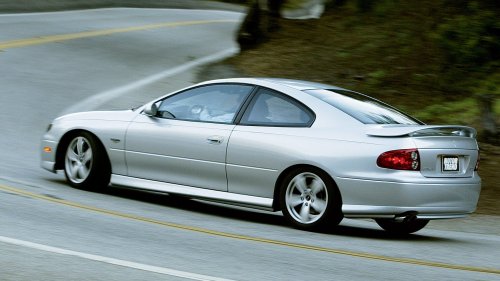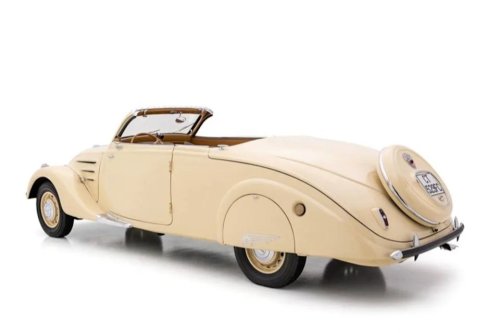
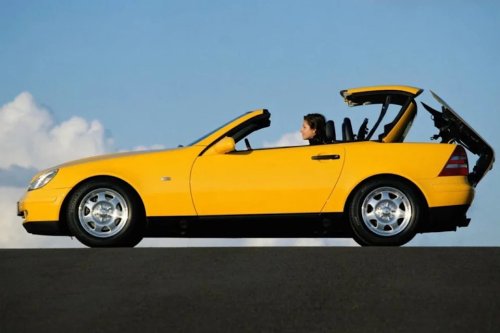
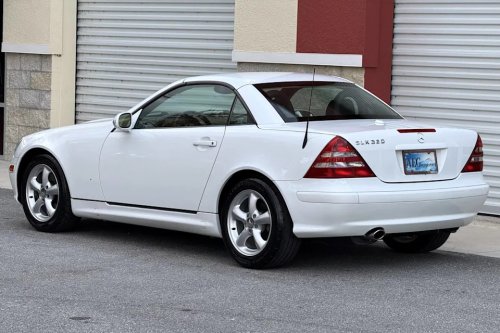
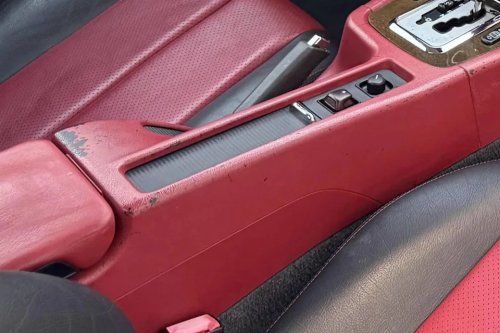
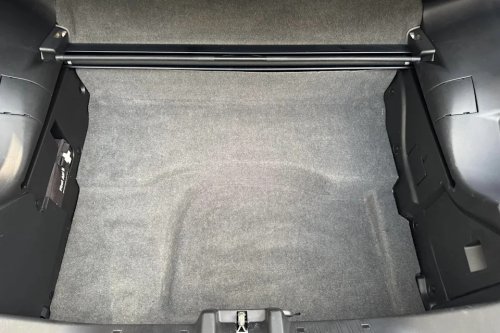
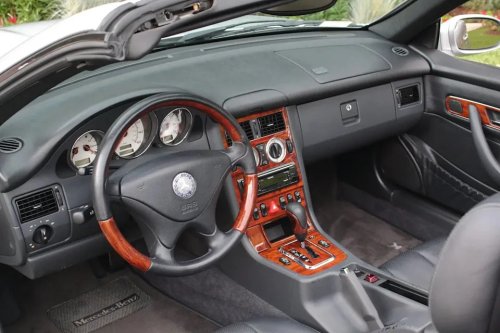
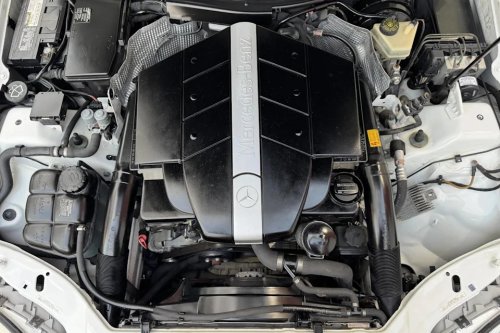



















Before the '90s, hardtop convertibles were few and far between, because they were expensive-to-engineer niche products with limited sales potential. Peugeot started it all in 1934 with the 401 / 601 / 402 Eclipse (below left), which stored its entire hardtop in one piece below the trunk lid. Only around 100 were ever built. Only six examples of Chrysler's hardtop Thunderbolt Roadster (below center) were built in the '40s, perhaps due to its high $6,000 price tag. The first hardtop convertible built in any volume was the 1950s Ford Fairlane Skyliner (below right), with 50,000 sold.1936 Peugeot 402 Eclipse ConvertibleAnameraBut the first-generation R170 Mercedes-Benz SLK would bring the hardtop convertible into the mainstream in 1996 with its innovative steel Vario Roof, which collapsed into two stacked pieces to save space and retain some trunk volume even with the roof down. The hardtop convertible had finally come of age, and Mercedes sold more than 300,000 examples. I went back in time and tried a facelifted SLK 320 to see what all the hype was about, a model you can get used in good condition for around $10,000 to $15,000 today.1996-1999 Mercedes-Benz R170 SLK Vario RoofMercedes-BenzExterior Styling: Classic Roadster ProportionsWith that long hood and stubby tail, the SLK has classic roadster proportions, and it's impossible to tell that it sits on a shortened W202 C-Class floor pan. It's less than 158 inches long, so its Sportlich, Leicht, Kurz (sporty, light, short) name is fitting. The R170 borrows two features from the 1954 300 SL's playbook: the dual power domes on the hood and the 94.5-inch wheelbase. It was essentially a return to the compact proportions of the original SL convertible, at a time when the '90s R129 SL had become a much larger, heavier touring car – a role it may be reverting to in the future.2001 Mercedes-Benz SLK320 in white roof upBring a TrailerThe ballet of the folding steel top must have been space-age stuff in 1996, and it does its job in 25 seconds, fully stowing or erecting under the back-hinged trunk lid. Unlike modern cars, though, you need to be at a standstill to operate it. The wind deflector is a net stowed behind the seats that requires quite a bit of effort to pull tight across the roll bars and secure in place manually before you can go al fresco. You'll appreciate the unobstructed view out, which is one of the advantages of driving a convertible, along with unlimited headroom when the roof is down.Interior: Delight and DisasterThe cabin looks the part for a Mercedes roadster, with a classic Merc center stack. Given the cost to develop a mass-market roadster with a folding hardtop, Mercedes cut costs in the cabin and tried to cover it up. The dashboard structure is pleasingly solid, but only the dash top is soft-feel, and the rest is hard plastic with a soft matte coating. It's solid enough, save for the hollow-feeling cubby lid, but that fancy matte coating comes off after a few years, exposing the black base plastic underneath. It looks truly horrible in cars with interiors in any color other than black (see red interior below), where the color coating peels and the black base plastic is exposed. It's a universally known R170 problem, and it's hard to imagine what the Mercedes engineer that signed it off was smoking.2001 Mercedes-Benz SLK320 with red interior trim peelingBring a TrailerMy tester's owner would have preferred a snazzy red interior, but the black interior of his SLK 320 ended up being its saving grace. He spent hours scrubbing off the peeling coating from the center console, exposing the very similar-looking black plastic underneath, and if he hadn't told me, I would have assumed this was just one impossibly well-kept R170 with a nearly immaculate cabin. This trick only works in an all-black interior, of course, and this matte coating will forever be the black mark against the R170, and markedly affects its used value. Trunk space of 9.5 cu-ft with the roof up is impressive for such a tiny car, but this is reduced to 3.6 cu-ft when the roof is folded down.2001 Mercedes-Benz SLK320 trunk with roof upBring a TrailerDriving the SLK 320 V6 AutomaticThe R170 SLK stands just 50 inches tall, and you duck well down to get in. Newer sporty convertibles such as the F23 BMW 2 Series feel like a sedan compared to this low-slung Merc. You sit right on the road, peering over that long hood with its seductive power domes, and it feels every inch the sports car. The 2000 facelift benefited from lowered suspension, sharper handling, and a stronger and more crashworthy structure (it achieved four EuroNCAP stars back in the day). With Mercedes' famous multi-link independent rear suspension, the outright grip is prodigious as the SLK blasts flatly through the corners.2001 Mercedes-Benz SLK320 with black interiorBring a TrailerContemporary road tests rated the BMW Z3 and Porsche Boxster higher for driver involvement, even if the Merc beat them on bald skid-pan g-forces. The grip limits are very high, but with the stability control switched out and the short wheelbase, it can let go suddenly and swap ends if you're not awake. The recirculating-ball power steering predates modern rack-and-pinion systems and takes a lot of getting used to. Worst is the lack of feel and feedback, but the ratio is also overly sharp off-center, causing you to steer too much when diving into a bend and requiring corrections as you corner. Its inherent sensitivity can be regarded as a flaw but, to be fair, you get used to it after a few days' driving, and then other cars tend to feel a bit flabby and slow on turn-in.The pre-facelift SLK rode taller and was softer, but was criticized for not being sporty enough, so Mercedes shortened the springs and dropped the ride height of this facelift. It's firm, grippy, and roll-free, but also rather abrupt over ridges, though still doing an admirable job of rounding off sharp ridges – certainly a lot better than the flex-prone and harsh Z3. The 3.2-liter naturally aspirated M112 V6 came with the facelift and put out 218 hp, good for a 0-60 sprint of 6.9 seconds with either the 6-speed manual or 5-speed automatic.Merc's first-ever V6 engine, the M112 is unusual in having single overhead cams and three valves per cylinder, and no variable valve-timing system in sight, just a variable intake manifold that flattens out the torque curve to produce the full 229 lb-ft of torque all the way from 3,000 to 4,600 rpm. It's a 90-degree block based on the M113 V8, so it has a balancer shaft to keep it smooth.The overriding impression is one of smoothness and a solid wedge of torque that comes on stream instantly. The motorsports guys at Merc had a go at the exhaust design, and the V6 blares heartily when extended, pulling cleanly to its low 6,000-rpm limit. The good old 5G-Tronic auto in my tester slurs through the ratios unhurried and as if wading through warm honey, without a lurch or jolt, but slow enough to frustrate enthusiasts. It tends to suit the car's cruiser role, but calls those sports-car claims into question once more.2001 Mercedes-Benz SLK320 3.2L NA M112 V6 engineBring a TrailerFinal ThoughtsThe R170 SLK is an ambiguous car that perhaps makes more sense in pre-facelift format, when it was a premium roadster with a comfortable ride. The facelifted car gave it a harder edge and better handling, but retained the feel-less recirculating-ball steering and unhurried 5-speed auto, so it's an odd mix of sporty and laid-back, without a clear identity. The 6-speed manual is interactive and fun, but one has to ask if that's the right choice for a car that's not really meant to feel like a Boxster anyway. The SLK 320 V6 is widely considered to be the most reliable R170 you can buy, with its bulletproof M112 V6 and 5G-Tronic auto.Instead of chasing lap times, drop the roof, listen to the charming burble of the torquey V6, and cruise the boulevards and mountain passes with your favorite passenger. If the weather turns foul, it turns into a proper coupe with a decent trunk, far cosier and quieter than any soft top of the era. The major turn-off remains the trim coating in the cabin, and you may be in for some restorative work, the permanence of which may be questionable if you go for the extroverted cabin colors.Pretty as those are at first sight, I suggest sticking to a black cabin and removing the stupid coating in a DIY job, and nobody will be any the wiser. It's the only major flaw in a landmark hardtop roadster that's still a pleasure to drive today, 30 years after its birth. Get a clean one while you can, because the number of roadsters you can buy is steadily declining, and there are only a few new ones left on the market.