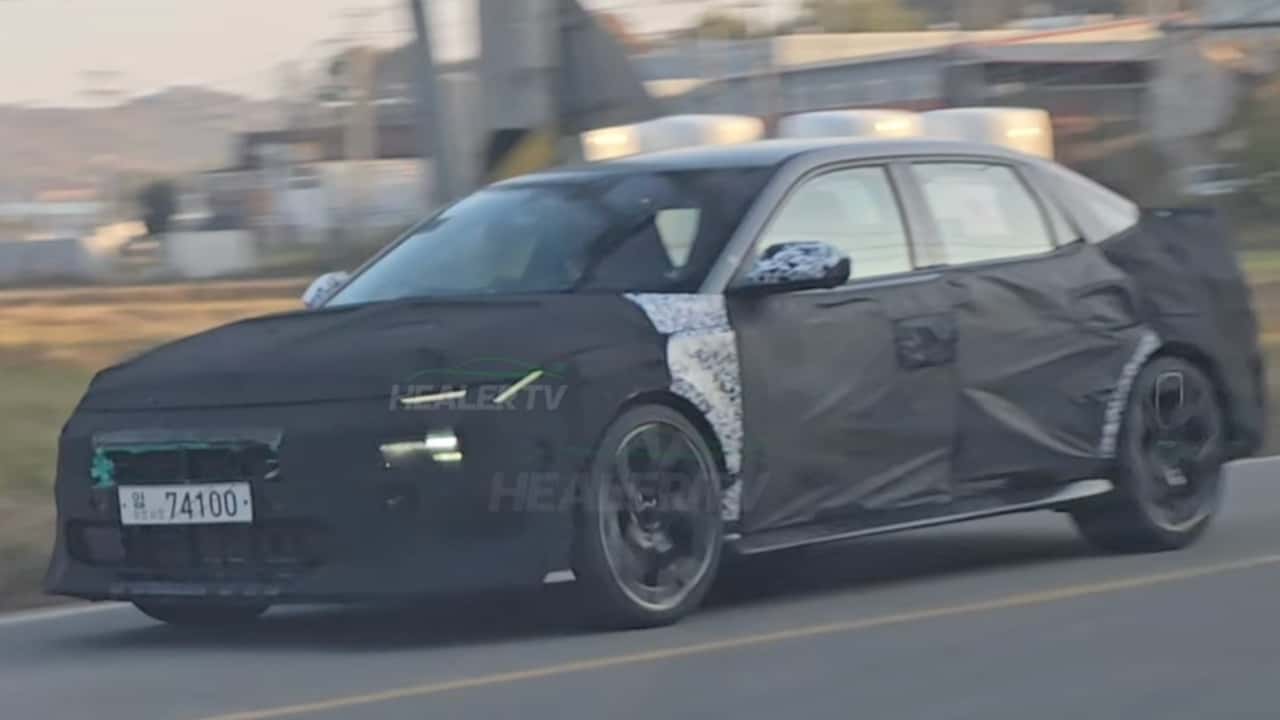
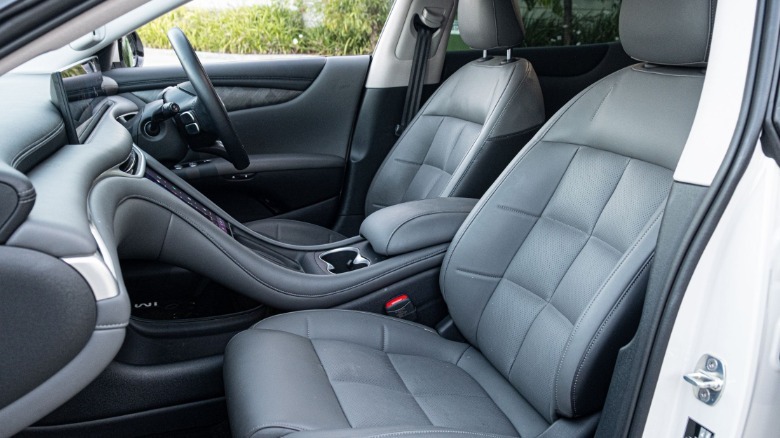
Brutalism is a polarizing style of architecture. Though the name seems to imply some sort of violence, the term “brutalism” comes from the French béton brut, meaning “raw concrete.” Brutalist buildings are distinct, they typically have broad swathes of unpainted concrete forms, periodically broken up at right angles by windows and doorways. Brutalism attempts to honour the beauty of the raw form of the very materials that constitute a building, rather than trying to sheathe them with siding or cladding. The exterior design of the new eighth-generation Hyundai Elantra wears what the brand calls its ‘Art of Steel’ design language, and I think it may be polarizing as well. As I mentioned in my coverage of the new-generation Hyundai Tucson, which also wears this design language, Hyundai cares not at all for tradition, or to gently link a new car to the one that came directly before it. Like the Tucson and its predecessor, the new Elantra is completely unrecognizable from the seventh-generation car that preceded it. Horizontal and vertical light elements emerge like gun slits from a geometric and blocky front fascia. A similar motif is found at the rear, capped with a knife-sharp rear spoiler, integrated into the trunk. The wheels of the car appear to be pushed out to the edges, housed in bodywork reminiscent of 1980s box flares. Like a brutalist concrete building, the result is imposing, making the car look much larger than it did before—but that may also be because it is. While the ‘Art of Steel’ design accentuates the car’s dimensions, the new Elantra is larger in every appreciable way. It’s 86 mm longer, 30 mm wider, and it rides on a wheelbase 30 mm longer than before. Hyundai is proud to note this increase in external size has translated to more internal space. For example, some of that additional wheelbase and length has gone to the rear passenger compartment, where you’ll find 30 mm more legroom than previously. Headroom and legroom for front and rear passengers has been improved, and you’ll also find 22 mm more shoulder room (although Hyundai did not clarify if this figure was for the front seats, rear seats, or both). Despite its blocky appearance, the new Elantra is deceptively efficient through the air, achieving a coefficient of drag of just 0.26, which is actually better than a current Toyota Prius. Open the door to the passenger compartment and you’ll find another study in contrasts. Externally, most brutalist buildings don’t look inviting, exactly, but their interiors usually contrast this. Like the new Tucson, the new Elantra wears Hyundai’s ‘Curve of Upholstery’ design language. According to Simon Loasby, Head of Hyundai Style, the idea is to bring the softness and comfort of your home furniture into a car. Where the outside design is all about aggression and dynamism, the interior is comparatively laid-back. Soft rolled curves permeate the interior. Odd little nooks have been scooped out of seemingly unused space to create a multitude of places to store, or lose, your phone. There’s a little bread-loaf-like centre armrest that opens to reveal a small hiding spot for your sunglasses or keys. The seats are soft and smooth, clearly leaning more towards comfort than performance. There are two screens inside: a slim rectangular screen lying horizontally across the dashboard ahead of and above the steering wheel; and a more traditional landscape-oriented centre touchscreen. The slim display ahead of the driver measures 9.9 inches across from corner to corner and houses three configurable widgets that can be made to display everything, from engine RPM to speed, or from navigation to fuel information. The position of this screen means you can adjust the steering wheel positively anywhere you like without obscuring the display. A 12.9-inch centre touchscreen is standard, and a larger 14.6-inch display (pictured) is optional. Readouts for vehicle essentials like gear, speed, and fuel are actually anchored on this screen at the top-left corner, and not the one ahead of the driver. The screen is highly customizable, and can be configured to show two or three different “windows,” with the leftmost window always being devoted to vehicle functions. With the remaining two-thirds of the screen, you can decide to make it all maps, for example, or split that vertically and have maps on one, and music information on the other. The infotainment itself is new to Hyundai. It’s called PLEOS, and it’s based on an Android Automotive OS. Wireless Apple Carplay and Android Auto are supported, and there are two wireless charge pads up front so both passengers can charge simultaneously cord-free. Below the screen you’ll find a row of neatly labelled toggle switches and two twist-knobs providing redundant hard-mounted tactile controls for all the most-used basic vehicle functions, like climate and music. For example, you can raise or lower the climate control temperature by pressing up or down on the toggle, or by pressing the temperature icon on-screen and adjusting the slider. I think this is a brilliant compromise between touch and tactile systems, allowing drivers to control their car functions in whichever way they prefer. I give extremely high marks for this excellent execution, and I really think some other brands could take a few notes, here. Additionally, the new Elantra (and Tucson) debuts Hyundai’s new Gleo voice assistant, which Hyundai claims is smart enough to intuit your desires when it comes to nav routing and climate control by reading a variety of inputs, including your in-car conversations. Hyundai says this new system is powered by AI, but when I experienced it myself, it acted just like any other voice-command setup — that is to say, it failed my more complex queries. (“Hey, Gleo, I am hungry for some ramen. Can you route me to the highest-rated ramen noodle restaurant near me?”) I’m also not super-hot about the idea of any digital assistant listening in on me, but our cell phones already are, so perhaps I am just grumbling at the clouds here. In any case, the new Elantra interior is a comfortable place to be, and one that feels refreshingly human-focused. The car I sat in had a mostly black interior, and I feel the design would really pop if I had a chance to see it in some more interesting colourways. At launch, Hyundai is offering just one powertrain: a 2.0L inline-four backed by a CVT automatic. This engine is basically identical to the current Elantra’s base engine, making a ho-hum 147 hp and 132 lb-ft of torque. The U.S.-spec version of this powertrain is good for 6.5 L/100 km, and the Korean-spec version is rated at 5.8 L/100 km combined on 16-inch wheels; or 6.1 on the optional 18-inch wheels. What will the Canadian version be rated at? We would assume closer to the U.S.-spec numbers, but we will have to see. A hybrid drivetrain is notably absent from official documents. This new Elantra is actually already on sale in Korea, where it offers a hybrid powertrain with a turbocharged 1.6L engine. In Korean trim, the hybrid Elantra (which is badged the “Avante” over there) is good for 155 horsepower and a commendable 4.4 L/100 km. It seems like an absolute no-brainer to bring the already-existing hybrid variant to Canada, but Hyundai was tight-lipped about even the possibility of bringing it over. It remains to be seen, but I would be surprised if the hybrid version doesn’t become available to Canadians at some point soon after launch. Speaking of launch, domestic Korean sales began in Q3 of this year, and Canadian sales will happen in 2027. Canadian pricing has yet to be announced, but the Korean pricing should give us a clue. Domestically, the sedan starts at 23,980,000 Korean won, which translates to CAD$25,774. Obviously the Canadian price won’t simply be a direct dollar conversion of the domestic price, but it would seem to hint at a price marginally higher than the $23,499 MSRP of the 2026 Canadian-market Elantra. In many ways, the Elantra is a representation of brutalism in automotive form. Its distinctive style celebrates the art of the very material that forms its structure but at the cost of it appearing a bit cold to the touch. Conversely, the comfy interior shows the human-focused nature of the car despite the imposing exterior. What’s it like to drive? We will have a road test on one very soon once we get our hands on one.