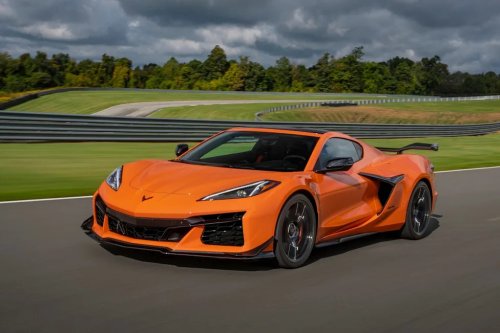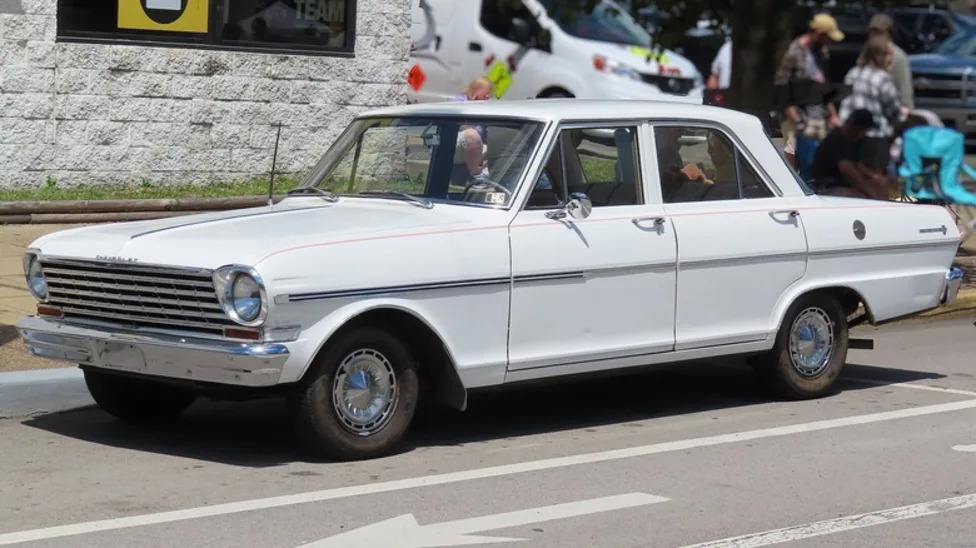
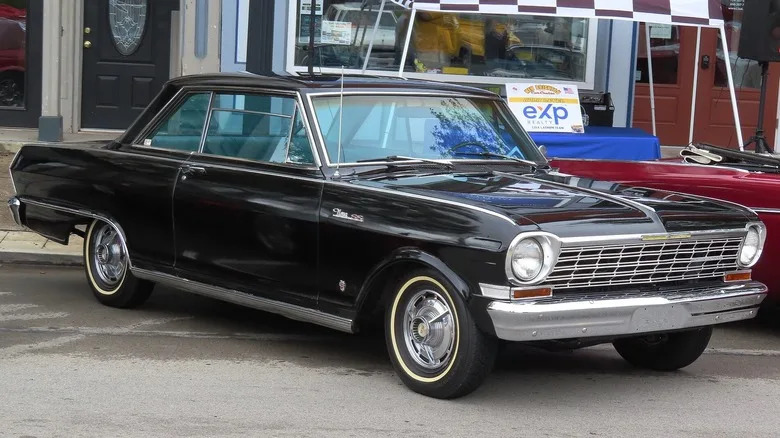
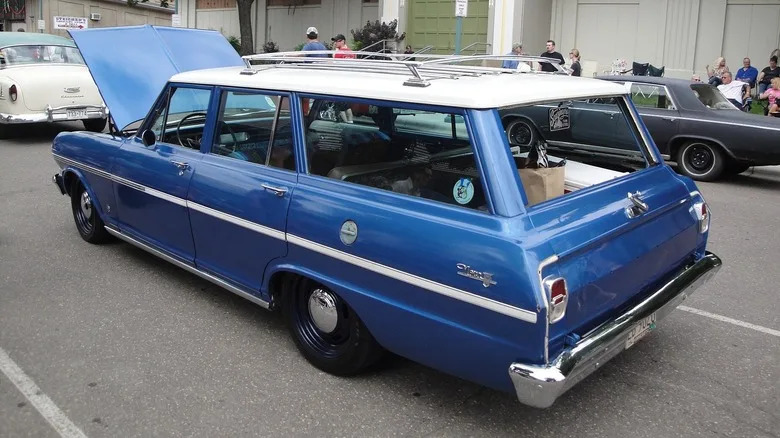



















Front 3/4 of white 1963 Chevrolet Chevy II 300 sedan parked on street - MercurySable99/Wikimedia CommonsGearheads may have noticed the 1,250-horsepower Chevrolet Corvette ZR1X and new Ford Mustang GTD Competition competing to bring down their Nürburgring times in recent years. Yet this is far from the first time that the Bowtie brand and the Blue Oval have battled for the hearts and minds of drivers. In 1960, for example, the two debuted their own modernized compact cars designed to compete with a new wave of foreign rivals.Chevy chose a rather radical-for-its-time solution with the mid-engine Corvair, a car that would also bring turbocharging to the masses and see more than 250,000 first-year sales in the process. Ford's more conventional 1960 Falcon, on the other hand, saw its sales volume go north of 435,000 units during the first model year.Needless to say, Team Chevy wasn't satisfied playing second fiddle to its crosstown competition, and the engineering department quickly got to work on a Corvair replacement. How quickly? Thanks to a back-to-basics approach and a sense of urgency, the 1962 Chevrolet Chevy II took a mere 18 months to go from being a concept to coming down the production line.AdvertisementAdvertisementFor some context, there's evidence that the R&D behind the Corvair took nine years. In comparison, today's automakers are looking to drastically reduce development time using artificial intelligence — GM required only 20 months to create the GMC Hummer EV with AI assistance. In that time, the General was able to develop a massive machine that barely fits real-world traffic but can blow away many much smaller gas cars when it comes to acceleration. As for what 18 months of work on the Chevy II brought customers, we'll discuss that next.Read more: 5 Iconic Poster Cars That Just Aren't That GoodA quick look at the details for the Chevy IIFront 3/4 of black 1964 Chevrolet Chevy II Nova Super Sport Coupe - MercurySable99/Wikimedia CommonsChevrolet went right after the Falcon by giving its new compact nearly the same basic dimensions. The Chevy II was 183 inches long and rode on a 110-inch wheelbase, while the Falcon's numbers were 181.2/109.5. Under the hood, Chevrolet customers could choose from either a 153-cubic-inch (2.5-liter) four-cylinder mill good for 90 horsepower and a 194-CID (3.2-liter) I6 capable of 120 horses. Both were tried-and-true units that traced some parts and tooling back to the iconic Chevy small-block V8.The front wishbone suspension was likewise borrowed from other Chevrolet products and featured strut-rod lower control arms and coil springs. At the back, however, engineers tried something new, with a monoleaf suspension that — to be clear — had nothing to do with the modified swing-axle configuration that contributed to oversteer issues in the Corvair.AdvertisementAdvertisementChevrolet even debuted an innovative process engineered to make the car easier to assemble. The Chevy II was a unibody design, and that wasn't new, of course. What was different was that Chevrolet's compact was first built in two individual halves that were then bolted together.The Chevy II's transmissions were a mix of the new and old as well. The standard gearbox was a regular three-speed manual, but the optional unit marked the first use of the brand's re-engineered two-speed PowerGlide slushbox. Nor did Chevrolet seem to waste too much time on the car's exterior design. The simple layout led to one of the Chevy II's nicknames, the "Box Nova" — which finally gets us to the naming business.What's in a name?Rear 3/4 blue 1963 Chevrolet Chevy II Nova 400 station wagon with white roof - Greg Gjerdingen/Wikimedia CommonsAnecdotally, the "Chevy II" moniker was the brainchild of Ted Little, then-chairman of the brand's advertising agency at the time, Campbell-Ewald. Now, "Nova" apparently had its fans among Chevrolet's decision-makers, but the brand's marketing strategy back then was to use names that began with the letter "C." It's sort of like Ford's tendency to use the letter "F" on cars like the Falcon, Fairmont, Fiesta, Fusion, Focus, etc., or its preference for the prefix "Ex-" for SUVs such as the Excape, Explorer, Expedition, and Excursion.Getting back to the Chevy II, the result was that Nova was first used on the range-topping trim of the Chevy II family — meaning it was officially the Chevrolet Chevy II 400 Nova. Lesser models included the 100 and 300 series, and the Chevy II could offer further customer choice through its multiple body styles. In the mix were sedans — in two- or four-door configurations — as well as a two-door coupe (with a B-pillar), a two-door hardtop (without a B-pillar), a convertible, and a station wagon.AdvertisementAdvertisementThe brand would drop the Chevy II name in 1968, premiering the all-new model as the 1969 Chevrolet Nova. A legend of the late muscle-car era, the second-generation Nova was designed — intentionally or otherwise — to handle the biggest Bowtie engines around. In fact, some tuners have been able to install Chevy's 454-cubic-inch big block V8, able to crank out 575 horses.The classic Nova would soldier on through 1978, when the final model was produced. That said, Chevrolet did revive the nameplate for use on a rebadged Toyota Corolla in 1985– but that was a "no-go" with traditionalists, and the car became the Geo Prizm in 1989.Want more like this? Join the Jalopnik newsletter to get the latest auto news sent straight to your inbox, and add us as a preferred search source on Google.Read the original article on Jalopnik.