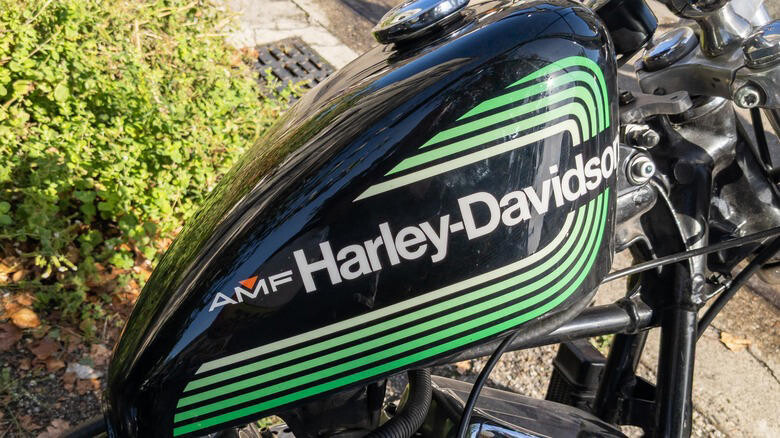
Back in 1961, Harley-Davidson collaborated with an Italian company to build a small-displacement bike to attract newer, younger riders to the American brand. That 250-cc four-stroke single was called the Sprint. It was made by Aermacchi, a company in which Harley owned a 50% stake. The bike experienced modest sales until it was discontinued in 1974. Today, no such co-ownership exists between Harley and India’s Hero Motocorp, but the two companies have joined forces to achieve the same goal set decades ago: To produce an approachable, affordable bike designed to attract new riders to the Harley experience. That bike is the 2027 Harley-Davidson Sprint 440. The bike was launched in Barcelona, Spain, and at first glance it ticked its first box: It looks great. Despite its entry-level displacement, it is a full-sized, well proportioned motorcycle. What powers the Sprint? The modern Sprint is powered by a 440-cc air-and-oil cooled single. It is fuel injected, has a single cam riding in a two-valve head, and it has a gear-driven counterbalancer to reduce vibration. It’s perhaps a simple design, but it is lightweight and cost effective. The engine has been around since 2024 in the Indian-market Hero Maverick 440 with no known mechanical issues, so early indications are that it should be reliable. Claimed output is 27 horsepower and 28 lb-ft of torque. The Sprint is Euro 5+ compliant, and it is claimed to sip fuel at about 3.0 L/100 km, which should get about 300 km out of its nine-litre fuel tank. Easy on maintenance The engine’s simplicity ticks another box: Home maintenance will be easy; dealer maintenance should be cheap. The oil filter is located under a cover on the right side of the engine. The air filter is easily accessible behind the right side cover. The battery is under the seat. The spark plug can be removed without taking anything else off the bike. The engine has screw-and-locknut valve adjusters. With all of these simple features, someone with basic mechanical skills can perform all of the maintenance at home. The Sprint is related to the Harley-branded X440 built and sold in India by Hero, though its styling was penned entirely in Milwaukee, and 65% of its parts are new, including the frame. It features a number of Sportster-inspired styling elements: The LED headlight hangs from a metal, Sportster-like nacelle; the fuel tank is reminiscent of the Sportster’s peanut tank; the cast wheels have Sportster-esque machined highlights on the spokes. Traditional Harley struts hold the bobbed rear fender in place. The fuel tank and fenders are made of metal, and the paint finish is excellent, and not just for a budget bike. Its ultra-thin decals are under the clear coat and are seamless to the touch. We tested Euro-spec bikes, and one thing that was not yet determined at the press launch is if the Harley Hare on the side covers will appear on North American bikes. About the only thing that looks atypical to me is the single, upright cylinder. When my eyes put all the styling elements together, my brain expects to see an air-cooled V-twin nestled under the tank. In fact, it’s easy to see the Sprint’s Sportster inspiration if you place your thumb strategically to block out the engine when looking at it from the side. Harley’s website claims it has “classic cruiser styling,” though it looks more like a retro roadster to me. 2027 Harley-Davidson Sprint SP440 Simplicity at the forefront Simplicity is the main theme throughout the Sprint’s design. It has a 3.5-inch TFT display nestled inside a round housing between the handlebars. The display is uncluttered and easy to read. There’s a tachometer reading at the top, a fuel gauge at the bottom, and between them is a digital speedo, gear indicator, and selectable odometer, trip meter, clock, and fuel-range indicator. There are no ride modes and no traction control, though ABS is standard. Hand levers are not adjustable for reach, and the switch pods are among the simplest I’ve seen. Some bonus features include an auto-dimming display, self-cancelling turn signals, and an easily accessible USB-C port located to the left of the headlight nacelle. The Sprint 440 riding position Seat height is low at 683 millimetres (26.9 inches) and claimed wet weight is 187 kilograms (412 pounds) making it easy to lift the bike off its side stand. The riding position is upright, neutral, and very Sportster-like, though the bike is much narrower and lighter. It’s an easy reach to the handlebar and to the ground, the latter a benefit of a narrow midsection and low seat. While forward-mounted footpegs are the norm on a cruiser, the Sprint’s mid-mounted footpegs are more comfortable, and they facilitate low-speed maneuverability. The riding position does not feel cramped for me at six feet tall, though there is an optional seat that moves the rider rearward and adds 50 mm of foam, as well as a seat that moves shorter riders forward by 25 mm for an easier handlebar reach. A solo seat is also optional (any seat option costs $294). Pleasantly powerful I have become tempered by riding three-digit horsepower motorcycles, so I was initially concerned about the Sprint’s published output. However, that concern was quelled after riding the machine, as it punches above its weight — another box ticked. While a higher horsepower number would be beneficial from a marketing standpoint, in real life it’s the torque delivery that counts. The Sprint’s broad, flat spread of torque provides a satisfying forward push when taking off from a stop. The long-stroke engine is tuned for torque, and not for peaky, high-revving horsepower, as revealed by its 6,000-rpm redline; there’s no need to wait for the revs to build. Some bikes of similar displacement don’t begin getting into the meaty part of their torque until past the Sprint’s redline. The Sprint can easily pull a taller gear or two without shuddering. It can lug along smoothly in top gear from as low as 50 kilometres per hour (~30 miles per hour), and can lope along effortlessly at just 4,000 rpm at 100 km/h (67 mph). While I did not have an opportunity to test the top speed, the bike easily maintained 115 km/h (71 mph) on a long, uphill highway stretch without the throttle bumped on its stop. Around town The Sprint proved to be effortless to ride and easily stayed ahead of traffic in Barcelona’s busy streets; and it is narrow and nimble enough to filter through tight spots. Clutch pull is very light, and the gearbox has a light, short-travel shifter that feels solid and precise. The muffler is tuned to produce a deep, bellowing exhaust note, sounding more like a big thumper rather than a small compressor. While the mirrors blur at a stop, the counterbalancer quells most of the vibration at speed; what’s left is a lower-frequency throbbing that makes the Sprint feel like a bigger bike than it is. One minor issue I had around town was related to the high-beam switch, which is in a location that makes it easy to trigger unintentionally when reaching for the turn signal switch. In the country On winding country roads the Sprint exhibited excellent stability, with light, neutral steering and a willingness to change direction effortlessly. It requires very little handlebar effort to maintain a solid line through curves. The brakes are unremarkable, which is fine for beginners; they get the job done, with the front being easy to modulate but requiring a good squeeze for harder stops. The suspension works better than I expected, and better than a number of recent Sportster models that have minimal wheel travel; another tick. Despite minimal adjustability (only rear preload), it is well damped and provides confident compliance that’s free of weaving through sweepers, while offering very good shock absorption over sharp bumps — I don’t think it bottomed out once during my ride. I did raise the rear preload one click to gain some cornering clearance, of which there’s plenty for a spirited pace. There’s plenty of cornering clearance to handle a spirited pace, but if you plan on riding harder, the peg feelers will produce sparks. Sprint 440 Pricing The Harley Sprint 440 ticks one final box. It is competitively priced, retailing for $8,499 (dealer prep and freight included, two-year warranty). It is available in three colours: Black, grey on black, or for a $300 premium, teal on black. Its closest competitors would be the Royal Enfield Guerrilla 450, which retails for $8,669 (fees included), and the Triumph Speed 400, at $7,869 (2026 model, fees included). The Sprint is being delivered to dealers as you read this in Canada, as our bikes come directly from India. The U.S. has to wait until spring, as their machines will be assembled at Harley’s plant in York, Pennsylvania, using components coming from India. Harley CEO Artie Starrs said in a press release that the Sprint 440 is “a great option for returning riders who want to get back on the road or as an uncomplicated and fun ride for experienced riders.” And uncomplicated it is. In spirit and appearance, Harley’s newest platform is all Harley. The Sprint’s build quality is excellent, it looks great, and it’s easy to ride. It’s also a no-frills, back-to-basics bike that turns the focus to riding, rather than introducing gadgets and distractions that detract from the ride. It ticks all the right boxes. Ride modes? None. Connectivity? Nope. Is it fun to ride? Absolutely. Harley-Davidson Sprint 440 Pros & Cons Pros ✔ Full sized motorcycle ✔ Easy, un-intimidating to ride ✔ Priced right Cons ✘ High-beam switch is poorly located ✘ Could use a bit more cornering clearance ✘ Historically, small Harleys haven’t sold well