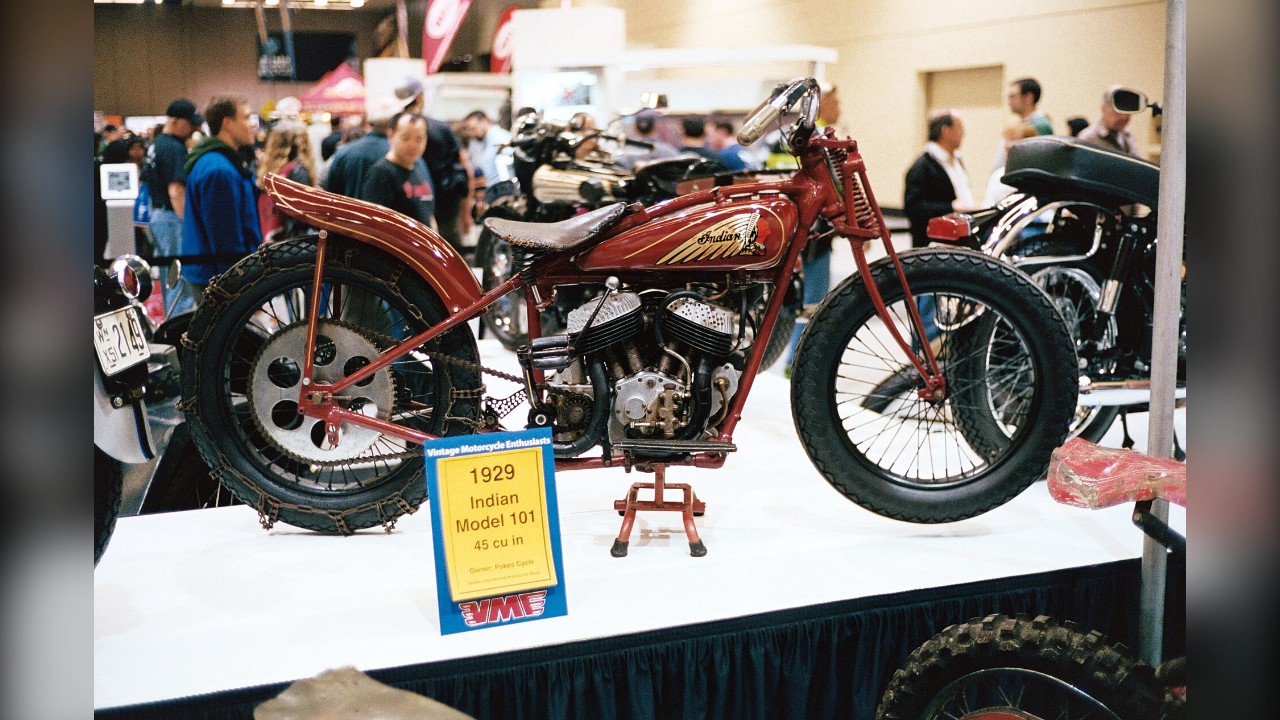
The Indian 101 Scout has been called the best motorcycle Indian ever made, yet the company dropped it after barely three years. That is the story of many great V-twins. A bike earns a loyal following, the maker moves on, and the survivors slowly vanish into garages, museums and private collections. The V-twin is the engine layout most riders know by sound alone. It powered American icons, British sidecar haulers, Italian cafe racers and Japanese superbikes. Some of those machines sold in huge numbers. Others sold in small batches, raced hard or simply wore out. These are our picks: seven V-twin motorcycles that, in our view, are becoming increasingly difficult to find. The facts come from museum records, period tests and maker histories. However, the judgment calls are our own. 1. 1929 Indian Model 101 Scout The 101 Scout replaced the original Scout in 1928, and riders loved it right away. Indian engineer Charles Franklin, who also designed the first Scout, led the design. According to the National Motorcycle Museum, the 101 got a wheelbase 2 5/8 inches longer than before. Franklin also moved the engine forward nearly 3 inches and dropped the saddle almost 2 inches. In addition, the 101 gained a front brake. The museum’s 1930 example uses a 45-cubic-inch side-valve V-twin rated at 22 hp. A smaller 37-cubic-inch engine was also available. Low weight, low seating and easy handling made the bike a favorite. In fact, riders still use 101 Scouts in wall-of-death stunt shows. So why did Indian drop it? The Great Depression hit the company hard, and the DuPont family bought it. Then the new owners standardized on one frame for the 1932 Scout, Chief and Four. The 101’s unique chassis cost as much to build as the bigger Chief, so it made too little profit. As a result, production ended in 1931. Our take: the Indian 101 Scout is the machine that riders, rather than stylists, tend to love most. With only a few years of production, good ones are hard to track down. If you find one, check whether it has its original frame. 2. 1938 Matchless Model X The Model X is the big British V-twin that most American riders have never heard of. Matchless built it in London from 1929 to 1940. It also sold the bike as the Sports Tourist. The engine was a 990cc side-valve V-twin, and Matchless aimed the bike squarely at touring riders. That same basic Matchless engine family powered some famous company, too. Before World War II, Brough Superior used the 990cc Matchless V-twin in its side-valve SS80 and overhead-valve SS100. Later, Matchless reworked the Model X into a quick touring machine in 1937. That year, The Motor Cycle magazine tested one and called the engine “delightful.” The bike could reach about 80 mph and hit 70 mph within a standing quarter mile. Meanwhile, Matchless reinforced the rear frame for heavy sidecar work. Production ended when the war broke out. In our view, the Model X is the overlooked cousin in the Brough Superior story. It shares that engine heritage at a fraction of the fame. However, finding one outside Britain is a real challenge. Look for a bike with its original sidecar mounts intact, since that shows how it lived. 3. 1948 Indian Chief The 1948 Chief comes from a short, unusual window in Indian’s history. After World War II, the Chief was the only prewar Indian model the company built. It carried a 74-cubic-inch V-twin of 1,210cc. That leaves just three model years of postwar girder-fork Chiefs. Two details set the 1946 to 1948 bikes apart. First, they used a girder front fork instead of the leaf-sprung fork from before the war. Second, they kept the plunger rear suspension Indian added in 1940. The big, decorative fenders also dated from that 1940 restyle. Together, those parts give the late-1940s Chief its flowing, Art Deco look. The window then closed. In fact, Indian made no Chiefs at all in 1949. When the bike returned for 1950, it had telescopic forks and a larger 80-cubic-inch engine. Production ended for good in 1953, and Indian stopped making motorcycles until 1999. Our take: the girder-fork Chief is the purest expression of postwar Indian style. It is heavy and old-fashioned, but it looks stunning. So if you want a true 1946 to 1948 bike, check that the fork, fenders and engine numbers all match those years. 4. Moto Guzzi Le Mans Mk1 The Le Mans Mk1 turned Moto Guzzi’s touring V-twin into one of the fastest bikes of the 1970s. Guzzi first showed it at the Milan show in November 1975. It then went on sale for 1976. The engine was an 844cc, air-cooled, 90-degree V-twin with pushrod valves. It breathed through Dell’Orto 36mm pumper carburettors with open velocity stacks. Lino Tonti designed the chassis, which grew out of the 1971 V7 Sport. Meanwhile, a small bikini fairing sat over the headlight. According to Shannons’ history of the Le Mans, Cycle World’s tester reached 134 mph on one. The first series did not last long. Guzzi historian Ian Falloon counts 219 bikes in 1975 and 2,532 in 1976. Some of those later bikes may have been the next series. Then the Mk2 arrived in 1979 and replaced it. In our view, the original Le Mans is the most beautiful Guzzi ever built. Its low bars, small fairing and long tank define the Italian cafe racer for us. Buyer advice: we would put original Mk1 bodywork first, so check that the fairing, seat and tank are correct. 5. 1977 Harley-Davidson XLCR The XLCR was Harley-Davidson’s bold attempt at a factory cafe racer. Willie G. Davidson’s design team created it, and it arrived for 1977. It was almost entirely black, with a bikini fairing and a two-into-two “siamese” exhaust. Underneath sat Harley’s 998cc pushrod 45-degree V-twin from the Sportster, with a four-speed gearbox. According to Motorcycle Classics, the frame combined a Sportster front section with a swingarm inspired by the XR750 racer. It also had triple disc brakes and cast alloy wheels. The price was the problem. The XLCR cost $3,595 new in 1977, which put it up against Italian sport bikes. Even so, Harley raised the price only slightly for 1978, to $3,623. Few buyers took the bait, and many bikes sat unsold. As a result, Harley built it only for the 1977 to 1979 model years, and the last few came from leftover parts. Our take: the XLCR is the coolest Harley of the 1970s, even though it flopped. Its all-black look and fairing turn heads at any meet. If you shop for one, look for the original exhaust and bodywork, which we think matter most. 6. 1980 Harley-Davidson XR750 The XR750 is a pure dirt-track racer, and it is one of the most successful race bikes ever built. Harley-Davidson introduced it in 1970 for dirt-track racing. At first, the engines used iron cylinder heads. They overheated easily, which earned them the nickname “waffle irons.” For 1972, Harley switched to an all-aluminum head and cylinder. The engine stayed at 748cc, but a bigger bore and shorter stroke made it far stronger. That version became a winning machine. In fact, riders on XR750s won 29 of the 37 AMA Grand National Championships from 1972 to 2008. The bike also had a famous stunt career. Evel Knievel used XR750s from December 1970 until January 1977. One of his bikes now sits in the National Museum of American History. Harley originally built about 200 for homologation and sold them through dealers for $3,200. In our view, a genuine XR750 is one of the most important American motorcycles. However, it was never a road bike, since the dirt-track version has no front brake. Race bikes tend to live hard lives. So, in our view, a clean, documented example with known history is very difficult to find. 7. Suzuki TL1000R The TL1000R was Suzuki’s V-twin answer to the Ducati 916. Suzuki built it from 1998 to 2003. It aimed to compete in World and American Superbike racing and to win buyers away from the Italian bike. The engine was a 996cc, liquid-cooled, 90-degree V-twin with four valves per cylinder. It also used double overhead camshafts. Suzuki rated it at 135 bhp at 9,500 rpm. Compared with the TL1000S, the R got forged pistons, stronger connecting rods and a stiffer frame. It also used hybrid chain and gear drive for its camshafts. The racing plan never took off. Suzuki ended the TL racing program and returned to the lighter GSX-R750 for Superbike. Even so, the road bike carried on until 2003. That means the R outlived the TL1000S, which Suzuki had launched a year earlier and dropped in 2001. In our view, the R is now the rarer sight of the two. Our take: the TL1000R is a forgotten superbike with a wonderful engine. Buyer advice: look for an unmodified bike with service records, and check the fairing for hidden damage.

 Liked by Camille Tremblay, Amelia Scott
 Liked by Camille Tremblay, Amelia Scott