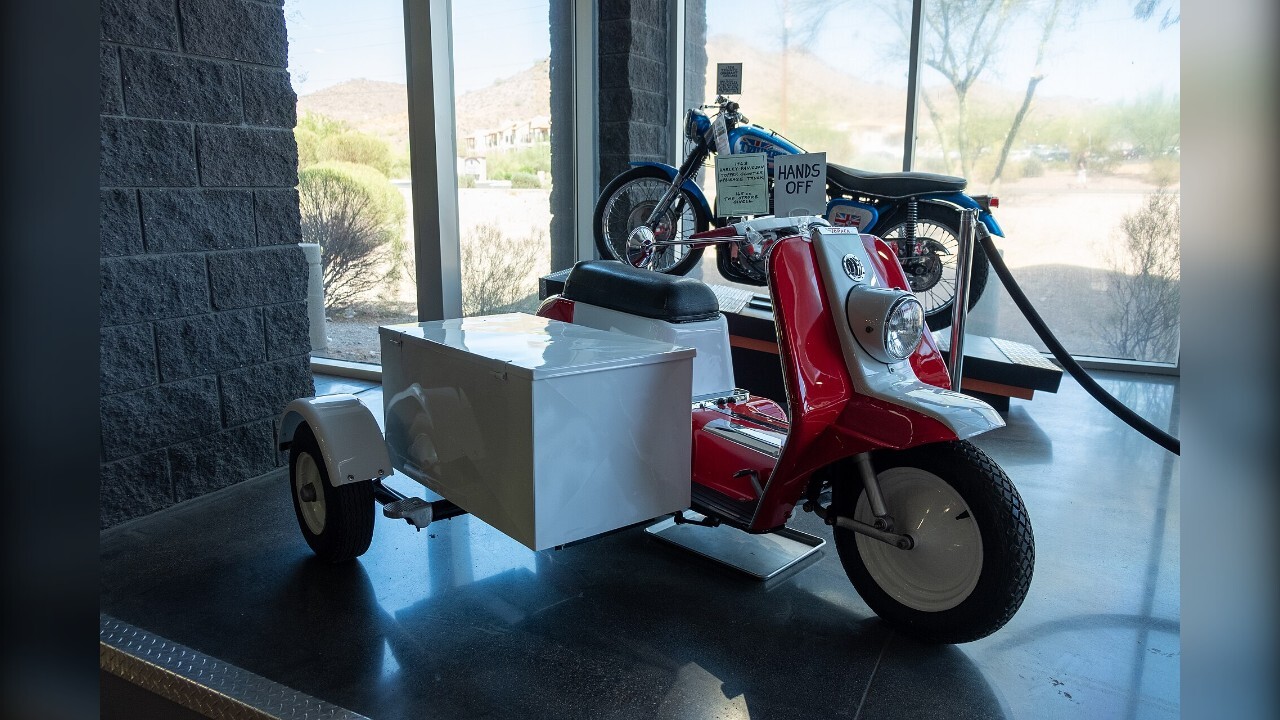
The Harley-Davidson Topper was the only motor scooter Harley-Davidson ever produced. It came out of Milwaukee in 1960 with a pull-start engine like a lawn mower. Most riders today have no idea it exists. That says a lot about how much of Harley’s past sits outside the big V-twin story. The company has built far more than cruisers. Over a century, it tried flat twins, racing singles, two-stroke lightweights and Italian-built sport bikes. Many of them sold modestly, left the catalog quickly and ended up in museums or long-term collections. These are our picks: seven Harley-Davidsons that, in our view, are becoming increasingly difficult to find. The facts come from period sources, club magazines and collector guides. The scarcity verdict is our own opinion, not a measured count. 1. 1920 Harley-Davidson Sport Model opposed twin Harley built the Sport Model, also called the Model W, from 1919 to 1923, and it looked nothing like a typical Harley. Its 584 cc side-valve engine was a flat twin rather than the V-twin people expect from Milwaukee. Output was a modest 6 horsepower, so the Sport Model was built for steady, gentle travel rather than speed. It also proved itself in public. Publicity manager Hap Scherer set record times on runs from New York to Chicago and from British Columbia to Tijuana. In July 1919, a Sport Model became the first motor vehicle to climb Mount San Antonio in California. Even so, American buyers stayed away. The bike cost more than a used Ford Model T, and Indian’s faster Scout arrived in 1920. Our take: slow home sales ended production after four years, which means few Sport Models existed to begin with. If you find a running Sport Model for sale, treat it as a rare chance. Then have an expert verify the engine and frame before you pay. 2. 1927 Harley-Davidson Model S Peashooter The Peashooter was Harley’s small single-cylinder racer, built for the AMA’s 21-cubic-inch class, which works out to 350 cc. The road-going version came in both side-valve and overhead-valve forms. Racers used the overhead-valve engine with an exposed valve train. In other words, the Peashooter was a lightweight built to win, not a commuter dressed up for the track. According to the American Motorcyclist Association’s profile of a 1926 Peashooter, the factory racer used a shortened frame and a minimal fork. It weighed about 215 pounds. Its racing engines reportedly ran close to 100 mph. The AMA adds that bikes like it usually led their class standings in the late 1920s. In our view, the Peashooter is becoming harder to find because racers lived hard lives. Racing bikes tend to get crashed, rebuilt and modified for the next season, so untouched originals are few. If you shop for one, ask for documented history, because a racing past is part of the value and also the hardest part to prove. 3. 1952 Harley-Davidson Model K The Model K arrived for 1952 as Harley’s modern middleweight, and it introduced ideas that shaped the company for decades. Its 750 cc side-valve V-twin shared one crankcase casting with the transmission, so the engine and gearbox formed a single unit. It was also the first civilian Harley-Davidson with hydraulic shock absorbers on both wheels. That combination made the K feel far more modern than the big twins it sat beside in the showroom. Racing followed, too. Harley’s KR, a racing-only 750 cc side-valve model, ran from 1953 to 1969. Meanwhile, the road bike evolved quickly, and the K gave way to the bigger KH for 1954. Our take: the Model K is the forgotten ancestor of the Sportster, which arrived in 1957. Because Harley built it for only two seasons before the KH replaced it, the 750 cc road bike is a short chapter in Harley history. If you see a 1952 K at a swap meet, ask a specialist to check the frame and engine numbers. A correct, matching bike is worth far more than a parts mix. 4. 1954 Harley-Davidson KH The KH replaced the Model K for 1954 with a bigger engine and the same basic layout. Its side-valve V-twin grew to 888 cc, which gave riders noticeably more muscle than the 750 cc K. Harley built the KH and the KHK from 1954 to 1956, both with the flat-head side-valve layout. Like the K, the KH kept its transmission inside the same crankcase casting as the engine. Then, for 1957, Harley replaced the K family with the first Sportster, and the KH’s showroom life ended after three seasons. In our view, the KH is becoming harder to find because it sits in the Sportster’s shadow. In our view, once newer Sportsters arrived, plenty of owners would have seen a KH as yesterday’s bike, which is rarely good for survival. Few casual riders could pick one out of a lineup. If you want one, budget for a careful restoration, because finding original side-valve parts takes patience. 5. 1955 Harley-Davidson Model B Hummer The Hummer was Harley’s smallest motorcycle, and it had German roots that surprise most Harley fans. Harley’s two-stroke singles came from the DKW RT 125, whose drawings left Germany after World War II as war reparations. The first version, the Model S-125, sold 10,000 units in its first seven months on the market in 1947. For 1955, Harley gave the 125 cc engine a redesign and adopted the Hummer name, which it used through 1959. The little two-stroke made about 3 horsepower through a three-speed foot-shift gearbox. In our view, it was the perfect bike for a teenager, a paperboy or a short commute. Our take: the Hummer is getting harder to find because people bought it as disposable transport. Small, cheap bikes like this tend to get ridden until they quit, and few owners saw them as worth saving. That is why survivors with original paint feel so special today. If you find a Hummer for sale, check for a seized engine first. A two-stroke that sat for decades often needs a full rebuild before it runs again. 6. 1960 Harley-Davidson Model A Topper Harley built the Topper in Milwaukee from 1960 to 1965, and it remains the company’s only scooter. A single-cylinder two-stroke of about 165 cc sat horizontally between the floorboards. The rider started it with a rope-recoil starter, much like a lawn mower, and the engine ran on premixed gas and oil. The Harley-Davidson Topper’s body mixed stamped steel up front with a molded fiberglass engine cover and rear body. However, the engine had no cooling fan, unlike most enclosed scooter engines, and some units overheated. Harley later added the Topper H with an alloy cylinder head. It also sold a detuned Topper U, limited to 5 horsepower, for states with licensing limits for young riders. In our view, the Harley-Davidson Topper is one of the hardest Harleys to find in original shape. It sold as a fun runabout, and some engines overheated, which is rarely a recipe for long survival. A 1960 Model A in good order is a rare sight at any show. If you buy one, inspect the fiberglass and the cylinder head closely, because those are the parts that tell you how the scooter was treated. 7. 1965 Harley-Davidson Aermacchi Sprint H The Sprint came from Harley’s partnership with Italian maker Aermacchi, and it looked nothing like a Milwaukee bike. According to Motorcycle Classics’ Sprint H profile, the bike used a 246 cc overhead-valve air-cooled single. Harley sold the Sprint line from 1961 to 1968. In our view, it remains the most charming way to own an Italian-built motorcycle wearing a Harley-Davidson tank badge. The H model was the sporting version. Motorcycle Classics lists a claimed 21 horsepower at 7,250 rpm and a period-tested top speed of 76 mph. The bike weighed about 271 pounds wet and returned 45 to 55 mpg, so it was cheap fun on a back road. A 1967 Sprint cost $750 new, according to the same profile. Our take: the Sprint H is getting harder to find because owners race the best ones in vintage events, and race bikes rarely stay stock. Motorcycle Classics puts today’s prices at $1,800 to $4,000, which is modest for a bike with such a rich story. If you want an original 1965 Sprint H, buy it now while prices remain in that range.

 Liked by Benjamin Johnson, Claire Fortin


 Liked by Benjamin Johnson, Claire Fortin