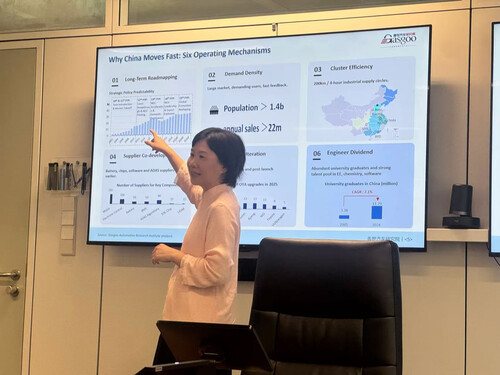
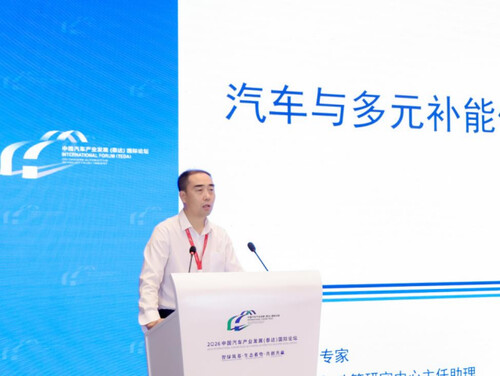
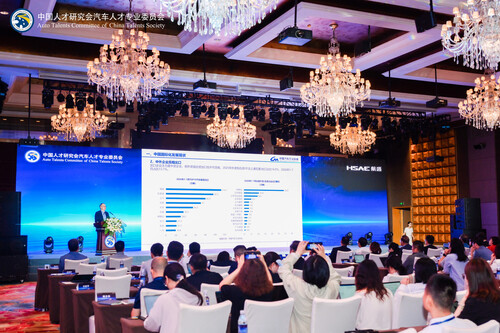
Gasgoo Munich- On July 2, 2026, Zhou Xiaoying, CEO of Gasgoo, delivered a welcome address at the 2026 China Automotive Decarbonization and Sustainability Summit and High-Efficiency Technology and New Materials Forum. Drawing on global climate trends and the current state of the auto industry, she shared her observations on the sector's low-carbon transition, the construction of green supply chains, and sustainability opportunities arising from the globalization of China's automotive market.She pointed out that low-carbon development is no longer just a matter of corporate social responsibility or a long-term goal; it is becoming a critical variable influencing the restructuring of global supply chains, market access, and corporate competitiveness. As China's auto industry accelerates its push into global markets, competition is shifting from reducing emissions in individual vehicles to decarbonizing the entire industrial chain. Low-carbon capability, alongside electrification and intelligence, is set to become a core competitive strength for China's auto industry on the world stage.Zhou Xiaoying | CEO of GasgooThe following is a summary of the speech:Distinguished President Gu, dear guests, hello everyone. I am Zhou Xiaoying from Gasgoo.Today's forum focuses on automotive low-carbon development and sustainability. I'd like to begin with a very real-world phenomenon.Recently, Europe has been enduring a new round of extreme heat. France, Germany, and the UK have all seen high temperatures, with some regions nearing or exceeding 40°C. The World Meteorological Organization noted that this heatwave has broken multiple temperature records, impacting health, infrastructure, agriculture, ecosystems, and labor productivity.This serves as a crucial reminder for the auto industry: low-carbon development and sustainability are no longer just about corporate social responsibility or long-term goals for the coming decades. They are becoming tangible variables that affect human society, global supply chains, energy systems, market access, and corporate competitiveness.Drawing on Gasgoo's long-term observations of China's auto industry, the NEV supply chain, and automotive globalization, I want to share a core judgment:The low-carbon competition in China's auto industry is shifting from "single-vehicle decarbonization" to "whole-industry-chain decarbonization." In the future, the truly competitive companies won't just be those that can build and sell good cars, but those that can leverage low-carbon capabilities to participate in the reconstruction of the global supply chain.In recent years, what the world has noticed most about China's auto industry is "speed": the rapid rise in NEV penetration, the fast iteration of smart features, and the supply chain's quick response times. But I believe as China's auto industry enters this new stage of global competition, the keyword isn't just "fast" anymore—it's also "green."Today, low-carbon development in the auto industry goes beyond just vehicle electrification or companies publishing ESG reports. It is unfolding across three levels:First is product decarbonization—the transition from internal combustion engines to new energy vehicles.Second is manufacturing decarbonization—encompassing green factories, green energy, green materials, and recycling.Third is supply chain decarbonization—moving from individual company efforts to a green supply chain where OEMs, parts suppliers, material companies, and logistics systems all reduce emissions together.Especially as China's auto industry accelerates its globalization, low-carbon capability is increasingly becoming a foundational skill. When exporting a vehicle or a component, it's not enough for the product to simply meet local regulations. The carbon footprint data behind the battery, materials, manufacturing, and logistics must be transparent, traceable, and verifiable. Last week, I visited Renault's factory in Morocco, North Africa, and was deeply impressed by their application of ESG, low-carbon production, and circular recycling.For OEMs, low-carbon capability will influence global market access, brand image, and long-term competitiveness.For supply chain companies, low-carbon compliance isn't just a simple environmental requirement; it is a "new language" for entering global customer systems in the future.In the past, suppliers won orders based on cost, quality, delivery, and technology. Moving forward, global OEMs will increasingly prioritize carbon footprints, the ratio of green energy used, material traceability, factory energy efficiency, and recycling capabilities when selecting partners. Those who can establish low-carbon data capabilities, green manufacturing processes, and global compliance standards earlier will find it easier to integrate into the supply chains of multinational automakers and globalizing Chinese firms.From Gasgoo's perspective, China's auto industry possesses a critical advantage: systematic synergy. This capability supported the rapid development of China's new energy and smart electric vehicle sectors in the past. In the future, it should be transformed into a long-term competitive edge in low-carbon sustainability.We have the world's largest NEV market, a complete supply chain for batteries, electric drives, electronic controls, intelligent manufacturing, and components. More companies are also exploring green factories, renewable energy, remanufacturing, and material recycling. If these capabilities can be systematized, standardized, and digitized, China's auto industry has the opportunity to form a new kind of global competitive advantage: exporting not just products, but low-carbon manufacturing capabilities, supply chain prowess, and industrial solutions.Therefore, the next goal for China's low-carbon automotive development is to make the entire industrial chain greener, more transparent, and more sustainable. In the future, low-carbon capability will stand alongside electrification, intelligence, and convergence as a core competency for China's auto industry as it goes global.This is also the industrial direction that Gasgoo hopes to continuously observe, connect, and drive.I look forward to working together with you all. Thank you!(The above content is from the welcome speech delivered by Gasgoo CEO Zhou Xiaoying on July 2, 2026, at the 2026 China Automotive Decarbonization and Sustainability Summit and High-Efficiency Technology and New Materials Forum.)