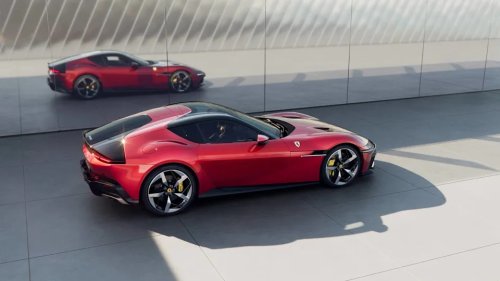
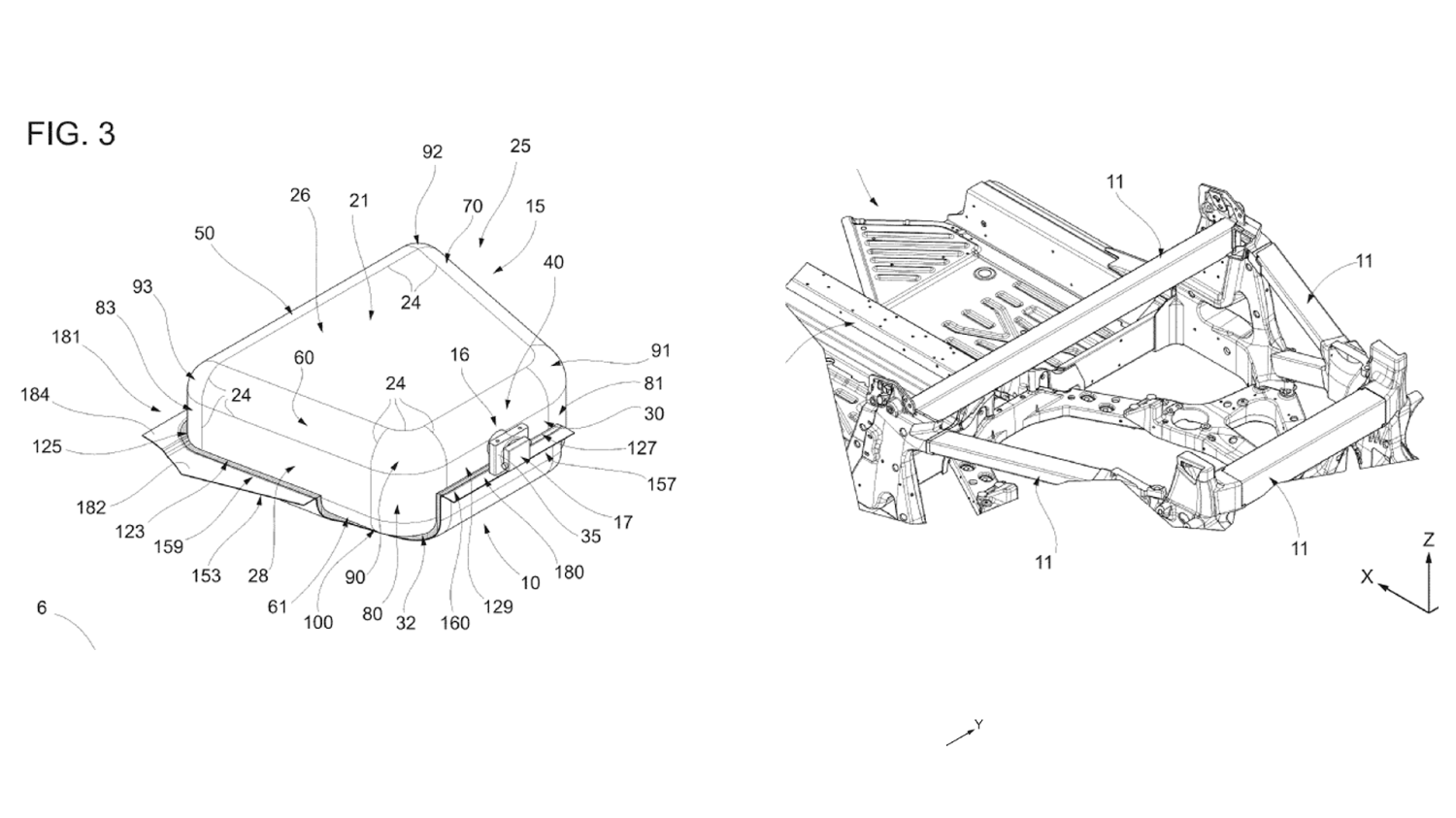
Never mind the Luce, Ferrari still isn't ready to commit to a fully electric future for its cars. However, that doesn't mean Ferrari won't explore other options besides fossil fuels. That's been made abundantly clear by the Italian automaker's latest patent, discovered by CarBuzz.It's for a car with hydrogen tank, made with a new design to store the fuel. And you might not like where Ferrari plans to put it. Ferrari Has Been Chasing Hydrogen Aggressively Ferrari Over the last few years, Ferrari has obtained multiple patents that cover hydrogen-fueled cars, both with electricity made through a fuel cell and by burning hydrogen directly. This one, though, is all about the tank that is needed to store the fuel.Currently, hydrogen for use in cars is stored in massive cylindrical tanks. The hydrogen is highly compressed for storage – it needs to be to hold enough for a worthwhile range. Toyota's Mirai FCEV, for example, stores its hydrogen at 10,000 psi in a purpose-built multilayer tank spun in carbon fiber.This patent applies to a new type of storage tank made from a deformable material. It can expand and shrink depending on the volume of hydrogen inside, but still withstand the incredible pressures. The tanks can get bigger and smaller, but the fittings need to be held rigidly in place, and that's what this patent is about.Ferrari's new tank idea is like a balloon in a basket. If you'll allow us to horrify the Italians, it's like the bladder inside a box of wine. The box, in this case, is rigid and only holds the bottom section of the bag.One side of the box comes up the side of the bag, and that's where the most important part of the mechanism goes. It's a fitting that lets hydrogen in when you're fueling up and lets it out when you're driving. In the patent, Ferrari describes it as a duct, but in reality it's a filler neck. Think of it as the spout in that 10,000 psi bag of wine.If this part moves around as the tank expands and contracts, it will stress the fitting and the attachment mechanism. That could lead to a very serious failure down the road. This new invention stops it from happening. Flexible Fuel Tank Could Be A Storage Game Changer FerrariThis just might be a fantastic idea for safety and to keep the fuel secure, but it could sacrifice practicality and one of the most iconic aspects of owning a supercar. Ferrari shows it in a frame mounted to the vehicle's chassis. But it's not under the floor where a gas tank would go, and it's not in the transmission tunnel like the Mirai's tank.Instead, Ferrari has this tank mounted high up in what would normally be the car's trunk. In a modern mid-engine Ferrari, you look in the mirror and see your engine cover. In this vehicle, you would be looking at the hydrogen tank or its cosmetic cover. No more mid-engine Ferrari.The engine, then, would need to be in the front. Though if it was a fuel cell model, the cell could likely stay in the back. Either way, you could probably kiss any sort of cargo space goodbye.If you're looking at the drawing, you might be wondering how this wouldn't ruin the handling of an Italian sports car or grand tourer, but there is good news. Hydrogen fuel is much lighter than gasoline. A Toyota Mirai holds around 12 pounds of hydrogen in its storage tank, which gives it enough for 300 miles of driving. Each tank weighs around 95 pounds.Compare that with the 40 pounds or so of an empty plastic gas tank and the 24 gallons of gas a 12Cilindri holds, which comes close to 200 pounds total. The modern flexible tank should be lighter than the older style, making the difference even greater. So putting the tank a little higher up isn't ideal, but it's also not a problem from a gravity standpoint.The question now is whether Ferrari plans to actually do something with these hydrogen patents. Or will H2 to-go remain even more niche than short-range electric vehicles for a long time? CarBuzz Insight – Why This Matters: Automakers have been chasing hydrogen as a clean, low-emission fuel source for more than a decade. Hydrogen works in combustion engines and as fuel cells for EVs, but it's still not a zero-emissions fuel. It won't be until we have enough green energy excess to make it using electrolysis instead of getting it from natural gas.That may never happen. But a company like Ferrari, which lives and dies on combustion power, has to hope that it will if it wants to meet future European emissions laws. Every innovation like this makes it one step closer to reality, so that if the fuel source is ready, the cars can be right away instead of another decade down the road.Patent filings do not guarantee the use of such technology in future vehicles and are often used exclusively as a means of protecting intellectual property. Such a filing cannot be construed as confirmation of production intent.Source: US Patent & Trademark Office




















 +40 others