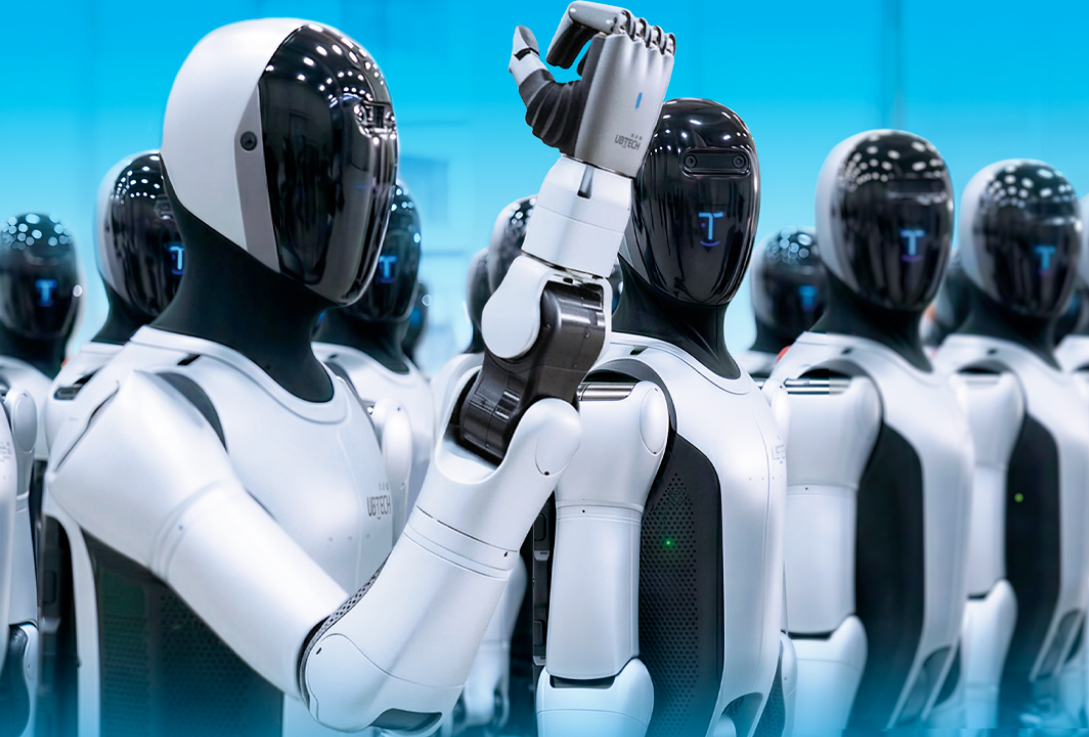



















Gasgoo Munich- Gasgoo News reported that on April 17, at a State Council Information Office press briefing titled "Starting the 15th Five-Year Plan," a remark by Fu Jiuling, director of the National Development and Reform Commission's (NDRC) Department of Industrial Development, struck a chord. "The aim of intelligence is to boost efficiency, not simply replace workers," Fu said. "We must find the right policy balance."That seemingly understated comment carries weight against a backdrop of frenzied financing and a race to mass production in embodied intelligence. It signals a recalibration of the underlying logic behind smart development: the relationship between humans and machines is no longer a zero-sum game. Instead, the industry must strike a delicate balance between efficiency and employment, and between technology and humanity.Embodied Intelligence in Overdrive: A Cold Look Amid Hot CapitalChina's primary market for embodied intelligence robots is in the midst of a financing frenzy in 2026.According to incomplete statistics from CENTI, the sector saw over 50 disclosed funding rounds in the first quarter alone, involving more than 30 companies. Total financing reached roughly 20 billion yuan — up nearly 60% year on year and a record high.Players like Unitree, Galaxy General, AgiBot, and Xinghaitu have already joined the "10-billion-yuan club." In March 2026 alone, investment and financing hit 14 billion yuan — 2.8 times the figure from the same period last year.Several humanoid robot manufacturers, including AgiBot, Unitree, and Noetix Robotics, have all announced plans to deliver 10,000 units by 2026.During a livestream at Longcheer Technology's Nanchang factory, AgiBot showcased impressive results: humanoids handled precision loading and unloading tasks, reducing cycle times from over 100 seconds initially to just 18 to 20 seconds. The overall success rate exceeded 99.5%. AgiBot revealed that the cost of using humanoids for such work has now dropped below that of manual labor.Yet, amidst this sprint, a dose of calm is required."Even if many manufacturers push for 10,000 units this year, humanoid robots may not have truly reached a commercial inflection point," said Wang Feili, an industrial analyst at UBS Securities. A significant portion of current shipments isn't entering industrial or commercial settings at all, but flowing into research institutes, data collection centers, and entertainment venues — essentially "non-work" applications.AgiBot partner Yao Maoqing also acknowledged that humanoids still aren't capable of fine manipulation involving tiny components. The core test remains whether they can move beyond isolated production lines to find continuous reuse across a wider range of industries.This reality validates the deeper thinking behind the NDRC's stance: intelligence is not an overnight "machine replacement" of humans, but a gradual process of industrial upgrading.The Dual Narrative of Displacement and Creation: The Real Picture of EmploymentThe impact of intelligence on employment has never been a simple choice between displacement and creation.Research from the Chinese Academy of Labor and Social Security indicates that AI's impact on employment is multi-faceted. It replaces some traditional roles through automation, but also creates new opportunities by spawning emerging industries — reshaping employment patterns, occupational structures, and skill requirements.On the creation side, more than 20 of the 72 new professions released by the Ministry of Human Resources and Social Security over the past five years are directly tied to AI. Each of these professions can drive employment for hundreds of thousands of people.Even more telling, the 2025 talent map for the embodied intelligence industry covers 106 roles across six areas, including strategy and management. New demands for skills are surfacing, such as multimodal perception fusion, algorithm optimization in real-world scenarios, and physical interaction design.Image Source: UBTECHFu Jiuling emphasized at the briefing that the total workforce across industries remained stable at around 110 million during the "14th Five-Year Plan" period. Both displacement and job creation effects are at play, he noted, requiring a proactive approach to achieve high-quality employment while driving industrial upgrades."Traditional industries have been moving toward newer and better development — it's ongoing and never stopped," he said. "Practice shows there are only outdated products, not outdated industries." That assessment offers clear policy expectations for the career transitions of ordinary workers navigating this wave of intelligence.The ultimate goal of intelligence is not to use machines to displace humans, but to use technology as a lever to expand human capabilities — allowing the gains from efficiency to benefit a broader segment of society.For the embodied intelligence industry, now accelerating at full tilt, the real test may not be building more dexterous robots. Instead, it lies in finding that "fast yet stable" balance point in the co-evolution of humans and machines.