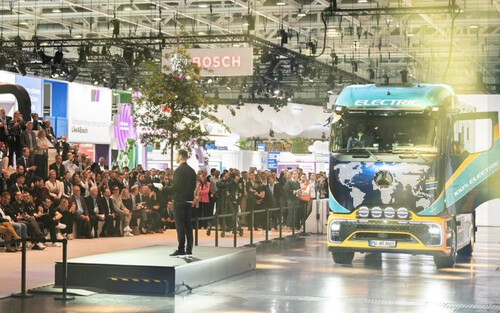
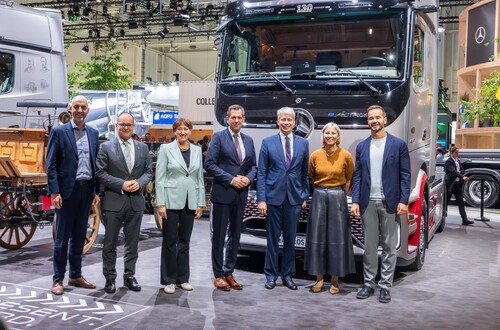
(Photo: Coretura)HANNOVER, Germany — A heavy truck today carries anywhere from 100 to 150 small computers. It's a persistent challenge keeping them updated with the latest software as soon as they roll off the assembly line. Coretura, the 50-50 joint venture of Daimler Truck and Volvo Group, was set up to change both, its CEO says.The company, based in Gothenburg, Sweden, provides what Johan Lundén called "essentially an enabler": standardized software for high-performance computers. Think of it like a truck operating system, the application programming interfaces truckmakers build their own software on, and the toolchain their developers use to do it. Lundén spoke with reporters at IAA Transportation.Not every one of those small computers has its own connection, so an over-the-air update may have to pass through several units to reach the one it was meant for. It can also have unintended consequences."You can change something you hadn't intended to. Say you're updating the infotainment system, and suddenly the vehicle won't start," Lundén said.Coretura's answer is to centralize more of that work on two main high-performance computers. One would carry advanced driver assistance and safety functions, the heaviest compute load. The other would run infotainment, with vehicle control placed wherever it fits because it draws less compute. Lundén said the split is "our proposal as of now. That's not a given standard."Replacing most of those units with two high-power computers could leave perhaps 40 to update instead of 150, Lundén said, with far less orchestration.Where Coretura sits in the truckCoretura's layer is the operating system. Everything above it, including transportation management systems and each truckmaker's own features, stays with the truckmakers or third-party vendors."In simplistic terms: the operating system on your computer, but for the truck — that's us — and then of course the layers above," Lundén said.He is less fond of the "iPhone on wheels" comparison."When your phone freezes or an app won't load, you get a bit annoyed, but life goes on," he said. "In a truck, a failure in a safety-critical system is a different matter."The platform walls off safety-critical systems from routine updates, and Coretura answers for the cybersecurity of the computers and connectivity unit it supplies. Coretura's starting point for automated driving is Level 2-plus. Later the founders' autonomous units would add compute and a virtual driver on top to reach Level 4.Trucks that improve after deliveryToday's truck slowly decays once it leaves the plant, Lundén said, with software updates limited to what maintenance requires."In a software-defined world, you could say it's at its worst when it rolls off the production line, and then every software update, every addition will just improve the performance of the vehicle, or could improve the performance of the vehicle," he said.The ceiling remains physics. "If you bought a 4×2 tractor, there's no software in the world that's going to make it a 6×2 or a 6×4," Lundén said.Battery-electric trucks have the most room because tuning battery use for a specific job takes little certification, he said. Changing a diesel's injection system triggers new emissions certification.While a driver may not have a preference on whether his vehicle is software defined or not, the benefits show up under the hood. What a driver would notice is updates timed so they don't cut into uptime and functions added after the truck is delivered. For example, driver assistance functions can be updated to improve safety, or software can be updated to improve quality and efficiency.Selling beyond Volvo and DaimlerVolvo Group and Daimler Truck are Coretura's first customers, and Lundén said the company is "here to sell to any and all commercial vehicle players" that want an operating system and base platform.The two founders together cover a large part of the market, which Lundén said puts Coretura "very close to a standard.""Taking the leap of faith and saying, yeah, we're going to replace the core of our vehicle's electronics and rely on you is a pretty big step for many," he said. Plenty of truckmakers have shown interest, Lundén added, but there remains a long way to go.Timeline runs to the end of the decadeCoretura started with about 50 employees in June 2025. Lundén said it is now closing in on 170, all in Gothenburg, and headed toward 400 to 450 by the end of the decade. Coretura builds everything as code stored in a repository, which supports a high degree of automation in development and testing.A toolchain for building applications in Linux and Android environments is already running, Lundén said. He pointed to Daimler Truck CEO Karin Rådström's remarks at the show that Daimler would have its first vehicle running Coretura software toward the end of the year. Autocar Professional reported that vehicle will be a demonstration."There's a lot of maturity steps where the really important ones are when you get into production-like and production-hardened software, which will be closer to the end of the decade," he said.The post Coretura wants trucks to improve after they leave the plant appeared first on FreightWaves.