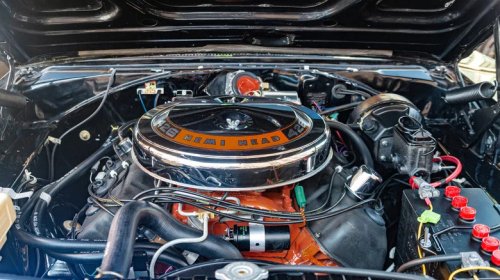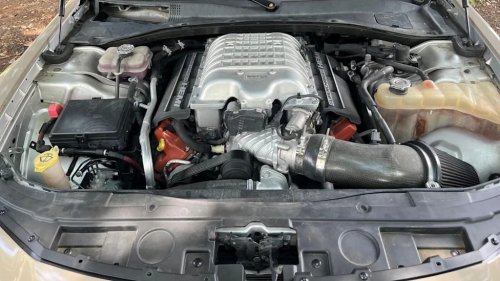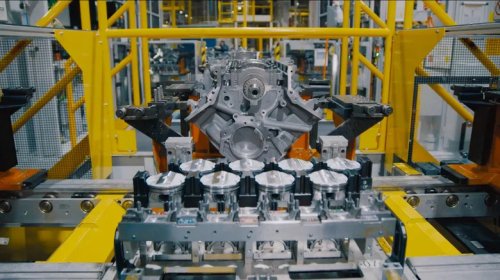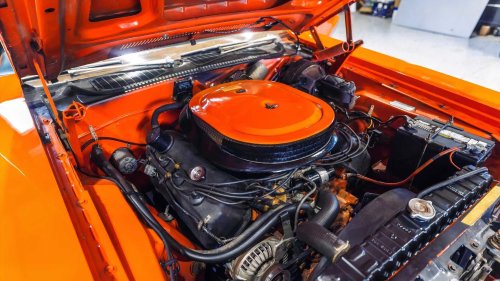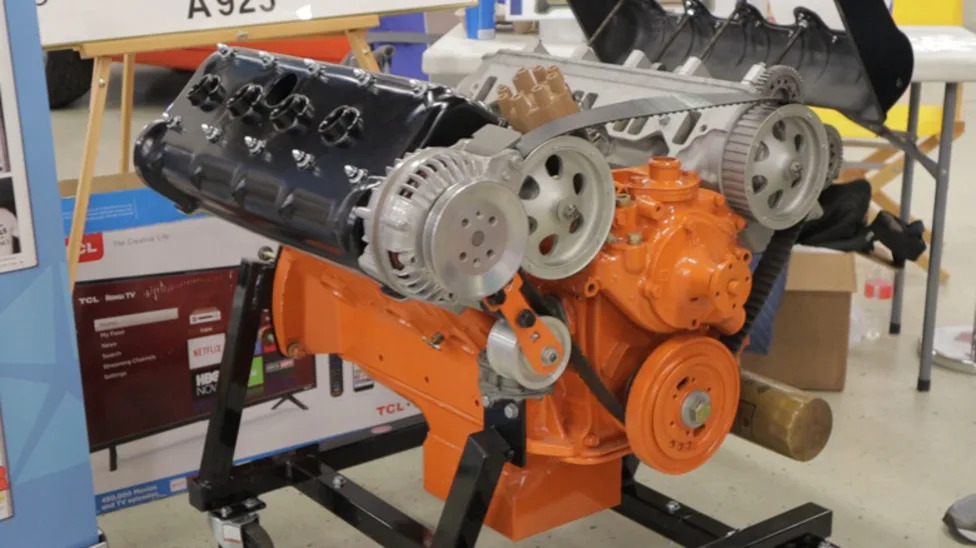
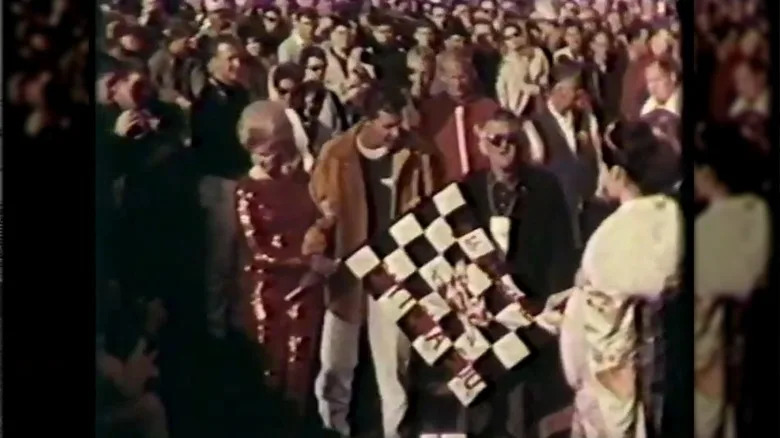
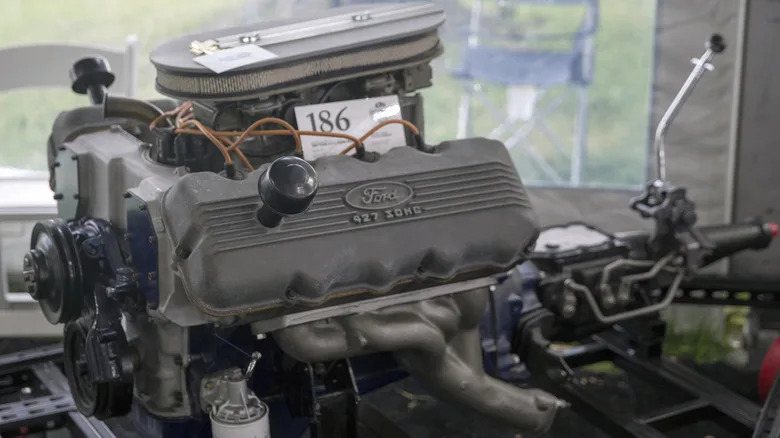



















A dual overhead cam 426 NASCAR engine - Uncle Tony's GarageOfficially called the A-925 engine in Chrysler documentation, the engine shown here — a 426-cubic-inch Hemi V8 with special dual-overhead cam cylinder heads — was intended to bring the fight to Ford in NASCAR for the 1965 season. Then, NASCAR outlawed the engine before it could ever compete.After Hemi-powered cars won the 1964 Daytona 500 by over two laps from the fastest Ford entry, the Blue Oval knew it needed more power if it was going to be competitive. Ford started preparing an overhead cam version of its 427 V8, and Chrysler needed to retaliate to levels of mutually assured destruction. The so-called Doomsday Hemi wasn't actually a "Hemi" at all. To fit four valves per cylinder, Chrysler resorted to a "Penta-Roof" A-frame-style head. Chrysler built the rest of the engine in basically the same manner as it normally would, except the block wasn't machined for the standard Hemi's central camshaft or pushrods. Each camshaft is driven by a cogged belt from the crankshaft in a triangular run. To save weight, the intake manifold and valve covers were all crafted from magnesium.AdvertisementAdvertisementBecause the cylinder head now flows more air, and each of the valves is smaller and lighter with less inertial mass, this atomic bomb of an engine is more comfortable at higher rpm than a standard 426 Hemi engine. According to reports from Chrysler engineers at the time, this engine was easily capable of 7,000 rpm and put down quite a bit more than the 500 ponies a standard Hemi made in NASCAR trim. Some allege it was capable of around 700 horsepower, an incredible amount of power for the time, and crucially, a lot more than Ford could make with its so-called Cammer 427 engine. Read more: 11 Huge Engines With Surprisingly Low HorsepowerThe Hemi dominates the 1964 Daytona 500Richard Petty wins the 1964 Daytona 500 - NascarAllOut/YouTubeWhen Chrysler debuted the legendary second-generation Hemi V8 at the 1964 Daytona 500, it was instantly obvious that it was head and shoulders above anything else in the field from Ford or General Motors. The combined might of the Wood Brothers, Bill Stroppe, Bud Moore, and Holman-Moody couldn't cut down the massive advantage the Hemi delivered. At the time, this was a race-only engine that wouldn't see production specs until 1966, and the race engines were cast just two weeks before the 500 in February. Paul Goldsmith popped his 1964 Plymouth sporting the new Hemi on pole position for the 500 with a new record lap speed of 174.355 mph — 13 miles per hour clear of Fireball Roberts' 1963 event pole. The new engine's effectiveness was evident, with Richard Petty starting second in his own Plymouth, and Junior Johnson's Dodge followed closely by Bobby Isaac's Dodge. In fact, you had to go down to A.J. Foyt's eighth-place starting position in a Ford to even find a non-Hemi car. It was about as dominant a qualifying session as there ever has been.AdvertisementAdvertisementFoyt briefly found his way to the lead of the race for laps 40 and 41, but ultimately, this was Richard Petty's race for 184 of its 200 laps. Petty's iconic No. 43 Plymouth found the lead for the final time on lap 52, and he maintained that lead to win the race as the only runner on the lead lap 148 rounds of the circuit later. Petty led an impressive Plymouth 1-2-3 finish that cemented the Hemi's dominance. He would go on to win nine races in 1964, netting him the NASCAR Grand National championship. Hemi quickly became synonymous with victory, and Ford wanted to do something about it.Ford's Cammer and the NASCAR banA high-performance Ford 427 "Cammer" V8 coupled to a Ford "Top-Loader" four-speed manual transmission. - Mr.choppers/Wikimedia CommonsHaving been soundly beaten by the Chrysler Hemi at Daytona, Ford knew it needed to bring the heat to have a chance at winning anything in NASCAR's 1964 season. Thanks to serious motorsport competition, Ford's FE V8 had ballooned to 427 cubes, but it still didn't have the power advantage enjoyed by Chrysler's Hemi. Within just 90 days, Ford developed a new overhead-cam cylinder head of its own to fight the NASCAR elephant. It had a "Total Performance" marketing effort to live up to, after all. Hot Rod Magazine independently confirmed that Ford had run the 427 "Cammer" to over 7,500 rpm and posted power numbers above 600 horsepower.Ford asked NASCAR to let it run the Cammer in competition for the remainder of the 1964 season, but the request was denied on the grounds that the engine was too European in design and wasn't available in any production cars. The United States Auto Club banned the engine as well, and it quickly became a drag-racing-only engine.With the Cammer deemed too exotic for NASCAR and Ford not installing the engine in any of its road cars, Chrysler pulled the plug on its Manhattan Project NASCAR 426 and went back to dominating the series the old-fashioned way. Unfortunately for Chrysler, it still hadn't installed the 426 engine in any of its production cars either, and the engine was banned for the 1965 season. The iconic engine wouldn't be reinstated in NASCAR until after it was made optional for a variety of street-going Plymouth and Dodge automobiles in 1966. Petty immediately won Daytona with Hemi power again.AdvertisementAdvertisementWant more like this? Join the Jalopnik newsletter to get the latest auto news sent straight to your inbox, and add us as a preferred search source on Google.Read the original article on Jalopnik.